Mark wrote his account of the Gospel to demonstrate to us Who Christ is, not only by recording His actions, but also by giving us a written account of His death, burial and resurrection of Jesus Christ. The ultimate goal of Mark’s writings, and the writings of any New Testament author, is to build our faith.
By recording His actions, Mark paints a vivid picture of Who Jesus of Nazareth was, makes the case that He is the Christ, the Messiah, moreover the Savior of all mankind.
He opened His Gospel by showing how Jesus was the fulfillment of the Old Testament prophecies concerning the messenger that would go before the Lord. While this prophesied messenger was indeed John the Baptist, Mark pointed out how John the Baptist clearly identified Jesus as being the Christ.
As he continues his opening statement, Mark demonstrates the authority of Christ by showing His authority to call the disciples into apostleship, His authority to teach, and His authority over demons.
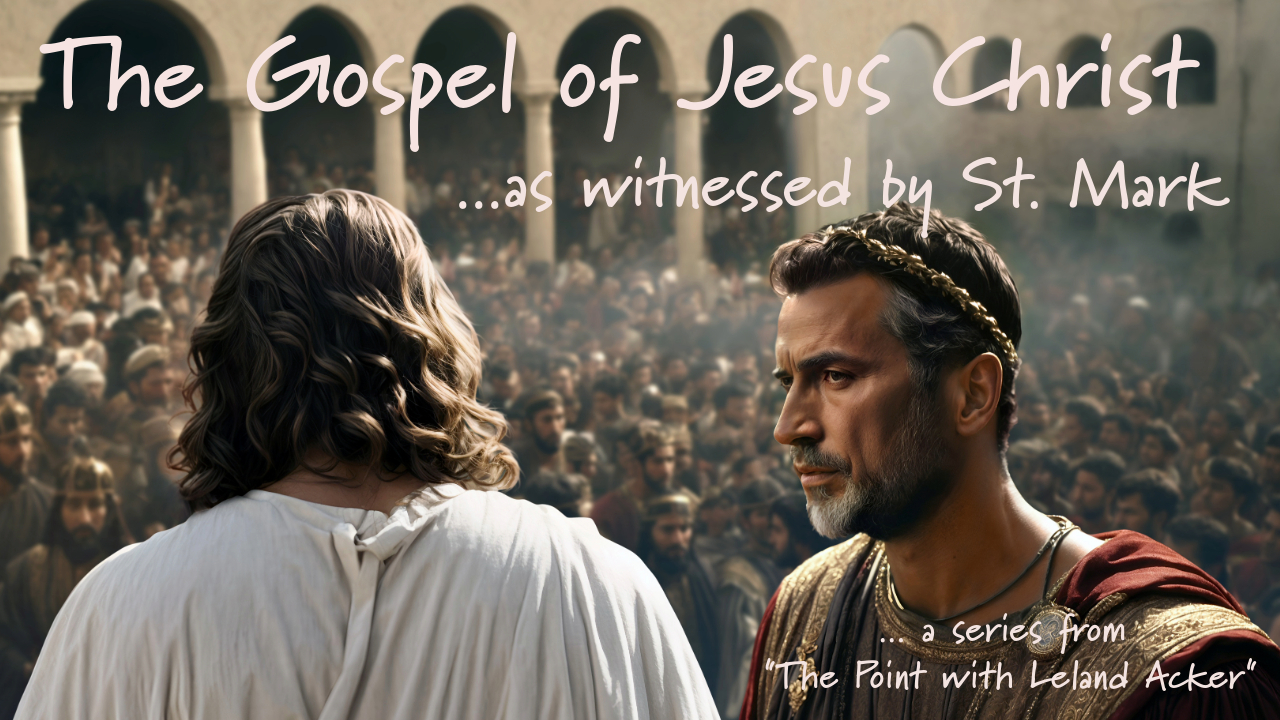
In Mark 1:16-20, Mark writes:
Now as he walked by the sea of Galilee, he saw Simon and Andrew his brother casting a net into the sea: for they were fishers. 17 And Jesus said unto them, Come ye after me, and I will make you to become fishers of men. 18 And straightway they forsook their nets, and followed him. 19 And when he had gone a little farther thence, he saw James the son of Zebedee, and John his brother, who also were in the ship mending their nets. 20 And straightway he called them: and they left their father Zebedee in the ship with the hired servants, and went after him.
Here, Mark records how Jesus called Simon (Peter) and Andrew, as well as James and John, to follow Him. When the Lord called them, He called them to follow Him, to learn from Him, and to help Him fulfill His mission. Likewise, when the Lord calls us, He calls us to salvation, to learn from Him, and to join His mission of spreading the Gospel.
Now, when He called them, He told them He would make them fishers of men. To them, fishing was a labor intense occupation where teams of men would drag nets throughout the sea to gather as many fish as they could. To be a fisher of men means to drag the net of the Gospel through the sea of humanity to bring as many to Christ as possible. This was a team effort.
Throughout the early years of Christianity, we see that it was always a team effort. The apostles always worked together in groups, whether they were sent out two-by-two by Christ into the villages of Galilee, or whether they were working together in the church of Jerusalem to preach the Gospel in the Temple court.
The Apostle Paul only traveled alone when he had to flee violence. However, during his missionary journeys, he always had people with him. Barnabas and Mark accompanied him on the first missionary journey. Other teammates to Paul included Luke, Silas, Timothy and Titus. Read any of Paul’s epistles, and you will see when he signs off that he lists the individuals who were with him who also sent their greetings to the church addressed in the letter.
Like the apostles, we are called to work as a team to spread, promote, propagate, publish and share the Gospel. We promote things all the time. We share funny posts on social media, we talk about our favorite TV shows and music, and we praise the restaurants that deliver amazing meals to our table. I’ll be sharing a link to this post as soon as I finish writing it.
Why don’t we share the Gospel more?
Social media is your story to the world. Through your posts and your comments, you tell the world Who you are and what you stand for. That story needs to center on the Gospel.
Like the Apostles were called to work together as a team in the ministry of Christ, we, too, are called to work as a team. There are no lone rangers in God’s work. We are to work as a team to spread the Gospel.
This is why much of the work in the Gospel is accomplished through the local church. We gather for worship, collect offerings to fund missionary endeavors, and we perform church outreach efforts. We fish together.
It is worth noting that when the Lord called us, He called us with the same authority with which He called His disciples on the shores of Galilee. This means that following the Lord’s call is not an optional feature to the Christian life. It is something the Lord calls us to, and something He expects from us.
Ephesians 2:8-9 say that it is by grace through faith that you are saved, and that not of yourselves, it is the gift of God. Not of works lest any man should boast. However, many Christians overlook verse 10, which says we are His workmanship, created in Christ Jesus unto good works, which God has before ordained that we should walk in them.
We were created to follow the Lord’s call, and to do His will, and to make an impact for the Kingdom.
Now, many Christians will object, citing work obligations, financial stress, and a busy family life. It is worth noting that the Apostles had things going on when the Lord called them as well. Simon and Andrew weren’t fishing as a hobby. Their abilities to feed their families depended on them having a successful catch.
James and John were not engaged in recreational crafting when they were mending their father’s nets. Those nets needed to be repaired in order to have another successful catch.
When Jesus called, they quickly left behind their livelihoods to follow. That requires faith.
The Lord has not necessarily called you to quit your job at 3M, the school, the state, or the phone company. However, using it as an excuse to fail to follow the Lord’s calling on your life will not work. By the authority in the Lord’s call, we have to prioritize the work of the Gospel.
Mark’s attention then turned to the Lord’s authority in how He taught.
Mark 1:21-22:
And they went into Capernaum; and straightway on the sabbath day he entered into the synagogue, and taught. 22 And they were astonished at his doctrine: for he taught them as one that had authority, and not as the scribes.
When Jesus taught in the synagogue, He did not spend time quoting other rabbis, discussing tradition, and sharing thoughts and ideas. He boldly proclaimed what the scriptures actually said. And what astonished those in attendance was the authority and certainty in which He delivered His teaching.
Well, of course He taught with authority. Not only were the scriptures about His redemption of His people, but it was through His Spirit that the scriptures were inspired and written in the first place.
There is a scene in the Chronicles of Narnia: The Lion, the Witch and the Wardrobe, where the white witch confronts Aslan the Lion about Edmunds betrayal, citing the deep magic’s requirement for such a one to be punished. Aslan responded by saying, “Do not cite the deep magic to me, I was there when it was written.”
In his Chronicles of Narnia series, C.S. Lewis attempted to explain the Christian faith in the form of a fantastical story involving talking animals and humans. In the Narnia universe, the deep magic was their scripture. Aslan the Lion was Lewis’ Christ-like figure, who submitted himself as a sacrifice for the betrayal of Edmund (and the sins of the creation). And in this scene, Aslan reminds everyone of His divinity and authority.
Likewise, when Christ taught in the synagogues, He was not merely another rabbi or scholar. He was the One Who inspired the scriptures, He was the subject of the scriptures, and His message, embedded in the scriptures, was redemption.
John 1 tells us that Christ was in the beginning with God, and that He was God, and that He created all things. Having created all things, then revealing Himself through scripture, we learn that Christ is the ultimate authority in the universe.
The scriptures were written by His authority and they say what He wanted said.
Therefore, when we study scripture, we are not merely reading a religious text or the works of a theological writer. We are reading the very words of God. We are in no place to reconsider, retranslate, reword, or question.
After demonstrating the Lord’s authority to call and His authority to teach, Mark showed us the Lord’s authority over demons.
Mark 1:23-26:
And there was in their synagogue a man with an unclean spirit; and he cried out, 24 Saying, Let us alone; what have we to do with thee, thou Jesus of Nazareth? art thou come to destroy us? I know thee who thou art, the Holy One of God. 25 And Jesus rebuked him, saying, Hold thy peace, and come out of him. 26 And when the unclean spirit had torn him, and cried with a loud voice, he came out of him.
Notice that, not only did the demon fear Jesus, but had to obey what Jesus told Him to do.
God and Satan are not two divine beings who are battling each other in a struggle of similar powers. God is God, has infinite power. Satan is a created being at the mercy of God’s power. Satan, therefore, has to obey and do what God orders. The same with demons.
So, when Jesus commanded the demon to come out of the man, he was forced to comply.
Demons have no power over the Lord. Further, Satan has no power with God either. He’s not a superboss at the end of a video game. He is a glorified demon. Nothing more.
Therefore, we can quit making Satan out to be a boogeyman, and we can quit fearing His antics. Go forward in faith, trust the Lord, and trust His call on your life.
Psalm 91:1 says, “He that dwelleth in the secret place of the most High shall abide under the shadow of the Almighty.”
We will find peace when we learn to live close to the Lord, under His authority, and depend on Him for our purpose, beliefs and protection.
 The Point...