Christian Living

Psalm 46 – The Lord is our Refuge and Strength

The Psalms are songs of praise to God, some written on certain occasions, and others written just to proclaim His glory. The context of Psalm 46 is debated. Some attribute it to King David after a battle was won. Some attribute it to the deliverance of Jerusalem from Assyria during the reign of King Hezekiah, in which the Assyrian army was miraculously wiped out by God. But, Psalm 46 is a Psalm of praise, praising God for His deliverance and the hope He gives.

In this world, we will face trouble. There’s the geo-political and economic troubles we see on the news. But then there’s our personal troubles. Jesus said in John 16:33, “These things I have spoken unto you, that in me ye might have peace. In the world ye shall have tribulation: but be of good cheer; I have overcome the world.”

In Psalm 46, we are remined that God is our refuge, that He is our hope, And we are invited to remember His marvelous works.

    GOD IS OUR REFUGE AND STRENGTH.

    Verse 1 – God is our refuge and strength, a very present help in trouble.

    God is our refuge. He is where we can go to escape the trials and tribulations of life.We can look to Him for peace and comfort.We can lift up our concerns to Him in prayer, and know He hears and He does good for us (Romans 8:28).

    God is our strength. He is the source of life.He is the force that gives us life and keeps us going.We press onward, not by our own strength, and not because we have to, but because He enables us, and powers us forward. Greater is He that is in us than he that is in the world.

    He is our refuge and strength because He has redeemed us, given us new life through Christ, and an eternal hope in His Kingdom. Everything in this life is temporary, and soon we will be rescued from the trouble of this life.

    Verses 2-3 Therefore will not we fear, though the earth be removed, and though the mountains be carried into the midst of the sea; Though the waters thereof roar and be troubled, though the mountains shake with the swelling thereof. Selah.

    Therefore, since God is our refuge and strength, we will not fear. We will not be overcome with anxiety. We will not entertain the thought that our ruin and demise has come.

    Though the mountains be carried into the midst of the sea. Though the things that we felt were unmovable moved… Though the things we relied upon have failed. Though our security blankets have unraveled, we will not fear. We will not tremble before this world. And we will not lose hope.

    Though the waters thereof roar and be troubled… Though things in this life rise up and intimidate us…Though our fears become reality…

    Job said in Job 3:25, “For the thing which I greatly feared is come upon me, and that which I was afraid of is come unto me.”

    Maybe your worst fear is coming upon you… Yet, you shouldn’t fear, because God is your refuge and strength.

    In remembering God as our refuge and strength, we need to remember the hope He has given us.

    THE HOPE GOD HAS GIVEN US.

    Verse 4- There is a river, the streams whereof shall make glad the city of God, the holy place of the tabernacles of the most High.
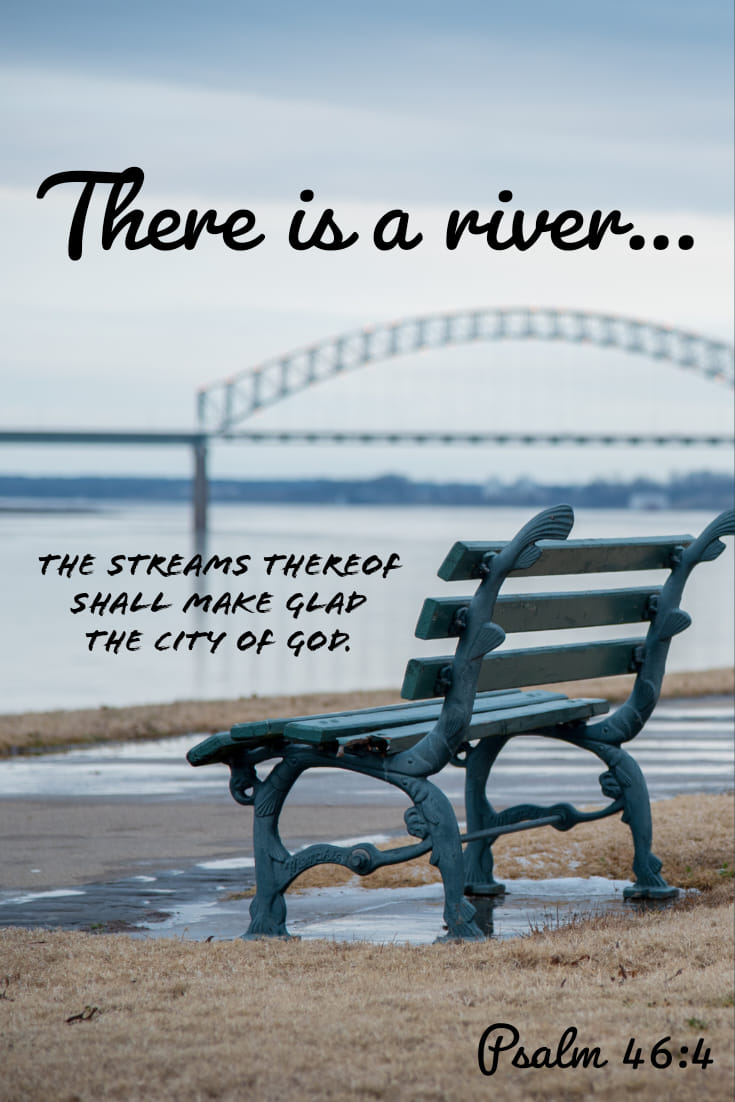
    The psalmist has stated that we will not fear, because God is our refuge and strength.He then lists some of the most cataclysmic things that could strike fear in our hearts (the mountains being carried into the sea…)

    Then, He redirects us to the hope by painting a picture of the city of God… and He starts this picture with a river. There is just something peaceful about sitting next to a river. But for a city, a river is a source of life, provision of water, and possibly commerce. When the writer references the City of God, He isn’t talking about Jerusalem, because there is no river in Jerusalem. The writer is referencing the Heavenly City… New Jerusalem. And the river… the river of life. The writer is referencing our eternal home, God’s house with many rooms. The place Christ said He was going to prepare for us.

    Heaven will be a place of eternal peace and rest. No anxiety, No trauma, no triggers, no painful memories haunting us. No problems, no turbulence, no tribulation.

    Verse 5 – God is in the midst of her; she shall not be moved: God shall help her, and that right early.

    The best part of Heaven will be the presence of God, and dwelling with our Lord Jesus Christ. Jesus said in John 14:3 – And if I go and prepare a place for you, I will come again, and receive you unto myself; that where I am, there ye may be also.

    The most comforting words the disciples heard in Jesus’ comments in John 14… “That where I am, there ye may be also.”

    If your faith and hope is in Christ, then the hope that you have in Heaven is seeing and living with Jesus. The Lord’s presence in Heaven will make it what we expect it to be.

    Verses 6-7 The heathen raged, the kingdoms were moved: he uttered his voice, the earth melted. The Lord of hosts is with us; the God of Jacob is our refuge. Selah.

    The Lord will have ended sin and iniquity on earth. He will have set everything at peace. And He is with us, and will be our refuge.

    BEHOLD THE WORKS OF THE LORD.

    Verses 8-9 Come, behold the works of the Lord, what desolations he hath made in the earth. He maketh wars to cease unto the end of the earth; he breaketh the bow, and cutteth the spear in sunder; he burneth the chariot in the fire.

    Look at what God has done.

    He’s ended wars and defeated the fiercest of enemies.He delivered Israel from Egypt, from the Amalekites, Philistines, Assyrians, Babylonians, Hittites and others. He has brought us through the worst life has thrown at us. He has raised up our nation, and given us His word.

    God, who gave His Son to redeem us, will not withhold that which is good from us.

    Romans 8:32 – He that spared not his own Son, but delivered him up for us all, how shall he not with him also freely give us all things?

    Knowing what God did for us in the Gospel, what makes us think that He won’t carry us the rest of the way through?

    Psalm 46:10-11 Be still, and know that I am God: I will be exalted among the heathen, I will be exalted in the earth. 11 The Lord of hosts is with us; the God of Jacob is our refuge. Selah.

    Be still and know that He is God. Trust God. Trust His timing. Wait for His perfect timing. He will be exalted. He will be victorious. And, He is with us. (If God be for us, who can be against us?)

    FINAL – There’s a lot of turbulence in the world today. Praise be to God that we can look to Him and find peace.

    Lazarus and the Rich Man

    The story of Lazarus and the rich man comes at the end of a series of parables Jesus gave in response to the Pharisees who had criticized Him for dining with sinners and publicans. In this parable, Jesus describes the rich man as an ideal Pharisee, while describing Lazarus as a most-reviled beggar. But when they enter into eternity, it’s Lazarus that is welcomed into Heaven, and the rich man who finds himself in Hell.

    The story of Lazarus and the Rich Man should wake us from our slumber. It should remind us that our salvation is not tied to our culture, accomplishments or expectations, but rather by God’s grace through our faith.

    Listen as Pastor Leland Acker discusses this passage, describing what God wants for us, contrasting the rich man from Lazarus, and telling us how to apply this message to our lives.

    Jesus Washes His Disciples’ Feet

    The Lord Jesus Christ, the only Begotten Son of God, the embodiment of God Himself, the Word that became flesh and dwelt among us, Who created all things and gave us life, took on the role of the lowest ranking servant in the household, and washed His disciples feet.

    In this one act of humble service, the Lord not only demonstrated His indescribable humility, but sent a message that pride, self-centered ambition and promotion, and the establishment of rank and pecking order have no place in God’s Kingdom.

    Think about it. If washing the feet of the disciples is not beneath Jesus, then nothing is beneath Jesus. And if nothing is beneath Jesus, how can we think that anything is beneath us, for the servant is not greater than the Master.

    In this message, Pastor Leland Acker exhorts us to love one another, and humbly serve one another, taking time to understand each others’ needs and viewpoints. If we do so, we will find true happiness.

    The Gospel Expedition: Wrestling with God

    In Genesis 32, Jacob is following God’s direction to return to the Promised Land, however, there’s just one problem… Esau. The last time Jacob heard from Esau, Esau wanted to kill him. No doubt Esau still lived there, but the question was whether Esau was still angry. Despite God showing his favor upon Jacob in a very favorable way, Jacob still acts as if he is doomed once he sees Esau. That struggle in his faith sparked an epic wrestling match that continues to have implications today. Listen to our latest episode of The Gospel Expedition, on YouTube, or on Soundcloud.

    Gospel Expedition: Selling the Birthright

    Esau was a cunning hunter, a barbecue pitmaster, his father’s pride and joy, and a man who could get things done. He saw himself as a winner, was powerful and strong.

    Jacob was a plain man, dwelt in the tents, and was an accomplished chef, administrator, and an excellent marketer.

    Though they were brothers, and were very skilled in their vocations, their rivalry was one of the bitterest this world has ever seen. This rivalry would see Jacob deceiving their father Isaac, and swindling Esau in an underhanded trade agreement over lunch. And this rivalry would see Esau set out to murder Jacob in revenge for his antics.

    In Genesis 25:27-34, Esau returns home after a day in the fields. Esau, the older brother, holds the birthright to his father’s estate by default. Being the holder of the birthright, the assumption is that he would also inherit the promises God made to Abraham, which had in turn been handed down to Isaac.

    Jacob, the younger brother, knew that God’s promise would be handed down to him. This was a promise God made to Rebekah, his mother. Jacob understood that God’s favor and blessing was upon him, but for some reason, Jacob still felt that he had to be the one to make things happen.

    So, when an exhausted Esau returns home after a tough day in the field, Jacob saw an opportunity. This occasion would see Esau denounce his birthright and God’s blessing, and would see Jacob put forth a dubious sales pitch in order to scam Esau out of the birthright.

    Listen to The Gospel Expedition’s Episode 25, “Selling the Birthright,” on YouTube or Soundcloud.

    This is Faith

    Religion has so diluted Christianity that we struggle to understand a simple word like “faith.” This is nothing new. The first century Christians faced the same problem, which is why the writer of Hebrews spent the entire 11th chapter explaining what faith is.

    The problem is that religion demands adherence, obedience, and loyalty. Religion demands purity in actions, and creed. In its demand for these things, the relationship between God and man, and God’s amazing grace that has been bestowed upon man, get relegated to merely being an introductory paragraph.

    Attend any seminary, and you’ll learn that there is historical faith, saving faith, and true faith. Talk to some religious leaders, and you’ll learn that there is a living faith and a dead faith. Some will even define faith as a system or a doctrine to be followed.

    All of this ignores the fact that God gave us His word… and words have meanings and definitions.

    Language is a gift from God. We speak in language and understand each other every day, most of the time without really thinking about it. When you tell me that you believe me, I don’t parse your statement to determine if the fact that you believe me will accompany obedience to me, or whether your belief in me is living or dead. I simply understand that, when you say you believe me, you are taking me at my word.

    So it is with faith. The biblical dictionary definition of faith (this is a combination of the Strongs and Thayer’s definitions) is a deep-rooted trust, or a conviction of the truth. Simply put, faith means trust.

    Hebrews 11:6 describes what it means to have a deep-rooted trust in God, and a conviction of His truth. Hebrews 11:6 says, “But without faith, it is impossible to please Him, for he that cometh to God must believe that He is, and that He is a rewarder of them that diligently seek Him.”

    Faith in God means believing that He is, and that He is Who He says He is. It also means to trust that God is good, and that He will respond to your faith. He will reward your diligent search for Him and His truth.

    Faith means believing God is, and that God is good.

    Faith really is that simple. And that simple faith is the faith that saves.

    What Made Enoch Special

    Genesis 5 says Enoch walked with God… how did he do that?

    When scripture discusses our walk, it is referring to our lifestyle. So, when scripture says Enoch walked with God, it means that Enoch lived a lifestyle of faith in the Lord. He took time to learn who God is, what God wanted, and he had an active prayer life.

    What made Enoch special was a simple willingness to trust God. While that sounds simple, it’s something few are willing to do.

    Walking with God is not something reserved for the super spiritual. Anyone can do it, so long as they are willing to build their life around their faith in the Lord.

    New Episode: Jacob Have I Loved…

    One of the most amazing things about God, and one of the unique things about the Christian faith, is how God can take a deeply flawed individual and transform him, using him in an amazing way. One of the most iconic stories in the Bible about this is the story of Jacob.

    Jacob lived his entire life under God’s favor. God had favored him from the time he was conceived, and throughout his life, Jacob was reminded by God and others of the Lord’s favor upon him. Yet, Jacob continually lived as if he had to work it out on his own. That lack of faith led to some of Jacob’s biggest sins and mistakes, and cost him dearly.

    However, by the end of his life, we find Jacob trusting and worshipping God. Take a listen to “Jacob Have I Loved,” from the Gospel Expedition Podcast, via Soundcloud or YouTube, below:

    Cain vs. Abel

    In Genesis 4, Cain and Abel both brought offerings to the LORD. Scripture tells us that Cain brought of the fruit of the ground, which makes sense because he grew crops for a living. Abel, on the other hand, brought one of the firstlings of his flock, which also makes sense as Abel kept sheep for a living.

    Now, Genesis 4 tells us that God had respect for Abel’s offering, but not Cain’s. As a result, Cain became very upset. God confronted Cain about his attitude, saying, “If you do well, won’t you be accepted? And if not, sin lies at the door.”

    Cain did not do well, however. As he and Abel worked in the field, Cain vented his frustration on Abel, resulting in a fight that led to Cain killing Abel. Cain was subsequently banished, leading him to found a godless society. Adam and Eve had another son, who fathered the Godly lineage in the pre-flood world.

    Such set the stage for the downfall of mankind, leading to the flood in Genesis 6-9.

    In taking all of this into consideration, the question is often posed, “Why did God respect Abel’s offering, but not Cain’s?”

    One answer commonly given is that Abel offered a blood sacrifice, while Cain did not. While this explanation harmonizes with the Gospel pattern of the shedding of blood for the remission of sins, the fact is that there is little Biblical evidence for it, especially when you consider that grain offerings were a completely legitimate part of the temple system of worship in the Old Testament.

    The explanation with scriptural evidence is actually much simpler. Abel offered his sacrifice by faith, whereas Cain did not.

    Hebrews 11:4 says, “By faith Abel offered unto God a more excellent sacrifice than Cain, by which he obtained witness that he was righteous, God testifying of his gifts: and by it he being dead yet speaketh.”

    Abel offered his sacrifice by faith. He knew God was God, trusted in His goodness, and rested in His grace.

    On the other hand, Cain lacked this faith. He obviously knew God existed, but did not trust God’s goodness and grace. For Cain, the offering was more of an obligation than an offer of thanksgiving or worship. Thus, God rejected it.

    Scripture is very clear, and the point is driven home in Hebrews 11. What pleases God is faith, that simple trust in His existence and grace. While that faith motivates action, the fact is without that faith, the most righteous acts in the world will not please God.

    So, with all that in mind, do you have faith. Do you believe that God is? And do you trust in His goodness and grace? (Hebrews 11:6)

    And if so, are you living by that faith? May God grant you clarity as you reflect on your faith.

    What you believe shapes how you see things

    Have you ever noticed that multiple educated people can evaluate the same sets of data, and come up with two completely different conclusions?

    One Wall Street analyst looks at a particular company and recommends buying their stock. Another looks at the same company, with the same financial statements and business prospects, and recommends selling their stock.

    One football scout watches a prospective quarterback and sees vulnerability and liability. Another sees the same quarterback in the same game and sees the future of the franchise.

    Multiple experts, same information, different conclusions.

    Today, we see the same things happening in the debate over evolution. The evolutionist sees evidence such as carbon dating and fossils, and concludes that evolution is true. The creationist sees the exact same evidence, and concludes that the fossil record proves the existence of the flood from Genesis 6-9, and thus creationism is true.

    Both the evolutionist and the creationist are highly educated and well-reasoned in their conclusions. So, how do they look at the fossil record, carbon dating, canyons and rock formations, and come to such different conclusions?

    It has to do with their faith.

    The evolutionist has a faith that the world was created by various physical forces and chemical reactions without the intervention of a divine creator. Thus, when he examines the fossil record, his faith is validated by what he sees as evidence of an old earth. Through his faith, he believes in evolution.

    The creationist has a faith that the world was created by God, so when he examines the fossil record, his faith is validated by what he sees as evidence of God’s intervention (such as the worldwide flood).

    You see, faith is not shaped by evidence, but rather, faith shapes how we evaluate evidence. If you are looking for proof before you believe, then you will never find the evidence you are looking for. However, if you believe, you will see things that validate your belief.

    Thus, we find in Hebrews 11:3 that “Through faith we understand that the worlds were framed by the word of God, so that things which are seen were not made of things which do appear.”

    Our demand for proof of God’s existence will never be satisfied, at least, not until the end time. However, when we decide to trust that God exists and that He is good, then God responds to that faith and rewards it (Hebrews 11:6).

    So, the question is, what do you believe? And how is that belief shaping your worldview?