Doctrine

Decoding the Parable of the Wheat and Tares: Satan’s Disruptive Antics

Photo by DESPIERRES Cu00e9cile on Pexels.com

Satan holds no power with God. He is not a divine opponent to our Heavenly Father, and he has no strength to truly battle with God. Satan was expelled from Heaven on God’s command, Satan is only allowed to operate within God’s permissive will, and Satan will ultimately be condemned to Hell for eternity by God’s divine order.

This is plainly seen in scripture as Satan had to obtain God’s permission before testing Job, as Satan had to obey the command of Christ to leave His presence in the wilderness, and as the demons cried out to Christ “Have you come to torment us before our time?”

Satan knows he has a limited time on this earth before his judgment is carried out and he is condemned to Hell for eternity. He knows he cannot win. So, his only recourse is to cause as much disruption as possible in an attempt to blunt God’s glory and to cause the Lord loss.

In God’s infinite power, Satan will find that to be an exercise in futility, because God takes all adversity and converts it to good, thus bringing Him glory.

In Matthew 13, Jesus gives the parables of the Wheat and Tares, the Leaven, and the Mustard Seed to foretell of Satan’s disruptive tactics among God’s people.

In the Parable of the Wheat and Tares, Jesus tells the story of a man who sowed good seed in his field. However, while men slept, his enemy came and sowed tares among the good seed. When it was discovered, the man recognized the tares as the work of his enemy.

Prioritizing the safety of the wheat (the good seed), the man instructs his servants to allow all of it to grow, and that the tares would be separated out at the harvest. In Matthew 13:36-43, Jesus gives the interpretation of this parable, which enhances the interpretation of the parable of the sower and provides a greater framework for interpreting the other Kingdom Parables (Leaven, Mustard Seed, Pearl of Great Price, and Treasure in a Field). Further framework in interpreting the parables can be found here.

In the Parable of the Wheat and Tares, we find that the man that sowed the good seed is the Son of Man. The good seed is the word, the Gospel. The field is the world.

As we learned in the Parable of the Sower, Christ sowed the Gospel to the entire world indiscriminately. He made the word available to everyone regardless of whether they would accept the word or not.

However, in the Parable of the Wheat and the Tares, we find that an enemy (identified in Matthew 13:39 as the devil, Satan), sowed a false gospel. He sowed a false word. As a result, true believers (wheat) and fake believers (tares) grow alongside one another in this world waiting for the day of the harvest, when the Lord will separate the believers from the non-believers, condemning the non-believers to Hell while gathering the believers into His Heaven.

The result is that the “righteous shall shine forth as the sun in the Kingdom of their Father.”

The reason Christ shared this parable was to prepare us for the inevitable conflict and disruptions that will come from having believers and non-believers living side-by-side. He prepared us for such disruptions so that we would not be discouraged or disillusioned by them.

The presence of Spiritual conflict is evidence that God is working. The presence of moral and Spiritual failures validates the predictions made by Christ in the parables, and thus lend even more credence to His words. Neither of these things, Spiritual conflict or Spiritual failures on the part of the people should discredit the Gospel. Quite the opposite.

In this parable, there are a few other lessons we should learn.

First, we ARE NOT to try to figure out who the non-believers and false believers are. This is a very clear point to this parable. The man in the story said that if the servants tried to dig up the tares, they may accidentally dig up the wheat also.

Our efforts to identify the “tares” among us will result in an atmosphere of constant scrutiny, and will create a culture of judgment. Often, we will misjudge a true believer to be a false believer, and destroy the faith or testimony of the true believer thinking they were false.

For the safety and sake of the true believers, Jesus taught us not to judge, not to scrutinize each other, and to allow Him to sort it all out on the day of judgment. This lesson from this parable holds true to the teachings of Christ in the Sermon on the Mount to “judge not lest ye be judged,” and the writings of Paul in Romans 14:4, “Who art thou that judgest another man’s servant? to his own master he standeth or falleth. Yea, he shall be holden up: for God is able to make him stand.”

Secondly, there is a dire warning to confirm whether you are a wheat or a tare. The wheat is gathered into barns. This is a picture of the saved being gathered and taken into God’s eternal Kingdom. The tares are gathered and burned in a picture of the eternal condemnation of Hell.

When I read the Lord’s interpretation of that part of the parable, it motivates me to check my faith and make sure my faith is in the true Gospel. It should be the same for you.

And thirdly, there is a message of hope. In that day, when the wheat and tares are separated, the “righteous shall shine forth as the sun in the Kingdom of their Father. (Matthew 13:43). The day is coming when the Lord will glorify us, and will give us the eternal blessing that He has promised.

We know for sure that we will inherit that promise, if we know Him as Savior.

Transformed by the Word of God (John 17:14-16)

As Jesus prayed in John 17:14, He made a profound statement. He said, “I have given them thy word; and the world hath hated them, because they are not of the world, even as I am not of the world.”

This statement proclaims how Jesus Christ transformed His disciples by giving them God’s word. Because they were transformed, they were no longer of the world, meaning they no longer held the world’s mindset. Thus, the world hated them.

Now when Jesus said that He gave them God’s word, He didn’t mean that He gave them the scriptures. The disciples had known the scriptures from the time they were children. Starting at the age of five, they would have begun attending school, where they would spend several hours per day memorizing the Old Testament.

The Old Testament scriptures were so familiar to the disciples, that Jesus could say things like, “You have heard it said, (quotes Old Testament scripture),” and the disciples would know the scripture and where to find it. You find the same phenomenon with the Apostle Paul, who would write things like, “As it is written…” before quoting Old Testament scripture, with the expectation that the reader would know the verse.

However, just because one knows what the scripture says does not mean that they know the Word. Often it is that men know the scripture without knowing the heart of God. They know the verses without knowing the God Who inspired them. They know the words without knowing what they actually teach.

Scripture without the Lord is dead. Such was the case for the Pharisees and the Sadducees of Jesus’ day. They knew the entire Old Testament word for word, but they didn’t know God. They didn’t know the Gospel. They didn’t understand God’s master plan, which is our redemption and reconciliation to Him.

Thus, to the Pharisees and Sadducees, the Old Testament became an endless list of proclamations, rules, laws, ceremonies, commandments, and ordinances. Knowing these scriptures meant endless word studies, explorations of word definitions, and debating whether the words actually meant what they said.

This impacted the way the scriptures were taught as the disciples were growing up. So, when Jesus said, “I have given them thy word,” He was saying that He completed the word they knew by giving them the Living Word, Himself.

He accomplished this by speaking past the noise of doctrinal debates by going to the heart of what the scriptures addressed. While the Pharisees and Sadducees quoted the commandment, “Thou shalt not commit adultery,” before debating what the definition of “adultery” was, Jesus said, “If you look upon a woman to lust after her, you have committed adultery in your heart.”

In that teaching, Jesus pointed out that the sin in your heart is what separates you from God.

Photo by Rodolfo Quiru00f3s on Pexels.com

Many people parse words from the scriptures to delude themselves into thinking that they haven’t sinned. They redefine terms, they make excuses or find exceptions. However, when we apply the teachings of Christ to the words of the Law, we find not only are we all sinners, but we still have sin in our hearts.

It’s a sentiment the Apostle Paul knew all too well when He wrote, “But I see another law in my members, warring against the law of my mind, and bringing me into captivity to the law of sin which is in my members. 24 O wretched man that I am! who shall deliver me from the body of this death? 25 I thank God through Jesus Christ our Lord. So then with the mind I myself serve the law of God; but with the flesh the law of sin.”

In Romans 7, Paul related how he struggled with sin, not doing the things he knew he should, while doing the things he knew he shouldn’t. It came to the point that even when he did the right things, he did those things with sin in his heart. It all came to the conclusion of Paul confessing his wretchedness and proclaiming his faith that Christ would redeem him from his brokenness.

Paul had this keen awareness of his broken condition because he not only knew the scriptures, but he knew the God behind the scriptures. Thus, in Galatians 3:24, he wrote that the “law is our schoolmaster to bring us unto Christ, that we might be justified by faith.”

As we continue to hold ourselves up to the light of the scriptures and the sinless perfection of Christ, we continually see our need for his grace and forgiveness. Thus, we find ourselves continually trusting in His forgiveness, and as we do that, we find ourselves being transformed by the scriptures to the point that we become more aligned with the values, character, and mission of Christ.

When that happens, we are no longer of the world, as Christ said. And when we are no longer of the world, we no longer have its values and mindset, it rejects us and we become its enemy.

We should not fear this, however, as Christ went on to pray that God would not take us out of the world, but that He would protect us from the evil one.

Christ wants us to be in the world so we can lead others to salvation. However, He wants us to be protected from being overcome by the world, absorbed by the world, or destroyed by the evil one. Knowing that this was Jesus’ prayer for us, and that the Father answers Jesus’ prayers, this should give us confidence.

So, spend time in the word, get to know the Lord through the word, and let that transform you. Then, boldly carry that word to others.

Does Your Faith Have Roots? Decoding the Parable of the Sower

Photo by Karolina Grabowska on Pexels.com

Why do scandals rock the church? Why does Christianity seem to struggle to stay relevant? Why do church members seem so apathetic?

The state of 21st century Christianity does not surprise the Lord, Who not only foresaw it, but planned for it, and foretold it to us so that we would understand it and be able to function within it. That’s why Christ gave us the Kingdom parables in Matthew 13.

The Kingdom parables present the spread, rapid growth of, and far-reaching impact of Christianity, but they also chronicle the struggles that would accompany the growth of the faith. To paint the picture of this growth, and the growing pains that would come with it, He gave us the parables.

As with anything regarding the Christian faith, we must first begin with examining ourselves. Jesus told us in the Sermon on the Mount that before we try to remove the speck from our brother’s eye, we should first remove the beam from our own.

In 1 Corinthians 11, the Apostle Paul instructed each man to examine himself to see whether he were observing the Lord’s supper properly and for the right reasons, adding that if we judge ourselves, we should not be judged (1 Corinthians 11:28, 31).

The premise is that instead of being preoccupied with what everyone else is doing, we should be focusing on what we’re doing, and examining our own hearts and motivations. Only through that exercise can we find the sin from which we need repentance, and align ourselves with the Lord’s will.

Thus, it’s fitting that the Lord began His series of Kingdom parables with the Parable of the Sower, for the Parable of the Sower is a warning to pay attention to how we receive the Gospel, and whether we have truly allowed the Gospel to take root in our hearts.

In the Parable of the Sower, as recorded in Matthew 13, Jesus told of a man who went forth to sow seed in his field. As he sowed, some of the seed fell by the wayside, and the birds (fowl of the air) came and devoured them up. Some fell on stony places, and sprung up quickly, but withered when the sun came up because they had no root.

Some fell among thorns, which choked the seed out before it could grow. Still, others fell on the good ground, spring up, grew, and bore fruit.

The trick to understanding this parable, and all parables, is to understand the imagery, and where we fit in the story. In Matthew 13, Mark 4 and Luke 8, Jesus gives us the key to interpret the Parable of the Sower. For a full look at the Kingdom Parable Decoder Ring, click here.

In interpreting this parable, Jesus tells us that the sower is the Son of Man. The seed is the word of God (the Gospel). The field is the world. And by necessary inference, we understand that the different types of ground are the different people who hear the Gospel.

The seed sown by the wayside that is devoured by the birds is the seed that is intercepted by Satan’s messengers. As we will learn in the Parable of the Mustard Seed, where the Gospel is being spread, Satan will send his messengers to disrupt things. That’s also a lesson learned from the Parable of the Wheat and the Tares.

Basically, the seed (the word, the Gospel) is sown, but before the hearers can let it take root, Satan (the birds) steals it away so that it doesn’t convert the soul.

The seed sown on the stony ground are those who gladly receive the Gospel, and show a great amount of enthusiasm early after professing faith, but they never allow the faith to truly take root in their heart. They possess a surface-level faith only, and it never really attains any depth in their heart.

The rising of the sun in this parable symbolizes trial, tribulation and persecution that arise as part of the Christian life, and when that happens, the surface-level believer withers, because he lacks the deep-rooted faith needed to endure.

The seed sown among the thorns are those who hear the word, but are so preoccupied with the cares of the world, that the Gospel never takes root in their lives. These are those that are too busy, have other priorities, and seem to always be overwhelmed with responsibility. Because of their busyness, they miss out on the Gospel.

But when the seed is sown on the good ground, the ground that is prepared to receive the Gospel, it bears fruit. These are people who have opened their hearts to the Gospel, are ready to receive it, and allow it to take root in their hearts and their lives. These are the ones who have a great impact on the Kingdom.

In demonstrating the results of the sowing, Jesus has warned us to look within ourselves to see if we have allowed the Gospel to take root. Have we truly listened to it? Have we truly believed in it?

As He explains in His parables, there’s nothing wrong with the seed. The same seed that produced nothing among the stones or the thorns is the same seed that produced much fruit in the good ground. The issue isn’t with the seed, it’s with the soil.

Likewise, there’s nothing wrong with the Gospel. The Gospel is the power of God unto salvation, and it has the power to convert the soul. The effectiveness of the Gospel has more to do with the hearer than it does with the message itself.

Furthermore, we find that the sower sowed the seed throughout the field, to the good ground and to the bad. He sowed the seed indiscriminately.

Likewise, Christ sowed the Gospel to everyone, to those who would hear, and those who would not. He sowed it to the believer and the one who would not believe. He spread the Gospel indiscriminately.

With that, we understand that the responsibility for how we receive the Gospel falls completely upon us, and if we leave this world without having believed the Gospel, then we “are without excuse” (Romans 1).

Therefore, before we examine the big picture surrounding the Christian faith, we must first examine the small one of our hearts. We must begin with a self-assessment. This is what Christ was teaching us in the Parable of the Sower.

So, before we continue further into our studies into the Kingdom Parables, ask yourself….

“When and How did I hear the Word?”

“How did I receive it?”

“Have I allowed the Gospel to take root in my life?”

Or, as Peter wrote, we need to make our “calling and election sure.”

So, heed the Lord’s warning. Assess your Spirituality. Believe the Gospel and let it take root. And watch how the Lord works wonders in your life.

Decoding the Kingdom Parables

Photo by Pixabay on Pexels.com

Never underestimate the power of storytelling. Through storytelling, theological truths and basic precepts become richer, and are more thoroughly understood by the human mind.

Which is one reason the Lord Himself used the power of story as He taught the disciples.

The Kingdom Parables in Matthew 13 were taught to the disciples so that they could understand the mysteries of the Kingdom. Those mysteries involved the future of the Kingdom, and the impact that Christianity would have on the world, as well as the challenges that lie ahead.

Nothing catches the Lord by surprise, and everything happening in the world today is not only being leveraged in His divine plan, but it was foretold to us by the Lord Himself 2,000 years ago.

From the infiltration of sin and apathy in local churches, to scandals involving high profile pastors, to conflict and division among Christians, all was foreseen, and all was foretold by the Lord. Furthermore, the Lord told us through the Kingdom Parables what our response should be.

In understanding these parables, we will understand the trajectory of the Christian faith, and the future of the churches. However, to understand these parables, we must know how to properly interpret them. To properly interpret them, we need the Lord’s special decoder ring, which He gave us in the first parable, the Parable of the Sower.

In the Parable of the Sower (Matthew 13:1-9), Jesus tells the story of a man who sowed seed in his field. Some of the seed fell by the wayside and were gobbled up by the fowl of the air. Some fell on stony places and dried up for lack of roots, some fell among thorns and were choked out, and some fell on good ground and sprang up, bearing fruit.

When the disciples asked why He was speaking in parables, He asked them, “Do you not understand this parable? How then will you understand all parables?” (Mark 4:13)

In asking that question, Jesus essentially declared that understanding the Parable of the Sower was the key to understanding all parables. This means that the symbolism used in the Parable of the Sower carries over into all the other Kingdom parables.

Jesus then told His disciples what everything symbolized.

The man (the sower) represents the Son of Man, Jesus Christ (Matthew 13:37).

The seed (also referred to as the good seed) is the word of God, the Gospel (Luke 8:11).

The field is the world (Matthew 13:38).

The fowl of the air (birds) are the wicked one, demons, or evil spirits (Matthew 13:19).

The thorns are the cares of the world (Matthew 13:22).

Not specifically mentioned in the Parable of the Sower, but consistent throughout all scripture, is that the leaven represents sin. That is why the Passover and the Lord’s Supper were both celebrated with unleavened bread, because the bread symbolized the body of Christ, and Christ was sinless. Furthermore, the Jews were required to sweep all leaven out of their house at the start of Passover.

There are other symbols used in the Parable of the Sower, but these will resurface in the other Kingdom Parables. Using these symbols, and this interpretation, we will seek to gain an understanding of the current state of Christianity through the Lord’s teaching in the days ahead. In the meantime, read the parables of Matthew 13 using these keys to interpretation, and comment below what you think these parables are teaching us today.

Jesus Said Goodbye (John 17:11-13)

What if today were your last day on earth?

What if you knew, without doubt, that this was your last day to live. How would you spend your time? How would you live? How would you feel?

As Jesus prayed the High Priestly Prayer of John 17, He knew He was in His final hours. In a short amount of time, He and the disciples would retire to the garden on the Mount of Olives, and He would be arrested, stand trial, and be executed by crucifixion.

For our Lord, this death would actually accomplish His divine plan. Through His betrayal and death, Christ would bear the wrath of God for man’s sin, clear us of our guilt, and rise again, conquering death and winning us eternal life.

You see, God is the master conductor, who can make the symphony sound magnificent regardless of whether the members follow the sheet music. If the woodwinds get off tune, God can adjust the brass section to off-set their error and keep the symphony sounding amazing. If the brass lose time, God can adjust the percussion section.

Photo by Nork Photography on Pexels.com

Moreover, when man rebels against God, God not only corrects the sin and redeems man from the condemnation and destruction that follows, but He also has a way of using man’s misdeeds to further His cause. That’s one reason why Romans 8:28 says that “all things work together for good to them who love God, to them who are the called according to His purpose.”

So there Jesus is, in the upper room, with His disciples, having just observed the Passover and the first Communion, praying for them, as He prepared to go to the cross to redeem man from sin.

In His prayer, the Lord mentions that He will be leaving the world and going to the Father, so He prays that the Father will keep the disciples by His name, so that they will be one as Christ and the Father are one.

Jesus prayed that God would keep the disciples through His name. In this, we learn that we are not only saved by the authority of God, we are kept by the authority of God. Therefore, there is no danger of us losing our salvation.

Then, Christ prayed that we would be unified. That unity comes under God’s authority, and it comes from the Gospel. For a more in-depth look at John 17:11-13, see our pastor’s message posted above.

You Best Believe in Love Stories, Because You’re in One.

What was the happiest moment in human history?

The most glorious, victorious moment would be when Christ paid for our sins on the cross and then rose from the grave, conquering death.

But, what was the happiest moment in history?

To answer that question, what is your happiest memory, excluding your salvation?

Ask this question to the general public, and you will find that most people’s happiest memories involve their families and loved ones. Such memories involve weddings, the birth of children, family reunions, Christmas celebrations with the family, or just the memory of how you used to spend time together.

Our best memories involve the ones we love, and those times are often the happiest times of our lives.

With that in mind, what was the happiest memory from human history?

Genesis 2:15-20 records how God spent personal time with Adam, having placed him in the Garden of Eden to keep and dress it, and creating animals for Adam to name. Genesis 3:8 records how Adam and Eve heard the voice of the LORD walking in the garden in the cool of the day, which gives you the idea that those walks were common, if not daily.

Reading between the lines of Genesis 2-3, you get the idea that life was good. God and man dwelt together, spent time together, created things together, and even dreamed together. Before the fall of man, there was no sin in the world, no illness, no problems. Life was just good.

For us, this sounds like a dream! Obviously, this was the happiest time in human history. However, when it comes to the happiest time in God’s memory, this would also be it.

God created man for that fellowship, a fellowship that came from a gratitude and a recognition of God’s blessing, but by man’s choice (hence the tree in the garden).

When man sinned in the garden, that fellowship was broken, death entered in, and the problem filled life we know today emerged. God was no longer physically present, and could no longer dwell among His people. Paradise truly was lost.

However, God loved us so much that He refused to let the story end there. Though man ended the relationship by taking a tangible step to remove God from his life, God undertook a centuries-long project to reconcile with man, and to redeem His creation so that He could once again dwell with His people.

It’s God’s desire to live with His people that motivated Him to order the construction of the Old Testament Tabernacle. Situated in the middle of the camp of the Israelites as they lived in the wilderness in Exodus-Deuteronomy, God’s presence filled the tent, and thus He literally dwelt in the midst of His people.

When the Lord became flesh and dwelt among us (John 1:14), God once again was able to dwell among His people, this time in a more personal sense than when He dwelt in the Tabernacle.

In the four Gospels (Matthew, Mark, Luke and John), we see the Lord’s love for His disciples, His compassion for people, and His frustration at the impact their lostness had on them. In John 17, we find Jesus in prayer in the hours prior to His crucifixion. In that prayer, we can see the heartbreak He experienced, not over His own death, but His pending separation from His disciples.

Having only lived His biggest dream for a few years, the Lord was about to undertake the redemption of all mankind so that He can once again live with us.

Once our redemption was completed on the cross, Jesus continued to advocate for us in Heaven. To this day, that advocacy continues, along with His ministry to us through the Holy Spirit, and His reaching out to us with the Gospel through His ministers on this earth.

All of this is building to the day when the Lord will return, and we will be reunited with Him forever, and that day will come when the last man on earth to accept the Gospel does so.

God’s love for us is so profound, that He sacrificed Himself, giving His only begotten Son for us, so that we can be reunited with Him upon our belief. There is no higher love than that.

And the center of this love story is our Lord, but the object of that love us you… so you best believe in love stories, you’re in one.

What Repentance Really Means

Facing death is an indescribable experience. We all know we are going to die, but we don’t know when, where, or how. There’s a moment of intensity you experience when all of those questions are answered.

Such was the case for the woman taken in the act of adultery in John 8. Here, she’s been thrown to the ground in front of Jesus, with a small mob of Pharisees accusing her of adultery and quoting Old Testament scripture in calling for her to be stoned to death.

The whole thing was a set-up to discredit Jesus and cause Him to lose followers. They intended on derailing His ministry altogether, but when you fight against the Lord, you lose every time.

John 8 records that Jesus wrote in the dirt, then told them that the one among them who had no sin could cast the first stone. Realizing their own hypocrisy, or maybe in an exercise in hypocrisy at its finest, they left.

Jesus then turned to the woman and said, “Where are your accusers, does no man condemn you?”

“None, my Lord,” she replied.

“Neither do I condemn you. Go, and sin no more.”

As teachers of grace, we often harp on the first part of our Lord’s pardon of the woman, “Neither do I condemn you.” However, the latter part is just as important, “Go, and sin no more.”

However, is it possible to go through life without sinning? Romans 7 teaches us that it is not.

So, did Jesus tell the woman to do the impossible? He did not.

Going back to the original language, Jesus was telling her to leave the lifestyle of sin. And in that, He painted us a perfect picture of repentance.

Repentance does not mean you live the rest of your life perfectly. It does not mean that you go back and make everything right with everyone you’ve ever sinned against. Repentance is more than simple sorrow or regret over sin. The act of repentance carries with it the notion that we are leaving our sinful ways behind.

Jesus instructed the woman to leave her adulterous lifestyle behind. Likewise, scripture commands the drug addict to leave the dealer and the user-buddies behind. The porn-addict is to step away from his computer, and the prideful man is to step away from the spotlight.

In the late 1980s, there was a church in the Dallas area that ministered primarily to Hippies and Rock and Rollers. This church routinely went into the nightclub district to find those who were being swallowed up by the darkness of sin. When they found someone ready to turn their life around and trust the Lord for salvation, they not only congratulated them on their profession of faith with a church invite, they took concrete steps to help that sinner leave the lifestyle they were caught up in.

Drug addicts were found homes away from their influencers. Prostitutes were rescued from their pimps. Homeless people were given food and shelter. They were all given the tools and opportunities they needed to leave the sinful lifestyle. That church didn’t merely preach repentance, they led you to it.

So, with all this in mind, let’s do a little self-assessment. Have we left our sinful lifestyle, habits, choices, and the tools that fuel them behind? Or do we keep them in a side-pocket in case we need them? Have you truly repented?

Why the fruit was a big deal, and why the tree was even in the garden

As creation and Christianity are debated between believers and skeptics, two questions often arise. The first is why God put the tree of knowledge of good and evil in the garden, and the second is why eating of that tree carried the death penalty.

In the below-posted video, Pastor Leland Acker makes the point that to fully give Adam and Eve life, they had to have the choice, the free-will to decide whether to follow God or reject Him.

When God formed man from the dust of the ground, and man became a living soul, man was gifted with the highest form of life. Far beyond existing, man was given self-awareness, consciousness, the ability to reason, to create, to problem-solve, to dream, and to cultivate. God, having created man in His image, bestowed upon man many of His own divine attributes.

Creating man to be a living soul, God wanted him to have the fulness of life. In order for man to be able to reason, create, solve and dream, man would also have to be given the choice of whether to trust and obey the Lord. God so wanted us to have the fulness of life, God gave us the choice.

So, to create the opportunity for that choice, God placed the tree of knowledge of good and evil in the midst of the garden of Eden. While one may wonder why knowledge would be a bad thing, keep in mind that this knowledge is an experiential knowledge. By eating the fruit, man would not be suddenly indwelt with endless information, rather he would come to learn good and evil by experiencing both. This knowledge would be gained apart from God, without His help and leadership.

Pursuing knowledge in this way would amount to a complete rejection of God.

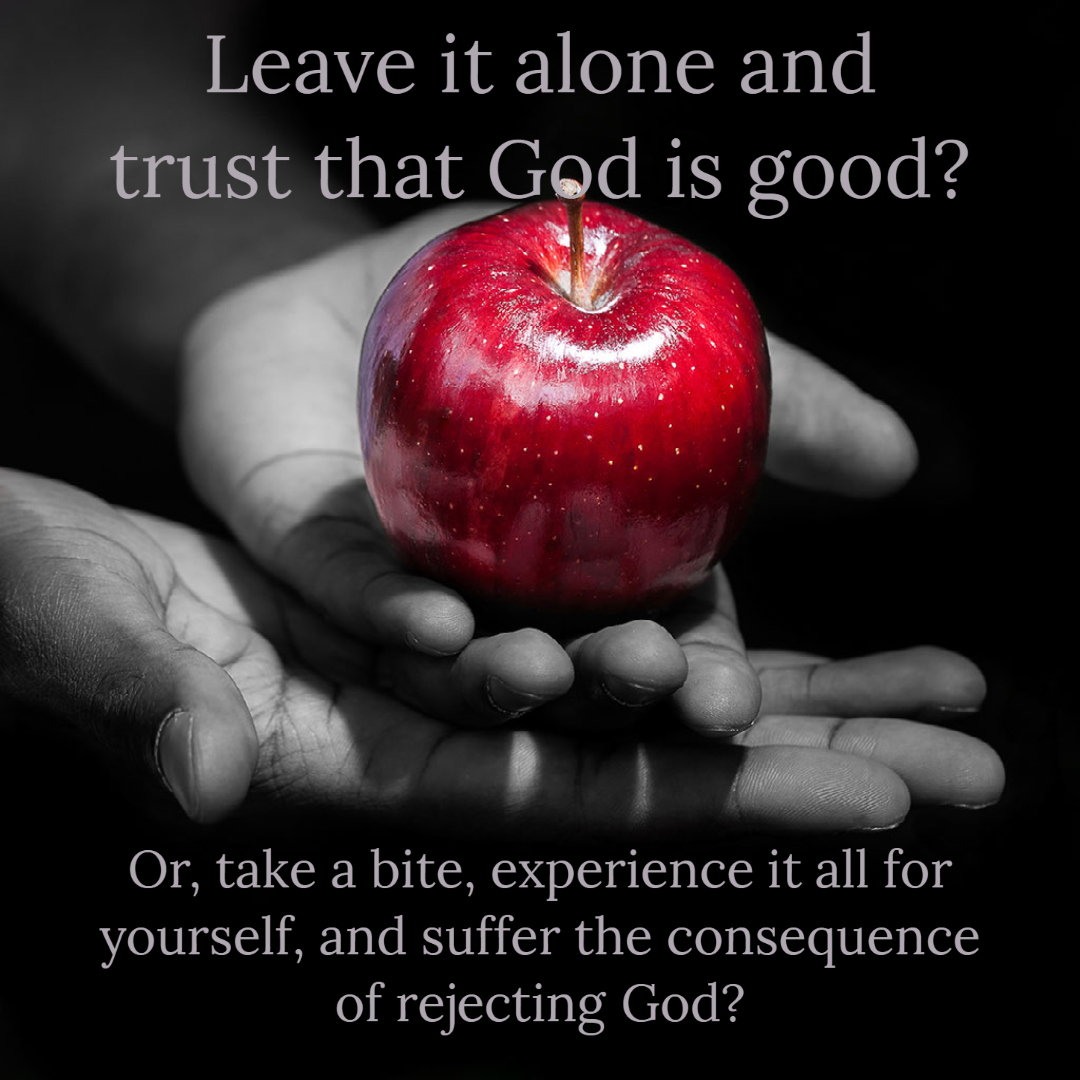
So, man had a choice. Trust that God is good and live forever in His presence, or doubt God’s goodness, overthrow His presence in man’s life, and strike out on his own. The former carried with it the promise of eternal blessing. The latter carried a risk of death and eternal judgment.

The serpent (a.k.a. Satan) tempted Adam and Eve with just that. In his speech to Eve in Genesis 3, Satan said, “You will not die. For God knows that in the day that you eat thereof, you will be as gods, knowing good and evil.”

Genesis 3:6 records the logic Adam and Eve used when deciding to eat the fruit. It says, “And when the woman saw that the tree was good for food, and that it was pleasant to the eyes, and a tree to be desired to make one wise, she took of the fruit thereof, and did eat, and gave also unto her husband with her; and he did eat.”

The logic was, “It’s good to eat, it looks good, and it will make us wise (as gods.)” They ate so they could experience the pleasures of everything, take power over their own lives, and eject God from the life that He gave them.

This was not a simple mistake or a poor food choice. It was an all-out rebellion against God. They cut themselves off from God, Who gave them life.

And when you cut yourself off from the source of life, you die.

This would be a good time to pause and reflect. God said, “In the day that you eat of this fruit, you will surely die.”

Satan said, “In the day that you eat this fruit, you will be as gods.”

The question arises, “Where are Adam and Eve today?” Based on the answer to that question, who was telling the truth, God? Or Satan?

If you’ve ever attended a funeral, you know the answer to that question. There is good news, however. In the same chapter, God offered a way of redemption. By promising that the seed of the woman would crush the head of the serpent, while suffering a death-blow Himself, God promised a savior, a redeemer, who would come and save His people from the death that comes as a result of sin.

That Savior was Jesus Christ, who both defeated Satan and suffered death upon the cross, and obtained final victory through the resurrection. Belief in this brings salvation and eternal life, and wins God’s favor.

The result of that salvation is being welcomed into His eternal Kingdom, where God will have restored life to what He intended on it being in the Garden.

So, with all that in mind, trust that God is good. Trust in Him, and place your faith in the death Jesus died on the cross for your forgiveness of sin. Then leave that sinful lifestyle behind and follow Him.

Safe and Sound (John 17:9-10)

Do we truly realize what our Lord Jesus Christ has done for us?

Our Lord gave us life. Scripture teaches that Christ was the Word which was in the beginning with God, and was God. That all things (ourselves included) were created by Him, and without Him nothing was made that was made.

In Him was life, and the life was the light of men.

The Lord created man and gave him life, so that he became a living soul. Our consciousness, creativity, dreams, and problem-solving ability are all effects of this life that the Lord gave us.

And when man rebelled against God, not only through disobedience, but through an attempt to overthrow God’s power and authority through that disobedience, the Lord redeemed us from the death and condemnation that came as a result.

To do that, He became man, lived the life of a man, endured the same trials and tribulations we do on a daily basis, yet He did so without sin (Hebrews 4:15-16).

Scripture says He came into His own, and we didn’t receive Him, nor did we recognize Him. In fact, we rejected and betrayed Him, turned Him over to the Romans and had Him crucified.

That is the greatest sin ever perpetrated in the history of the world, the sin of rejecting Christ and nailing Him to the cross.

Yet, even in that, He endured the wrath of God on our behalf, so that we could be cleared of all guilt and could stand faultless before God. He even prayed, “Lord, forgive them for they know not what they do.”

Having paid for our sins on the cross, the Lord resurrected on the third day, conquering death and the grave, and later ascended to the right hand of the throne of God where He ever lives to make intercession for us. He maintains our salvation by continually putting our cause before the Father in Heaven.

So, in John 17:9-10, it makes perfect sense that Jesus would clarify to the Father that He is praying for us. He said, “ I pray for them: I pray not for the world, but for them which thou hast given me; for they are thine. And all mine are thine, and thine are mine; and I am glorified in them.”

In that statement, Jesus said that He prays for us, that we are securely His, and that He finds glory in us.

Jesus prays for us. He earnestly pleads before the Father on our behalf, and He advocates for us. He stated that He prayed for “them,” and not the world. “Them” are His disciples, and not only His disciples, but all those who would believe based on their words. Therefore, since we have all become believers based on their words, then this prayer is for us as well.

And we know that Christ prays for us, because Hebrews 7:25 says that He “ever liveth to make intercession” for us. He intercedes, advocates for us. Advocacy… we don’t often associate that word with Christ, but it is truly what He does for us.

1 John 2:1-2 says “My little children, these things write I unto you, that ye sin not. And if any man sin, we have an advocate with the Father, Jesus Christ the righteous: And he is the propitiation for our sins: and not for ours only, but also for the sins of the whole world.”

John told us to sin not. That means to leave sin behind, to leave the sinful lifestyle behind, to leave “the life.”

However, if anyone sins, “we have an advocate with the Father, Jesus Christ the righteous.” He truly is our advocate.

His advocacy is one reason we are secure in our salvation, if we know Him as Savior.

Jesus said in John 17:9-10, “all mine are thine and thine are mine.” We belong to God, and in John 10, Jesus said, “no man is able to pluck them from my hand.” We have been passed from death to life, from condemnation to salvation, from guilt to innocence.

Then Jesus concludes this verse by saying, “and I am glorified in them.”

When Jesus said He was glorified in His disciples, it means His disciples bring him honor, renown, and cause Him to be well-known in a good day. This was something Jesus said had already happened. Simply by following Him, remaining faithful to Him even when all others walked away, and preaching His Kingdom, the disciples had already glorified Jesus.

When we remain faithful to the Lord, we glorify Him as well.

So, in light of this passage, knowing that Jesus prays for us, has secured our salvation, and is glorified in us, let us spend time in prayer, trusting in His forgiveness and redemption, and promoting His Gospel.

God is Good, We Have Proof!

Is God good?

For decades, if not centuries, the assumption has been that God is good. He is the creator of all things, the redeemer of sinful man, and the good force in the universe that battles the evil forces of Satan and his demons.

However, an increasingly skeptical generation is rising up. While this increased skepticism may alarm some Christians, a sincere search for the truth will not only quench the thirst of the skeptics, but will also deepen their faith, as knowing why you believe something endows you with a faith strong enough to endure the hardest temptations.

The skeptic looks at a broken world full of suffering and questions whether a truly good God could allow such. However, if we only evaluate God by the current conditions of this world, a work that is still very much in progress, then our perception will be skewed.

The fact is that while God created the world, not everything in the world is of God’s doing. God created a perfect world, a perfect environment, and a life for man with no suffering.

And God’s gift to man was the gift of life. To fully understand the gift of life, let’s take a look at Genesis 2:7, “And the LORD God formed man of the dust of the ground, and breathed into his nostrils the breath of life; and man became a living soul.”

This concept of life includes a certain consciousness, a sense of self-awareness, a certain creativity, a problem solving ability, and the desire and ability to create beauty.

This concept of life includes a certain freedom, the freedom to choose one’s destiny and will.

To lock in that freedom, God placed the tree of knowledge of good and evil in the Garden of Eden. Man was warned that eating of that tree would amount to rebellion against God and death. More on that in a moment.

The life God gave was one of freedom, creativity, consciousness, intellect, problem solving, engineering, art, beauty, music and progress. All of this is birthed from the life God gave, and the life God breathed into man’s nostrils.

Man is capable of all of this because God made him a living soul.

So, everything good we enjoy about life, whether it be music, art, sports, or entertainment, springs forth from the life God gave us. Everything good we accomplish, from building things, business, to medical advancements, comes from the life God gave us.

And God intended on us doing these good things with the life He gave us, which is why He told Adam to keep and dress the Garden, meaning that God’s intention for man was to make his perfect creation even better.

As Genesis 2:15 says, “And the LORD God took the man, and put him into the garden of Eden to dress it and to keep it.”

So, everything good you enjoy in life comes from the life God gave, thus everything good in life comes from God, because He is good.

As James 1:17 says, “Every very good gift and every perfect gift is from above, and cometh down from the Father of lights, with whom is no variableness, neither shadow of turning.”

So, seeing that God’s creation is good, and seeing that the gifts He gives is good, then we can conclude that God is good. Jesus Christ said that there is none good but God.

So what about the suffering? We did that on our own. God created the perfect world and gave us a perfect life, but in sinning against Him, we broke it. Not only that, but we continually perpetuate the suffering by sinning against each other.

So God is not the source of what’s bad in the world, we are. God is good, but we are not. But praise be to God, He can take all of our badness and turn it into good, and He does that continually (Romans 8:28)

So, God is good. The life He gave is good. The gifts He gives through that life is good. Therefore He is worthy of our faith – we should trust Him all the more.