One of the most forgotten attributes of Christ is His healing power.
As Christians, we love to discuss salvation, family, work ethic, and morals. However, many times people enter the doors of our churches carrying the pain that life too often brings.
Whether that pain is grief over a lost loved one, the emotional damage brought on by divorce, the fear that ensues losing a job, or the literal pain of a chronic illness.
Many live resigned to the idea that the pain will never go away, and that the scars will remain indefinitely. This resignation, however, completely overlooks the fact that Christ is the Great Physician. He heals, calms and restores.
In Mark 1, we see the power of Christ to heal physical disease on full display as the Lord heals Peter’s mother-in-law from a fever. While we at Life Point completely support the use of modern medicine and accessing the healthcare system, we have not forgotten that the Lord can, and often does, heal us of physical disease. And when He chooses not to heal, we find peace in His plan, knowing that He brings all things into our lives for good.
For the most part, the Lord has blessed us to live in a time when medicine has advanced far beyond anything it has accomplished in human history. Those living today have unparalleled opportunity to be healed of viruses, infections, heart disease and organ failure, and even cancer in many situations. Diseases that were once terminal just a few decades ago can be managed with the patient living a meaningful life.
Still, the Lord has been known to heal supernaturally. In cases when He doesn’t heal, we are often reminded that the Lord often uses disease to transition us from this life into the next, where we will be in His presence and there will be no more pain or suffering.
What most people struggle with, however, is emotional and Spiritual pain. While modern medicine is making advancements against cancer and diabetes, it has very little to offer in terms of healing emotional and Spiritual pain.
There are medications that can numb the pain and manage mood swings, but no medication can heal grief or regret. No medication can resolve an ongoing conflict or secure victory in a Spiritual battle.
However, the Lord can.
We see His power to do this on full display as He cleansed the leper in Mark 1. Now, on the surface, it may appear that healing leprosy would fall under the heading of physical healing, and on the surface, you would be correct.
But leprosy presents a far deeper symbolism in scripture. Leprosy is very similar to sin, in that it infects, scars and disfigures, and can have an affect not only on the leper himself, but on those who come into contact with him.
This is why the Old Testament law went into such detail as to how lepers were to behave, how lepers were to be treated, and if cleansed, how their cleansing was to be made official via temple rituals.
When Jesus cleansed the lepers, He not only demonstrated His power over physical disease, but He demonstrated His power to cleanse and restore us from the devastation of sin, and from the pain of grief and regret.
Last, but certainly not least, the Lord demonstrated His power to forgive sin.
In Mark 2:1-13, we see Jesus in a house, surrounded by the “press,” when four friends broke a hole open in the roof and lowered their disabled friend to Jesus to be healed. Jesus first response was to tell the man that his sins were forgiven.
The Pharisees balked, saying to themselves that only God had the power to forgive sin. When Jesus perceived their thoughts, He healed the man’s disease to prove His divine power, and His power to forgive sin.
In the above posted edition of The Point, we go into greater detail about the Lord’s power to heal. He heals us on multiple levels. That fact should bring us relief, joy and peace.
The second season of “Ancient Scrolling” is kicking off with an in-depth exploration of the Gospel according to John.
In AD 65, some three decades after the death, burial, and resurrection of Jesus Christ, many in the Christian faith began to drift theologically. Several theories and doctrines about the identity of Christ surfaced, with many being wrong and others being outright blasphemous.
The Apostle John took this theological drift personally, as he not only knew Jesus personally, but was “The Disciple Whom Jesus Loved.”
So, John endeavored to set the record straight. His efforts, inspired by the Holy Spirit, and thus being scripture and the word of God, are what we now know as “The Gospel according to John,” and “1st, 2nd, and 3rd John.”
In Episode 1, John sets out to establish the identity of Christ, and to demonstrate that Jesus of Nazareth was the Christ.
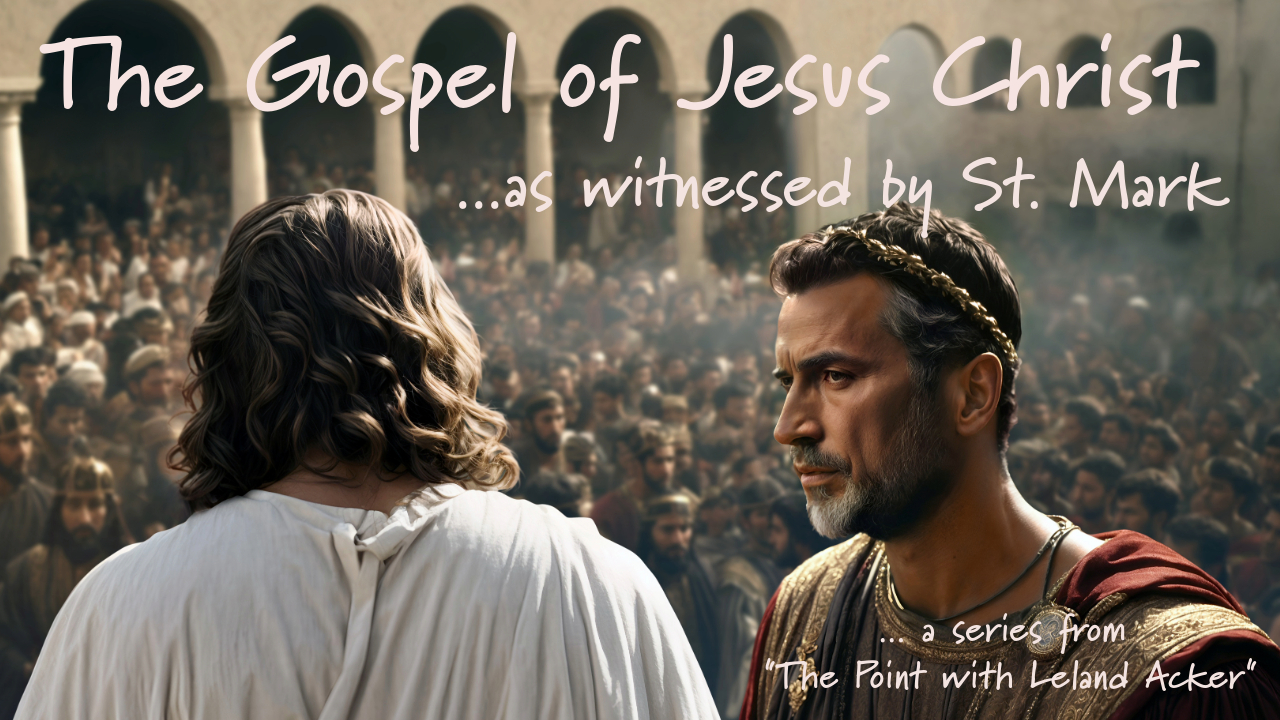
Mark wrote his account of the Gospel to demonstrate to us Who Christ is, not only by recording His actions, but also by giving us a written account of His death, burial and resurrection of Jesus Christ. The ultimate goal of Mark’s writings, and the writings of any New Testament author, is to build our faith.
By recording His actions, Mark paints a vivid picture of Who Jesus of Nazareth was, makes the case that He is the Christ, the Messiah, moreover the Savior of all mankind.
He opened His Gospel by showing how Jesus was the fulfillment of the Old Testament prophecies concerning the messenger that would go before the Lord. While this prophesied messenger was indeed John the Baptist, Mark pointed out how John the Baptist clearly identified Jesus as being the Christ.
As he continues his opening statement, Mark demonstrates the authority of Christ by showing His authority to call the disciples into apostleship, His authority to teach, and His authority over demons.
In Mark 1:16-20, Mark writes:
Now as he walked by the sea of Galilee, he saw Simon and Andrew his brother casting a net into the sea: for they were fishers. 17 And Jesus said unto them, Come ye after me, and I will make you to become fishers of men. 18 And straightway they forsook their nets, and followed him. 19 And when he had gone a little farther thence, he saw James the son of Zebedee, and John his brother, who also were in the ship mending their nets. 20 And straightway he called them: and they left their father Zebedee in the ship with the hired servants, and went after him.
Here, Mark records how Jesus called Simon (Peter) and Andrew, as well as James and John, to follow Him. When the Lord called them, He called them to follow Him, to learn from Him, and to help Him fulfill His mission. Likewise, when the Lord calls us, He calls us to salvation, to learn from Him, and to join His mission of spreading the Gospel.
Now, when He called them, He told them He would make them fishers of men. To them, fishing was a labor intense occupation where teams of men would drag nets throughout the sea to gather as many fish as they could. To be a fisher of men means to drag the net of the Gospel through the sea of humanity to bring as many to Christ as possible. This was a team effort.
Throughout the early years of Christianity, we see that it was always a team effort. The apostles always worked together in groups, whether they were sent out two-by-two by Christ into the villages of Galilee, or whether they were working together in the church of Jerusalem to preach the Gospel in the Temple court.
The Apostle Paul only traveled alone when he had to flee violence. However, during his missionary journeys, he always had people with him. Barnabas and Mark accompanied him on the first missionary journey. Other teammates to Paul included Luke, Silas, Timothy and Titus. Read any of Paul’s epistles, and you will see when he signs off that he lists the individuals who were with him who also sent their greetings to the church addressed in the letter.
Like the apostles, we are called to work as a team to spread, promote, propagate, publish and share the Gospel. We promote things all the time. We share funny posts on social media, we talk about our favorite TV shows and music, and we praise the restaurants that deliver amazing meals to our table. I’ll be sharing a link to this post as soon as I finish writing it.
Why don’t we share the Gospel more?
Social media is your story to the world. Through your posts and your comments, you tell the world Who you are and what you stand for. That story needs to center on the Gospel.
Like the Apostles were called to work together as a team in the ministry of Christ, we, too, are called to work as a team. There are no lone rangers in God’s work. We are to work as a team to spread the Gospel.
This is why much of the work in the Gospel is accomplished through the local church. We gather for worship, collect offerings to fund missionary endeavors, and we perform church outreach efforts. We fish together.
It is worth noting that when the Lord called us, He called us with the same authority with which He called His disciples on the shores of Galilee. This means that following the Lord’s call is not an optional feature to the Christian life. It is something the Lord calls us to, and something He expects from us.
Ephesians 2:8-9 say that it is by grace through faith that you are saved, and that not of yourselves, it is the gift of God. Not of works lest any man should boast. However, many Christians overlook verse 10, which says we are His workmanship, created in Christ Jesus unto good works, which God has before ordained that we should walk in them.
We were created to follow the Lord’s call, and to do His will, and to make an impact for the Kingdom.
Now, many Christians will object, citing work obligations, financial stress, and a busy family life. It is worth noting that the Apostles had things going on when the Lord called them as well. Simon and Andrew weren’t fishing as a hobby. Their abilities to feed their families depended on them having a successful catch.
James and John were not engaged in recreational crafting when they were mending their father’s nets. Those nets needed to be repaired in order to have another successful catch.
When Jesus called, they quickly left behind their livelihoods to follow. That requires faith.
The Lord has not necessarily called you to quit your job at 3M, the school, the state, or the phone company. However, using it as an excuse to fail to follow the Lord’s calling on your life will not work. By the authority in the Lord’s call, we have to prioritize the work of the Gospel.
Mark’s attention then turned to the Lord’s authority in how He taught.
Mark 1:21-22:
And they went into Capernaum; and straightway on the sabbath day he entered into the synagogue, and taught. 22 And they were astonished at his doctrine: for he taught them as one that had authority, and not as the scribes.
When Jesus taught in the synagogue, He did not spend time quoting other rabbis, discussing tradition, and sharing thoughts and ideas. He boldly proclaimed what the scriptures actually said. And what astonished those in attendance was the authority and certainty in which He delivered His teaching.
Well, of course He taught with authority. Not only were the scriptures about His redemption of His people, but it was through His Spirit that the scriptures were inspired and written in the first place.
There is a scene in the Chronicles of Narnia: The Lion, the Witch and the Wardrobe, where the white witch confronts Aslan the Lion about Edmunds betrayal, citing the deep magic’s requirement for such a one to be punished. Aslan responded by saying, “Do not cite the deep magic to me, I was there when it was written.”
In his Chronicles of Narnia series, C.S. Lewis attempted to explain the Christian faith in the form of a fantastical story involving talking animals and humans. In the Narnia universe, the deep magic was their scripture. Aslan the Lion was Lewis’ Christ-like figure, who submitted himself as a sacrifice for the betrayal of Edmund (and the sins of the creation). And in this scene, Aslan reminds everyone of His divinity and authority.
Likewise, when Christ taught in the synagogues, He was not merely another rabbi or scholar. He was the One Who inspired the scriptures, He was the subject of the scriptures, and His message, embedded in the scriptures, was redemption.
John 1 tells us that Christ was in the beginning with God, and that He was God, and that He created all things. Having created all things, then revealing Himself through scripture, we learn that Christ is the ultimate authority in the universe.
The scriptures were written by His authority and they say what He wanted said.
Therefore, when we study scripture, we are not merely reading a religious text or the works of a theological writer. We are reading the very words of God. We are in no place to reconsider, retranslate, reword, or question.
After demonstrating the Lord’s authority to call and His authority to teach, Mark showed us the Lord’s authority over demons.
Mark 1:23-26:
And there was in their synagogue a man with an unclean spirit; and he cried out, 24 Saying, Let us alone; what have we to do with thee, thou Jesus of Nazareth? art thou come to destroy us? I know thee who thou art, the Holy One of God. 25 And Jesus rebuked him, saying, Hold thy peace, and come out of him. 26 And when the unclean spirit had torn him, and cried with a loud voice, he came out of him.
Notice that, not only did the demon fear Jesus, but had to obey what Jesus told Him to do.
God and Satan are not two divine beings who are battling each other in a struggle of similar powers. God is God, has infinite power. Satan is a created being at the mercy of God’s power. Satan, therefore, has to obey and do what God orders. The same with demons.
So, when Jesus commanded the demon to come out of the man, he was forced to comply.
Demons have no power over the Lord. Further, Satan has no power with God either. He’s not a superboss at the end of a video game. He is a glorified demon. Nothing more.
Therefore, we can quit making Satan out to be a boogeyman, and we can quit fearing His antics. Go forward in faith, trust the Lord, and trust His call on your life.
Psalm 91:1 says, “He that dwelleth in the secret place of the most High shall abide under the shadow of the Almighty.”
We will find peace when we learn to live close to the Lord, under His authority, and depend on Him for our purpose, beliefs and protection.
The Lord Jesus Christ, the only Begotten Son of God, the embodiment of God Himself, the Word that became flesh and dwelt among us, Who created all things and gave us life, took on the role of the lowest ranking servant in the household, and washed His disciples feet.
In this one act of humble service, the Lord not only demonstrated His indescribable humility, but sent a message that pride, self-centered ambition and promotion, and the establishment of rank and pecking order have no place in God’s Kingdom.
Think about it. If washing the feet of the disciples is not beneath Jesus, then nothing is beneath Jesus. And if nothing is beneath Jesus, how can we think that anything is beneath us, for the servant is not greater than the Master.
In this message, Pastor Leland Acker exhorts us to love one another, and humbly serve one another, taking time to understand each others’ needs and viewpoints. If we do so, we will find true happiness.
Enoch is probably one of the most enigmatic figures in the Bible. He was pivotal. At least two New Testament writers made references to him, and he is remembered as one of the Godliest men who had ever lived. Yet, despite all this, we actually know very little about him.
Nevertheless, that hasn’t stopped writers from exploring the man and myth of who Enoch was. Some of what is written is based on ancient manuscripts. Other writings are based on legends and myths. From all this, entire belief systems and doctrines have arisen from perceptions of who Enoch was, what he wrote, and what he did.
Here’s the thing. The only relevant information about Enoch was given to us in the Bible. Genesis 5 tells us that Enoch was the father of Methuselah, that he walked with God for 300 years, and then was translated up into Heaven.
Hebrews 11:5 summarizes Enoch’s life this way, “By faith Enoch was translated that he should not see death; and was not found, because God had translated him: for before his translation he had this testimony, that he pleased God.”
All God wants us to know (because this is all He inspired to be included in scripture) is this. That he fathered Methuselah, walked with Him for 300 years, and was captured up into Heaven. God also makes the note in Hebrews 11:5 that Enoch pleased God by his faith.
So, what God wants us to know is that He is pleased by our faith. When we trust God, God sees that faith and places us in the same league as Enoch.
Hebrews 11 follows that thought with verse 6, which says, “But without faith, it is impossible to please Him. For he that cometh to God must believe that He is, and that He is a rewarder of them that diligently seek Him.”
There are many things written about Enoch, and there are entire religious doctrines built on myths surrounding a relatively unknown, yet pivotal Biblical figure. However, what God wants us to know is that Enoch had faith and lived by his faith in God, and that pleased God. Further, God wants us to follow that example.
In Genesis 4, Cain and Abel both brought offerings to the LORD. Scripture tells us that Cain brought of the fruit of the ground, which makes sense because he grew crops for a living. Abel, on the other hand, brought one of the firstlings of his flock, which also makes sense as Abel kept sheep for a living.
Now, Genesis 4 tells us that God had respect for Abel’s offering, but not Cain’s. As a result, Cain became very upset. God confronted Cain about his attitude, saying, “If you do well, won’t you be accepted? And if not, sin lies at the door.”
Cain did not do well, however. As he and Abel worked in the field, Cain vented his frustration on Abel, resulting in a fight that led to Cain killing Abel. Cain was subsequently banished, leading him to found a godless society. Adam and Eve had another son, who fathered the Godly lineage in the pre-flood world.
Such set the stage for the downfall of mankind, leading to the flood in Genesis 6-9.
In taking all of this into consideration, the question is often posed, “Why did God respect Abel’s offering, but not Cain’s?”
One answer commonly given is that Abel offered a blood sacrifice, while Cain did not. While this explanation harmonizes with the Gospel pattern of the shedding of blood for the remission of sins, the fact is that there is little Biblical evidence for it, especially when you consider that grain offerings were a completely legitimate part of the temple system of worship in the Old Testament.
The explanation with scriptural evidence is actually much simpler. Abel offered his sacrifice by faith, whereas Cain did not.
Hebrews 11:4 says, “By faith Abel offered unto God a more excellent sacrifice than Cain, by which he obtained witness that he was righteous, God testifying of his gifts: and by it he being dead yet speaketh.”
Abel offered his sacrifice by faith. He knew God was God, trusted in His goodness, and rested in His grace.
On the other hand, Cain lacked this faith. He obviously knew God existed, but did not trust God’s goodness and grace. For Cain, the offering was more of an obligation than an offer of thanksgiving or worship. Thus, God rejected it.
Scripture is very clear, and the point is driven home in Hebrews 11. What pleases God is faith, that simple trust in His existence and grace. While that faith motivates action, the fact is without that faith, the most righteous acts in the world will not please God.
So, with all that in mind, do you have faith. Do you believe that God is? And do you trust in His goodness and grace? (Hebrews 11:6)
And if so, are you living by that faith? May God grant you clarity as you reflect on your faith.
Have you ever noticed that multiple educated people can evaluate the same sets of data, and come up with two completely different conclusions?
One Wall Street analyst looks at a particular company and recommends buying their stock. Another looks at the same company, with the same financial statements and business prospects, and recommends selling their stock.
One football scout watches a prospective quarterback and sees vulnerability and liability. Another sees the same quarterback in the same game and sees the future of the franchise.
Multiple experts, same information, different conclusions.
Today, we see the same things happening in the debate over evolution. The evolutionist sees evidence such as carbon dating and fossils, and concludes that evolution is true. The creationist sees the exact same evidence, and concludes that the fossil record proves the existence of the flood from Genesis 6-9, and thus creationism is true.
Both the evolutionist and the creationist are highly educated and well-reasoned in their conclusions. So, how do they look at the fossil record, carbon dating, canyons and rock formations, and come to such different conclusions?
It has to do with their faith.
The evolutionist has a faith that the world was created by various physical forces and chemical reactions without the intervention of a divine creator. Thus, when he examines the fossil record, his faith is validated by what he sees as evidence of an old earth. Through his faith, he believes in evolution.
The creationist has a faith that the world was created by God, so when he examines the fossil record, his faith is validated by what he sees as evidence of God’s intervention (such as the worldwide flood).
You see, faith is not shaped by evidence, but rather, faith shapes how we evaluate evidence. If you are looking for proof before you believe, then you will never find the evidence you are looking for. However, if you believe, you will see things that validate your belief.
Thus, we find in Hebrews 11:3 that “Through faith we understand that the worlds were framed by the word of God, so that things which are seen were not made of things which do appear.”
Our demand for proof of God’s existence will never be satisfied, at least, not until the end time. However, when we decide to trust that God exists and that He is good, then God responds to that faith and rewards it (Hebrews 11:6).
So, the question is, what do you believe? And how is that belief shaping your worldview?
Many Christians mistakenly define faith as “the substance of things hoped for, the evidence of things not seen.” That definition, which is a quote of Hebrews 11:1, doesn’t really tell you what faith is, rather it tells you what faith does.
Faith is a deep-rooted trust in the Lord and a deeply held conviction of His truth. Faith means having a belief that cannot be deterred by circumstance, blessing or curse.
When you hold this level of faith in the Lord, the intangible things of God no longer cause you to question His existence or goodness.
That’s why Hebrews 11:1, which kicks off an entire chapter demonstrating faith through the lives of the Old Testament saints, states that “Faith is the substance of things hoped for, the evidence of things not seen.” Because we strongly believe in the Lord, He is real to us.
It’s not that faith can create a being and alter reality, but rather, because of our faith, we can see the unseen God move. We can see His work. And because we see His work and the effects of His working, we see further evidence of His existence, power and goodness.
It’s like Jesus told Nicodemus in John 3:8, “The wind bloweth where it listeth, and thou hearest the sound thereof, but canst not tell whence it cometh, and whither it goeth: so is every one that is born of the Spirit.”
We don’t see the wind, but we know it exists because we feel its presence and we see the effects of its movements. Likewise, because we believe in God, we can feel His presence and see the effects of His movements.
This faith, in turn, shapes our worldview, which then influences our actions and our choices. It’s this faith that pleases God and guides us to where He wants us to be and what He wants us to do.
It’s this faith that gives substance (tangibility) to the things that we hope for, like Heaven, healing and peace. It’s this faith that shows us the proof (evidence) of the things of God that we do not see. And it’s this faith that helps us understand that God created all things by His word (Hebrews 11:3).
And it’s this faith that pleases God (Hebrews 11:2, 6) and brings us salvation (John 3:16, Romans 5:1, Ephesians 2:8-9).
Do you trust the Lord? Do you have this level of faith?
“Gospel” is a buzzword that is widely circulated in Christian circles. There’s Gospel music, Gospel preaching, spreading the Gospel and standing for the Gospel.
There are full Gospel churches and Gospel revivals.
With all this talk about the “Gospel,” what is it really? What is “The Gospel?”
Some say that the Gospel is the entire word of God from Genesis to Revelation. However, while the scriptures contain the Gospel from Genesis to Revelation, the scriptures themselves are not the definition of the Gospel.
The Gospel is defined in 1 Corinthians 15:3-4, which states that Paul delivered unto the saints at Corinth how Christ “died for our sins according to the scriptures, that He was buried, and that He rose again the third day according to the scriptures.” Thus, the Gospel is the death, burial and resurrection of Jesus Christ for our sins according to the scriptures.
By giving His life on the cross, our Lord endured God’s punishment for sin, thus removing the condemnation of sin from us. We have been forgiven because our sins have been paid for, and it was Christ that made that payment.
By rising from the grave, Christ defeated death, and brought eternal life to all who believe.
This is the central message of the Bible, and the theme that runs through all the scriptures. The deeper you dig into scripture, the deeper an understanding you gain of the Gospel.
It is through the Gospel that we have salvation. It is through the Gospel that we find peace, and we find deliverance from shame and regret.
In His messages of repentance, Christ urged the people to believe the Gospel. By believing the Gospel, your faith is placed squarely on Christ and you will have salvation. With that salvation, you have the blessed assurance that you will spend eternity in Heaven.
To explore the theme of the Gospel throughout the Bible, check out The Gospel Expedition, posted via YouTube or Soundcloud below:
Here’s a challenge for you… go to any Bible study, Sunday School class, or online Bible forum, and ask the question, “What is faith?”
You will get a variety of answers. One common answer is, “Faith is the substance of things hoped for, thge evidence of things not seen.” That answer is a quotation of Hebrews 11:1. Your next step is to ask, “What does that mean?”
The tragedy of modern Western Christianity is that salvation comes by grace through faith (Ephesians 2:8-9), but most don’t even know what faith is.
If we don’t know what faith is, how can we be saved? If we don’t understand faith, can we truly experience redemption and reconciliation?
In John 3, Jesus is approached by Nicodemus, who recognizes that Jesus was sent by God, but the Lord’s radical teaching of repentance and faith did not always line up with the religious traditions that Nicodemus followed.
Nicodemus, unlike his fellow Pharisees, wanted the truth. Recognizing that Jesus came from God, and that what Nicodemus believed didn’t line up with what Jesus taught, Nicodemus came to Jesus to reconcile his personal belief system with what God actually wanted.
Jesus knew this, which is why Jesus said that a man “must be born again” in order to be saved.
The rest of the conversation in John 3 is about how to be born again, that is, how to be saved, or how to be redeemed and reconciled to God. John 3 is one of the most important passages of scripture, because it is here that Jesus, the only Begotten Son of God who went to the cross to pay for our sins, tells us how to be saved.
These instructions on how to be saved are as valid and true to us today as they were to Nicodemus. Nothing has been added or changed since, for if it were, this passage would not have been recorded in scripture.
In John 3, telling us how to be born again, Jesus tells us that “whosoever believeth in Him should not perish but have everlasting life.” And just in case we confuse ourselves on what it means to believe, Jesus tells us (and Nicodemus) and Old Testament Bible story.
In John 3:14, Jesus said, “And as Moses lifted up the serpent in the wilderness, even so must the Son of Man be lifted up, that whosoever believeth in Him should not perish but have eternal life.”
In this verse, Jesus references an incident from the book of Numbers, where Israel complained and rebelled against God. Because of the severity of their rebellion, the LORD sent what the King James Version refers to as “fiery serpents” into the camp. Fiery serpents were more than likely poisonous snakes, as the scripture described how they bit the people, and the people began dying.
As they died, they cried out to Moses for help. Moses prayed to God, and God told Moses to make a bronze serpent, place it on a pole, and set it up in the middle of camp. If anyone is bitten, they can look at that bronze serpent and live.
Being saved from the snake bites in Numbers was as simple as looking to that serpent on the pole. No sacrifices, no offerings, no religious works. Just a simple look.
In John 3, Jesus said in the same way, He was to be lifted up on the cross. And in the same way, if people look to Him on the cross, they will be saved. Looking to Jesus on the cross constitutes belief, because that is what you are depending on for your forgiveness and salvation. Because Jesus went to the cross, you know you have been redeemed and reconciled to God.
Belief in Jesus is as simple as looking to Jesus and remembering that He redeemed you through His death on the cross. And that belief is the ONLY condition that must be met in order to be saved.
Faith and belief are used interchangeably in the New Testament. They are both translated from the same Greek word. So, with that in mind, we conclude that faith simply means a belief, a trust in the Lord. We have faith because we believe that Jesus will receive us into Heaven, because He paid for our sins on the cross. That’s faith. Nothing more. Nothing less.
Faith is not a religious system. Faith is not an expression of religious works (on the contrary, your works reveal whether or not you have faith.) Faith is belief.
Do you believe in Jesus? Do you believe that He died on the cross for your sins? Can you look to Him on that cross and know that because of His death and resurrection, you are going to Heaven? If you can, and if you have done that, you have been saved, and you have become a Christian.
While that faith will change the way you live and think, please know and be assured that it is the faith that has saved you.


 The Point...