Having begun His earthly ministry, and having performed several miracles along the way, Jesus called Levi to follow Him.
Levi was a publican, a Jewish man who had taken on the role of tax collector for the Roman government. For most Jews in Israel at the time, there was no lower life form. To the Pharisees, if a man became a publican, he had sold out his portion of Israel’s inheritance and his stake in the Kingdom of God. To the Pharisees, publicans could never be saved and would never go to Heaven.
Being cast out of Jewish society, many publicans took to self-indulgence and sinful lifestyles, which is why you often see sinners and publicans mentioned in the same sentences in the New Testament.
So, here you have Levi. Named after the son of Jacob who became the father of the Levitical tribe. Levi’s tribal namesake was responsible for the upkeep of the Tabernacle in the Old Testament, and for the upkeep of the Temple in Jesus’ day. The Levites were given six cities in which to live, cities that became “cities of refuge” for those trying to escape retribution from accusations over fatal accidents.
But, even with all this heritage, Levi sits at the receipt of custom, alienated from his countrymen, and a friend to sinners and other publicans.
And it was in that state that Jesus called Him to be a disciple, and Levi happily followed. He would later be renamed “Matthew,” which is a variation of the Greek word for “disciple.”
Having been called to be a disciple of Jesus, Levi holds a dinner for his sinner and publican friends. And in this passage, we see the mission of Christ on full display.
Levi’s plight reminds us of who we are, sinners who are irredeemable without the grace and mercy of God. We see what God did, in sending Jesus Christ to redeem us from sin. And, we see the proper response to the Gospel, which is repentance and faith.
One of the most forgotten attributes of Christ is His healing power.
As Christians, we love to discuss salvation, family, work ethic, and morals. However, many times people enter the doors of our churches carrying the pain that life too often brings.
Whether that pain is grief over a lost loved one, the emotional damage brought on by divorce, the fear that ensues losing a job, or the literal pain of a chronic illness.
Many live resigned to the idea that the pain will never go away, and that the scars will remain indefinitely. This resignation, however, completely overlooks the fact that Christ is the Great Physician. He heals, calms and restores.
In Mark 1, we see the power of Christ to heal physical disease on full display as the Lord heals Peter’s mother-in-law from a fever. While we at Life Point completely support the use of modern medicine and accessing the healthcare system, we have not forgotten that the Lord can, and often does, heal us of physical disease. And when He chooses not to heal, we find peace in His plan, knowing that He brings all things into our lives for good.
For the most part, the Lord has blessed us to live in a time when medicine has advanced far beyond anything it has accomplished in human history. Those living today have unparalleled opportunity to be healed of viruses, infections, heart disease and organ failure, and even cancer in many situations. Diseases that were once terminal just a few decades ago can be managed with the patient living a meaningful life.
Still, the Lord has been known to heal supernaturally. In cases when He doesn’t heal, we are often reminded that the Lord often uses disease to transition us from this life into the next, where we will be in His presence and there will be no more pain or suffering.
What most people struggle with, however, is emotional and Spiritual pain. While modern medicine is making advancements against cancer and diabetes, it has very little to offer in terms of healing emotional and Spiritual pain.
There are medications that can numb the pain and manage mood swings, but no medication can heal grief or regret. No medication can resolve an ongoing conflict or secure victory in a Spiritual battle.
However, the Lord can.
We see His power to do this on full display as He cleansed the leper in Mark 1. Now, on the surface, it may appear that healing leprosy would fall under the heading of physical healing, and on the surface, you would be correct.
But leprosy presents a far deeper symbolism in scripture. Leprosy is very similar to sin, in that it infects, scars and disfigures, and can have an affect not only on the leper himself, but on those who come into contact with him.
This is why the Old Testament law went into such detail as to how lepers were to behave, how lepers were to be treated, and if cleansed, how their cleansing was to be made official via temple rituals.
When Jesus cleansed the lepers, He not only demonstrated His power over physical disease, but He demonstrated His power to cleanse and restore us from the devastation of sin, and from the pain of grief and regret.
Last, but certainly not least, the Lord demonstrated His power to forgive sin.
In Mark 2:1-13, we see Jesus in a house, surrounded by the “press,” when four friends broke a hole open in the roof and lowered their disabled friend to Jesus to be healed. Jesus first response was to tell the man that his sins were forgiven.
The Pharisees balked, saying to themselves that only God had the power to forgive sin. When Jesus perceived their thoughts, He healed the man’s disease to prove His divine power, and His power to forgive sin.
In the above posted edition of The Point, we go into greater detail about the Lord’s power to heal. He heals us on multiple levels. That fact should bring us relief, joy and peace.
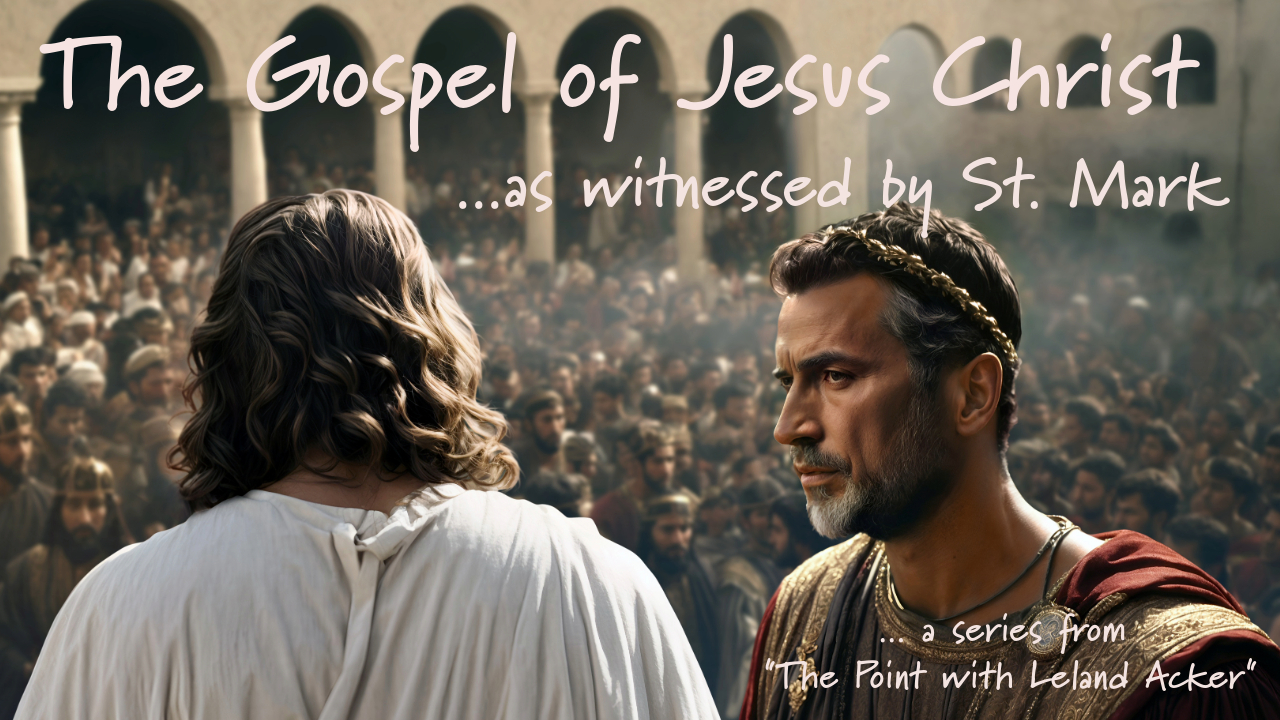
Of all the men who walked and ministered alongside Jesus, Mark may have been the most overlooked. He was a disciple, yet he was not an apostle. He provided the upper room where Jesus instituted the Lord’s supper, was present at the arrest of Christ, and remained with the apostles after the crucifixion and resurrection of Christ.
Mark’s failures are recorded in scripture, and only twice do we see his successes in the faith. The book of Acts records how Mark accompanied Paul and Barnabas on the first missionary journey. However, Mark left the journey prematurely and returned home. His abandonment of the first missionary journey created a rift between he and Paul, and when Barnabas suggested that they take Mark on the second missionary journey, Paul vehemently objected. That conflict led to the breakup of Paul and Barnabas as a missionary team.
When Jesus was arrested, instead of trying to fight the temple guard as Peter did, Mark fled, not even taking the time to collect his garments.
Yet, despite all of this, Mark was a mighty man of God. He provided the upper room for the last supper. He remained with the apostles following the crucifixion and resurrection of Christ, taking part of a missionary journey with Paul, and ministering alongside Barnabas after that.
In his final days, the Apostle Paul wrote a letter to Timothy we now know as II Timothy. In it, he asked Timothy to come to Rome, and to bring Mark with him, because as Paul put it, he was profitable in ministry.
The Mark of II Timothy was a man who had grown from his failures in faith and his moments of weakness, and had become a mighty man of the Gospel.
We don’t know what prompted Mark to write his account of the Gospel, aside from the inspiration of the Holy Spirit. There doesn’t seem to be a specific occasion or audience. We do know that his work was an effort to record the crucial actions of Jesus leading up to the cross.
Matthew demonstrated how Christ fulfilled the Old Testament prophecies concerning Christ. Luke put together a comprehensive anthology of the actions and teachings of Christ. John recorded seven key miracles that demonstrated the divinity of Christ.
But Mark focused on an abridged collection of key actions and teachings from Jesus leading up to the Gospel.
Mark’s account of the Gospel is believed to have been the first written, and many scholars believe that Luke referenced his Gospel when writing his own. Mark’s Gospel demonstrates Who Jesus is so we can know Him, and knowing Him we can believe. The ultimate goal of Mark is to build our faith in the Lord.
Please understand, our efforts to provide historical and cultural context to books of the Bible should in no way lead the reader to think that these books are anything less than inspired scripture, thus being the actual word of God. It is through the historical and cultural context of these scriptures that we are able to hone in on what God was actually saying, and get the true message of the Bible.
So, as Mark opens his account of the Gospel, he provides us an introduction to Christ. He begins by showing the fulfillment of the scriptures, particularly pertaining to John the Baptist. John’s status of a prophet was almost universally accepted among the Jews and Judeo-Christian believing gentiles of the day. Mark showed through Old Testament prophecies that John’s ministry was to identify the Christ for us, and to prepare us to meet Him.
Mark then demonstrated that the ministry of John the Baptist was all about Jesus, preparing the people to meet Him and identifying Him as the Christ. He showed how John lived up to that prophetic purpose.
Mark then showed how God Himself witnessed to the identity of Christ at the Baptism of Jesus, saying “This is my Beloved Son, in Whom I am well pleased.”
Through these words, and through the rest of the writings in the Gospel of Mark, one must come to the conclusion that Jesus of Nazareth was indeed the Christ, the Savior, the divine Son of God Who gave His life for the sins of the world, so that man could be forgiven, saved from wrath, and redeemed into the Kingdom of God.
In Luke 10, Jesus told His disciples to tell the cities that rejected Him that “the Kingdom has come near” to them. Those cities had the opportunity to hear Jesus, see Jesus, be healed by Jesus, and most of all be redeemed by Jesus, yet they passed on that opportunity and rejected Him.
We live in an amazing time where we have an abundance of Bibles in multiple languages and translations, we have stores full of books about the Bible and the Christian faith, and you can go online and listen to almost any Bible teacher in the world. We live in a time when the Gospel and scripture, as well as solid Bible teaching is readily available. The Kingdom truly has come near to us.
The question is, what do we do with that? Join Pastor Leland Acker in Luke 10:10-24 by listening to the audio posted above.
The mission of the church is the Great Commission, the Lord’s call to mentor and disciple others into faith, baptizing and teaching the believers all about Jesus. In this message, Pastor Leland Acker discusses what missions is, and three key things we all need to understand about missions.
Daniel was a man who had done everything right, yet, time after time, adversity and tribulation troubled him. Captured from his homeland of Israel during his younger years, he was one of several elite captives taken from Israel and enslaved in Babylon.
Though Daniel’s assignment wasn’t the worst, he worked personally for the Babylonian king, he still faced troubles, from impure foods being offered, to being thrown in the lions’ den, to seeing his friends thrown in the fiery furnace. (Daniel and his friends were delivered from all of those, by the way).
By the time we get to Daniel 9, the Babylonian empire has been conquered by the Medo-Persian empire, and Daniel is now working for another king. Having lived through the entire Babylonian captivity, Daniel now sees the light at the end of the tunnel, and the captivity is coming to a close.
Daniel sees God’s deliverance coming, and it is at this time that God begins to show Daniel how He will redeem His people and restore the nation of Israel. In Daniel 9:24, the Lord gives us his plan:
Seventy weeks are determined upon thy people and upon thy holy city, to finish the transgression, and to make an end of sins, and to make reconciliation for iniquity, and to bring in everlasting righteousness, and to seal up the vision and prophecy, and to anoint the most Holy.
God would redeem His people, and restore His nation, by ending man’s rebellion, cleansing man from sin, and establishing His Kingdom on earth. Listen to Pastor Leland Acker discuss this message of hope below:
As more cases of COVID-19 are confirmed across the US (we have a local case here in Brown County, Texas), more people are asking the question, “Is this a sign of the end times?” Yes, and no.
In the days leading up to the return of Christ, Matthew 24:7 says “For nation shall rise against nation, and kingdom against kingdom: and there shall be famines, and pestilences, and earthquakes, in divers places.” Verse 8 goes on to say, “All these are the beginning of sorrows.”
“Sorrows” in scripture is often a euphemism for child birth. If you’ve ever had a baby, or if your wife or anyone close to you has had a baby, you know how this works. An expectant mother has a contraction. She doesn’t panic and run to the hospital, rather, she waits for the next contraction. There it is.
At first, the contractions are mild, and far apart (2 or more hours), but as time progresses, the contractions grow closer together, and become more severe. Ultimately, they become just a few minutes apart. Mom delivers the baby, and the joy of that newborn erases any memory of the pains of childbirth. (Or, so I’m told).
The end times, and the return of Christ works the same way.
The signs given in Matthew 24:1-8 are birth pangs, contractions, “The beginning of sorrows.” These signs repeat themselves with greater frequency and intensity until the Tribulation starts, ends, and Christ returns.
These signs both get our attention, and move the world closer to a place where the final events of this age can happen. It is all in God’s plan, and He is still in control of all things.
That’s why Jesus said in Matthew 24:6, “See that ye be not troubled: for all these things must come to pass, but the end is not yet.”
As the news continues to fill up with stories of COVID-19, outbreaks, and instability, remember the words of Christ. See that ye be not troubled, these things must come to pass, but the end is not yet.


 The Point...