The Greatest Love Story Never Told (Song of Solomon)

The Song of Solomon is often overlooked in Bible studies for a variety of reasons. First, it’s located in the middle of the Old Testament. Secondly, the imagery of passionate romance depicted in the book can seem awkward for groups with young children, or groups with both genders. Thirdly, and possibly the biggest reason, is that the book can be difficult to understand.

Even the great Bible expositor Charles Haddon Spurgeon expressed difficulty in interpreting the Song of Solomon when he said the book could only be understood by the “initiated,” and that the book stood in the middle of the Old Testament like the Tree of Life in the Garden of Eden, whose fruit you cannot eat unless you are brought by Christ past the cherubim with the fiery sword. Apparently, Spurgeon was incapable of simply saying, “This book is hard.”
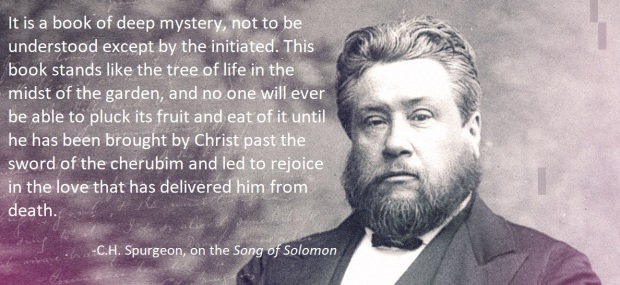
Spurgeon song of solomonSong of Solomon is often preached as a book about marriage. However, Spurgeon believed, as do many other Bible teachers, that Song of Solomon is an allegory for the love Christ has for His people.

It’s with that context that we examine the book, Song of Solomon. The Song of Solomon can be divided into three parts… the romance, the wedding, and the marriage. Each mirrors a stage in our walk with Christ. The romance, where Christ loves us regardless of our station in life, and draws us to Him. The wedding, where we repent and commit ourselves to Him, and the marriage, where He takes us to our eternal home. In each of these parts, we can see the passionate love that Christ has toward us.

In the beginning of Song of Solomon, we see the romance develop between the Shulamite woman and King Solomon. In Verses 1:5-6, the Shulamite woman notes that she is black, that she keeps vineyards for others, and her mother’s children were angry with her. The fact that she is black indicates that she has spent her life in hard field labor. She has not known luxury, nor has she been able to preen or care for herself. While she says that she is comely (she looks good,) her body shows the effects of her life of hard labor.

She also says that she has not kept her own vineyard, which means she has no vineyard. She has no wealth, she has no assets.

She is hardly a bride suited for a king. In Old Testament times (as well as medieval times, and even modern times), royalty married those who could bring peace or prosperity to their kingdoms. Alliances, trade agreements, and even mergers were orchestrated through royal weddings. The Shulamite woman can offer none of these.

Yet, despite her destitute situation, King Solomon loves her. In Verse 2:4, the Shulamite woman says, “He brought me to the banqueting house. His banner over me was love.”

This is a Cinderella-type story if there ever was one. King Solomon not only loves the Shulamite woman, and cares for her, but he brings her to the banquet. There’s a banquet, a ball. The creme de la creme are there. And King Solomon has this Shulamite woman on his arm, is introducing her to every one, and his proud to be in love with her.

It means a lot that King Solomon makes this romance public. He loves the Shulamite woman. She is the object of his love, and he is driven by his love to care for her. She is not a scandal to him, and he is not ashamed of her.

This is a mirror to how Christ loves us. He loves us in spite of the fact there is nothing we can do for Him. He loves us in spite of the rejection we suffer at the hands of others. He lifts us out of our hopelessness and takes us into His kingdom, where we can know love, care, and be provided for.

In Chapter 3, we see the wedding. In Verse 3:11, the Shulamite woman tells the daughters of Zion to “Behold King Solomon,” who has been crowned with the crown of his espousals. Also in chapter 3, we see that King Solomon takes the Shulamite woman to His bedchamber, which is surrounded by 60 of the best fighters in the king’s army.

The espousals, the wedding, is the union of King Solomon to the Shulamite woman. The marriage union is an eternal union never to be broken. This is why marriage is so sacred to God. It provides a picture of the love between the Lord and His people.

Being married to King Solomon, the Shulamite woman would never again know fear. She would sleep in the safest place in the kingdom, and the king would never put her out.

Likewise, when you are a child of God, when you know Christ as your Savior, you are in the safest place in the universe, because nothing can get to you without going through God first. And God will never turn you away.

Jesus said in John 5:24, “Verily, verily, I say unto thee. He that heareth My words, and believeth on Him that sent me, hath everlasting life, and shall not come into condemnation, but is passed from death unto life.”

Basically, if you know Jesus as your Savior, you will never need to fear God’s wrath, and you will never come into condemnation. You are safe, and the Lord will receive you into His kingdom.

Finally, in Song of Solomon, we see the marriage.

No marriage is perfect. All marriages endure hard times, conflict, and sometimes estrangement. Thus, in Song of Solomon 5:2-8, we see such an occasion arise between the Shulamite woman and King Solomon. The king has come to her door, but she has just gotten ready for bed, her coat is put off, and she has washed her feet, and she doesn’t want to get messy. So, he leaves.

How often does the Lord knock on our door, but we are too busy with the day to day things of life to answer His call? How often are we preoccupied with the things of this world to answer God’s call on our life? How often do we put off doing something for the Lord because today is not a convenient day?

We miss our Bible devotional time, and our prayer time because we are too busy. We refrain from giving to the church because we have a lot of financial plans and obligations. We do not surrender to the ministry God has called us too because it would disrupt our current lifestyles. Then one day, we find ourselves apart from God, wondering why He is silent, and distant.

He knocked. We couldn’t be disturbed. Therefore, the fellowship was broken.

The good news is that there is reconciliation. In Verses 6:1-3 we see the reconciliation between the Shulamite woman and King Solomon. When we repent and turn to the Lord, He forgives, and we are reconciled to Him.

Closing out the Song of Solomon, we see a beautiful sight. In verse 8:12, the Shulamite woman has her own vineyard. The woman who had no vineyard in chapter 1 now has a vineyard of her own. She lives happily ever after, with Solomon.

Likewise, those of us who wonder this earth without a home, those of us who know Christ as our Savior, will one day have an eternal home.

In John 14:2-4, Jesus said, “In my Father’s house are many mansions: if it were not so, I would have told you. I go to prepare a place for you. And if I go and prepare a place for you, I will come again, and receive you unto myself; that where I am, there ye may be also. And whither I go ye know, and the way ye know.”

If you know Christ as your Savior, He has prepared an eternal home for you in Heaven. The day is coming when He will return and take you to that eternal home, and you will be with Him forever.

Even so, come Lord Jesus.

As Solomon loved the Shulamite woman, so Christ loved us. Will we receive His love by turning from sin and trusting in Him? Or will we spurn His love in favor of the sins of this world. Each will choose for himself or herself. How will you choose?

All Hands on Deck!

belief bible book business

Photo by Pixabay on Pexels.com

With a number of Life Point’s members and friends facing serious situations this week, we’d like to call all of our members and friends to prayer.

There are specific prayer requests being lifted up to us for those who have lost loved ones, those battling serious illnesses, and those facing serious problems in life. We plan on praying for each and every one. If you have a prayer request to add to this list, email it to our pastor, Leland Acker, at LelandAcker@gmail.com.

If you would like to pray with us, you can do so in person at 6 p.m. Wednesday, at Life Point Baptist Church, 599 Sunrise Dr., Early, TX, or you can do so where you are.

May God hear your prayers, heal your hurt, and comfort your heart.

The Greatest Love Story Never Told

Spurgeon song of solomon

Rarely will churches embark on a study of the Song of Solomon. This is mainly due to two reasons. (1) Interpreting the book presents a challenge, and (2) some of the romantic language is a bit more passionate than most are used to hearing during church services. It’s a shame, because few books fully illustrate the love Christ has for His people as the Song of Solomon.

As King Solomon loved the Shulamite woman, so Christ loves us. As Solomon woo’ed the Shulamite woman, so Christ drew us to Himself. As their love endured difficulty at times, so do we often fail our Lord. Yet, as Solomon loved the Shulamite woman, and took her to a special place, so does Christ love us, and will one day take us into His Kingdom.

For a PG interpretation of the Song of Solomon in light of the Gospel, come to worship at Life Point Baptist Church, 11 a.m. Sunday, Feb. 17, 2019, at 599 Sunrise Drive in Early, TX. Come experience the love of Christ.

Contentment in Christ

The book of 1 Timothy is a letter from the Apostle Paul to a young preacher named Timothy who would taking leadership over one of the strongest churches ever organized under the Apostle’s ministry. Ephesus was a Gospel-driven, doctrinally sound church, which, despite its strengths, still had a tendency to drift from the Gospel.

So, in writing 1 Timothy, the Apostle Paul encouraged Timothy to stay Gospel-focused, to turn from minute, petty teachings, to keep the peace by unifying the church under the Gospel. Timothy was to teach the people to be Gospel-centered.

In the final two chapters of 1 Timothy, Paul gives instruction on what the Gospel-centered life looks like, particularly in how we relate to others. Chapter 5 deals with those who are impoverished and destitute, and Chapter 6 teaches us how to handle our wealth in light of the Gospel.

The simple message of Chapter 6 is, (1) don’t be driven by greed, (2) look forward to the return of Christ, and (3) invest in the Lord’s work. However, if you look at these teachings in relation to the Gospel, they take on a whole new meaning.

In the above posted sermon, preached at Life Point Baptist Church on Feb. 10, 2019, we will study how God wants us to find contentment with Him, how we are to look forward to the Lord’s return, and how our limited time left on this earth should impact our financial priorities.

Whatever Happened to Simple Pleasures?

13139229_10209006359102001_6160792898451924492_n

Life in the United States has become more hectic. The cost of living has increased. Jobs demand more time and effort, and the kids are involved in more activities. Today, it is not uncommon for a high school student to put in a 12-hour day at work (classes and extra-curriculars) before coming home to do two hours worth of homework.

Meanwhile, Dad, who already clocked a 10-hour workday, sits on the couch checking and responding to work emails. Today, it seems that we are always working on something. We always have somewhere to be, or something to accomplish. The American life today is busy.

Life today is far from the future envisioned by a 1960s-era CBS News documentary about the future life in America. In it, Walter Cronkite previewed future technology, such as the internet, big screen TVs, automated home systems, the home office and distance learning. Much of that technology had not even begun development, but Cronkite foresaw it, and optimistically declared that, with life being made easier by these new devices, Americans would have more recreational time than ever before.

Cronkite’s vision of future technology came to pass. His vision of more recreation and leisure, and an easier lifestyle did not. Why?

We could list the societal changes and issues that drive our current pace of life, but the root cause is that we, by nature, are discontent. To be human is to be discontent. To be human is to want more. To be human is to want it better. Our desire for more, our discontentment drives us to take on more projects, duties, activities, and so forth to accomplish more and to profit more. In some cases, that is thrust upon us by discontent employers. The root cause is the same. Discontentment.

Lost in all of this hustle and bustle of discontentment are the simple pleasures of life… iced tea on the back porch, fishing on a Saturday afternoon, watching your kid step up to bat in a little league game. We are so busy trying to survey and claim the entire forest that we miss the beauty of the trees. And so, we miss the simple pleasures in life. Thus, our discontentment grows.

Scripture speaks into this in 1 Timothy 6:6, which says, “Godliness with contentment is great gain.” Basically, if you can learn to trust God and be content with what you have, you are the richest person you know.

Think about it. Who’s happier right now? The multimillionaire who stares at his portfolio all day stressing about the right time to make the next trade? Or the Social Security retiree who is sitting on the banks of the Mississippi river with his line in the water? At this very moment, which person would you rather be?

If you believe that peace and happiness will come at a time when you achieve a certain financial goal, you will never feel secure, and you will never be content. However, if you find contentment in the Lord, and the simple pleasures He brings into your life, you have already achieved wealth, and will find yourself at peace.

Now, if you’ll excuse me, I think I’ll go find my cane pole.

Written by Pastor Leland Acker

What Vince Lombardi Can Teach Us about Church

WP_20140713_007

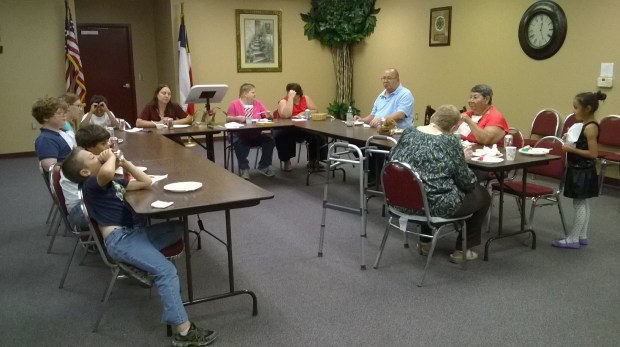
Life Point Baptist Church gathered around a fellowship meal in 2014

Christianity has become such a mainstream facet of American culture that often we pursue the activities of the faith under the assumption that everyone knows the basics. As a result, we rarely discuss the basics because we don’t want to insult anyone’s intelligence. As a result, many move forward on the false assumption that we all understand the basics.

One need not be offended by discussing the basics, or by having the basics taught to them. Legendary Green Bay Packers coach Vince Lombardi often began his first practice of the year by holding out a ball and saying, “Gentlemen, this is a football.” Lombardi then went on to discuss what all you could do with a football, as well as the objective of the game of football. Lombardi explained that the objective of football was to get possession of the ball, maintain possession of the ball, and advance the ball across the goal line for a touchdown. Then, the process repeated. The secondary objective, which was accomplished if you met the first, was to keep the other team from advancing the football across the goal line.

Advancing the football could be accomplished by running the ball, or passing the ball. He demonstrated how to carry the ball, and how to throw the ball, etc. This is riveting stuff for a football novice. However, Lombardi was talking to players who were professionals. These guys had been playing their entire lives. Still, he understood the value of fundamentals. And he was successful.

In that vein, we’d like to return to the fundamentals. And we begin by asking, “What is a church?”

The word, “church,” in the New Testament was translated from a Greek word, ekklesia, which means an assembly. This is important. As our Lord founded the Christian faith, He used words that were already widely in use in that culture. Our Lord did not sit down with the disciples and invent a new vocabulary and systems of practices for this new religion we call Christianity. No, He merely taught that we were to repent of our sins and trust His death on the cross for our salvation. He did so using common words of that day.

So, when the Lord said, “Upon this Rock I will build My church,” He didn’t invent a new word. That’s why none of the disciples said, “What is a church?” They already knew. Our English translations of the Bible say, “Upon this Rock I will build My church.” What the disciples heard was, “Upon this Rock I will build My assembly (ekklesia).”

The word “assembly,” i.e. “ekklesia,” was widely used, and practiced in the Roman Empire. Ekklesias were called out assemblies in local cities used to conduct business, take a vote, or discuss a pressing matter. There was a legal structure and framework for these.

You see this concept in action in Acts 19. The entire city was gathered to discuss the controversial teachings of Paul, who proclaimed that there were no other gods besides God, and that the way to God was through repentance and faith in Jesus Christ. As a result, the local industry (sales of idols to the goddess Diana) suffered as more turned away from idolatry and toward Christianity. The town clerk realized that the assembly did not meet the legal requirements to hold such a meeting under Roman law, and as such, “he dismissed the assembly (ekklesia).”

When Christ said, “Upon this Rock I will build My church,” He said, “upon this Rock, I will build My assembly.” This verse, supported by other verses throughout the New Testament, shows that the will of Christ for His followers is that we are to assemble, conduct His business, and encourage each other.

Therefore, given the meaning of the word, and the will that Christ expressed, and the teachings expressed throughout the New Testament, a church is an organized assembly of saved, scripturally baptized believers who have come together to carry out the Lord’s will. This assembly is a literal assembly, a local assembly.

Which means that, in order to be a part of the church, you must assemble with the church. And the Lord’s will is that you be a part of the church.

At Life Point Baptist Church, we’d love to have you be a part of our church, a part of our assembly. However, if you do not feel led to join with us, we will encourage you to join a church where God is leading you, and that you follow His will there.

May God bless you richly as you follow His teachings.

The Concept of Prayer Service

48423434_608600369559694_43192085209153536_o (1)Scripture says that “The effectual fervent prayers of a righteous man availeth much.” At Life Point Baptist Church, we not only believe that prayer changes lives, heals the sick, and transforms us as believers, we have seen it happen. Over the past five years, we have seen two cancer patients turn up cancer free after intense prayer was lifted up on their behalf. These are healings that can only be explained by God’s miraculous response. This is not that televangelist “lay hands on the sick” and heal, “only if they have healing faith” approach. There is no show here. There are no theatrics. Just simple, sincere prayer, and quietly trusting God to answer.

Over the past few years, we have seen a man who was in his final days recover and return home. We have seen patients with failing kidneys see their kidney function restored. In each of these cases, the patients sought medical care as we prayed. We trust doctors, too. In each case, healing occurred for which the doctor had little explanation.

Healing does not occur in all cases. Sometimes God, in His divine will, simply tells us, “My grace is sufficient for you.”

We have seen God provide for financial needs. And most importantly, we have seen God move in the lives of our loved ones. We have seen lives changed, souls saved, faith made complete.

For these reasons, and because scripture commands us, we pray.

Wednesday nights, Life Point meets at 6 p.m. for Prayer Service. We begin with a hymn, a congregational prayer, a message from the Bible, then we lift up our prayer requests, and then we all pray, simultaneously, individually, before reuniting in prayer to close out the service. The entire service lasts less than an hour.

So if you have a need in your life, one for which you want God to intervene on your behalf, pray. And, if you be so inclined, some join us, that we may pray with you. Then, we will all trust God together for the answer.

May God bless you. See you Wednesday.

Looking ahead into 2019

The fall and winter of 2018 has been one of radical transformation for Life Point Baptist Church. We completed our new worship facility at 599 Sunrise Drive in Early, and we’ve moved in. Currently, we’re developing new ministries, including a special prayer service every Wednesday night at 6 p.m., and we are developing an exciting new youth program as well.

We are also committing ourselves to further developing our online presence as well. We now have a domain for this blog, www.pointtolife.net, and we will be stepping up our social media presence as well. Currently, the bulk of our activity is at www.Facebook.com/pointtolife.

Follow us on Facebook, and follow this blog, and we will continually update you with Bible teaching, encouragement, and church news. May God bless you.

Inside the Throne Room of Christ (Revelation 4-5)

If one is rushing through the book of Revelation to get to the “good stuff,” one might miss the amazing thing that happens in Revelation 4. The Apostle John, imprisoned on the Isle of Patmos for spreading the word of God, has been invited into Heaven. Not only has he been invited into Heaven, but He has been invited into the nerve-center of Heaven, the throne room of Christ.

As John is conveying to us everything he saw as he entered into the throne room of Christ, it can be easy for us to get lost in all the precious stones, gems, and spectacular sights of that place. For example, how does one interpret verse 3, which says, “And he that sat was to look upon like a jasper and a sardine stone: and there was a rainbow round about the throne, in sight like unto an emerald?”

What’s interesting is that the things John sees are not only brilliant and spectacular, but are symbolic as well. As John looks upon the One sitting upon the throne, he sees a being that looks like jasper and sardine stone. While this speaks to the glory of Christ, there is also a deeper meaning. Jasper and sardine stone are both red. Isaiah 1:18 tells us that the color of sin is red. The color of the blood of Christ is red. When you look through a red lense, that is, these precious stones and the blood of Christ, the redness of sin is cancelled out.

Thus, as the Bible says in Isaiah 1:18, “though your sins be as scarlet, they shall be as white as snow; though they be red like crimson, they shall be as wool.”

Surrounding the throne is a rainbow, which you might remember is the symbol of the covenant God made with Noah to never destroy the world with a flood again. Right there in front of Christ is a reminder of His grace and mercy.

In the secular world, in the business world, we tend to decorate our offices (our throne rooms, if you will,) with the things that we are most proud of… the things which are the most important to us.

When you look into the throne room of Christ, you see symbol after symbol of our redemption and salvation. What does that tell you about the Lord’s passion for you?

Life is More (Revelation 3)

As we continue our study in Revelation on The Point, it is important to remember that the book is really a letter being addressed to seven individual churches in Asia minor. The Lord Jesus Christ appeared to the Apostle John on the Isle of Patmos, where John was incarcerated for his ministry in Ephesus, to give him the word to deliver to those seven churches.

The Lord’s purpose in appearing to John and giving us the Book of Revelation was three-fold. (1) He appeared to remind us that He is returning. (2) He appeared to give us hope by reminding us of His return. (3) He appeared to warn us to correct the sin in our lives in preparation for His return.

It’s important to keep this context in mind, as many theologians make the mistake of treating Revelation like some artifact found by Indiana Jones. Instead of considering it as direct communication between Jesus and seven individual churches, they look for mysterious codes hidden within the text that will unlock some deep truth that will give them a special insight into the future of the human race. This is how cults get started.

With the understanding that Revelation is merely a letter dictated by the Lord (or His messengers) to seven individual churches, we can reject the notion that the letters to the seven churches in chapters 2 and 3 somehow symbolize seven ages, or seven different classifications of churches. Instead, we can simply look at what the Lord has to say to those seven churches, and learn from it.

So, in Chapter 3, we see three letters written. One was written to Sardis, one to Philadelphia, and one to Laodicea.

Sardis had all the appearances of a church that thrived. They were reaching many. The church was growing. In modern times, their programs would have been working. Jesus told Sardis that they had a reputation that they lived, but were dead (Rev. 3:1). He added that their works were not perfect before Him (Rev. 3:2), which could mean that they did things with impure hearts, or that they had wandered from truth. Either way, they were warned to “strengthen the things which remain (Rev. 3:2)” and “Hold fast and repent (Rev. 3:3)” so that they would be prepared for the Lord’s return.

This teaches us that life is more than our reputations. It doesn’t matter what people think of us as much as it matters what God thinks of us. Therefore, we are to do all things according to His truth, and obey His calling on our lives, regardless of what others think.

Philadelphia was a good, faithful church. Notice that the Lord offers no correction to Philadelphia, as none is needed. Instead, He praises their faithfulness and promises that their suffering will not be in vain. He then encourages them to stay the course.

This teaches us that life is more than the pain we feel right now, and that the Lord sees our suffering, and will reward our faithfulness. Continue in your faith. You will not be disappointed.

The final church mentioned in Revelation 3 is the church at Laodicea. Many preachers have preached that the church of Laodicea is symbolic of the modern church age, where we have become so prosperous and lazy that we are no longer making an impact for the Lord. While some may point to the modern, American contemporary church as the fulfillment of this text, the Christian in Southeast Asia who is being tortured for his faith is nowhere close to being an example of a Laodicean Christian.

Those who say that the modern church is a fulfillment of the Laodicean church age have an American-centric view of Christianity, and have disregarded the plight of the majority of Christians around the world, who have been sentenced to poverty, imprisonment, slavery, and torture as a result of their faith.

That being said, the words Christ spoke to the Laodiceans should be observed by the American church, and any church that has grown lackadaisical. The Lord wants to be an active part of our lives, and He wants us to stand for something.

This teaches us that life is more than our material wealth. Life is about what we do for Christ. What are you doing for Christ?

The overall lesson from Revelation 3 is that we need to prepare for the return of the Lord by recommitting ourselves to Christ and to let our faith in Him propel us through our day to day lives. As we move forward into the book of Revelation, “things get real.” Are you prepared to meet Christ?