
Adam and Eve

Pinocchio’s Downfall and Redemption

The Christian faith is the fabric with which Western literature is woven. Great writers like Andrew Klavan and philosophers like Jordan B. Peterson clearly see it.

The classic, Pinocchio, is no different. The classic 1940 Disney animated movie, based on a classic novel, centered on Pinocchio, a wooden puppet who was given life at the request of his creator, Geppetto.

Geppetto loved Pinocchio, and Pinocchio loved Geppetto. At the very outset, you see a parallel with scripture, where God created Adam and gave him life. God loved Adam and Adam loved God.

Had Pinocchio been content to be loved by Geppetto, and to find his value there, Pinocchio’s story would have been one of endless bliss. Alas, Pinocchio wasn’t satisfied with Geppetto’s love.

Pinocchio had an intense desire to become a real boy. This desire, coupled with his desire to be like all the other boys, would lead Pinocchio down a path of misadventures which would separate him from Geppetto and create unnecessary suffering.

The first misadventure happened when Pinocchio was lured away from his walk to school by a character named Honest John, who persuaded Pinocchio to join his puppet show. Pinocchio’s decision to follow John’s temptation landed him in the show, but also a bird cage, and set up a chain of events that would see Pinocchio on a ship to Pleasure Island.

On Pleasure Island, Pinocchio befriends Lampwick and begins to indulge in bad behavior on the false promise that there would be no consequences for such behavior. When Jiminy Cricket tries to intervene, Pinocchio spurns him, prompting Jiminy Cricket to leave.

However, once Cricket discovers the horrible truth of what is going on at Pleasure Island, he returns to deliver Pinocchio right as the curse was beginning to turn him into a donkey.

At this point, Pinocchio realizes he had it good all along and sets out to reunite with Geppetto, a journey that takes him back home, and even into the belly of a whale. (Shadows of Jonah in that scene.)

What we learn from Pinocchio is that our downfall is often caused by unthankfulness, our desire to find meaning and pleasure apart from our creator, and our misplaced pride in ourselves.

Pinocchio loved Geppetto, but wanted more. Likewise, Adam and Eve loved God, but didn’t want to live under His authority. Their decision to seek their own divine nature by eating the forbidden fruit saw them expelled from the garden, and rendered as mere mortals who would have to face death.

We also say we love God, but all too often we seek pleasure and fulfillment everywhere but God, and often, we wish to cast His authority off from our lives. Our consequence is destruction in this life, and absent from repentance and faith, eternal condemnation before God.

As Pinocchio faced excruciating consequences as a result of seemingly harmless choices, we often find ourselves in bad situations caused by seemingly insignificant choices that took us further from God’s presence. Thus, scripture compares us to sheep, saying that “all we like sheep have gone astray, we have turned every one to his on way, and the Lord hath laid on Him the iniquity of us all. (Isaiah 53:6)

And finally, as Pinocchio found healing and reunification by turning his heart back to Geppetto, we find healing and reconciliation with God by turning from our sinful ways and trusting Him for salvation.

The Christian faith really shapes Western Literature, and why shouldn’t it? Both Christianity and literature contain the stories of who we are.

So, when you find yourself dissatisfied with life and wanting more, be careful. Seek healing and fulfillment with God, and not from the pleasures of this world. Otherwise, you may turn into a donkey and find yourself in the belly of a whale.

But seriously, we forfeit so much peace and endure so much unnecessary suffering simply because we don’t trust God enough. Have faith. Turn to the Lord. And find fulfillment in Him.
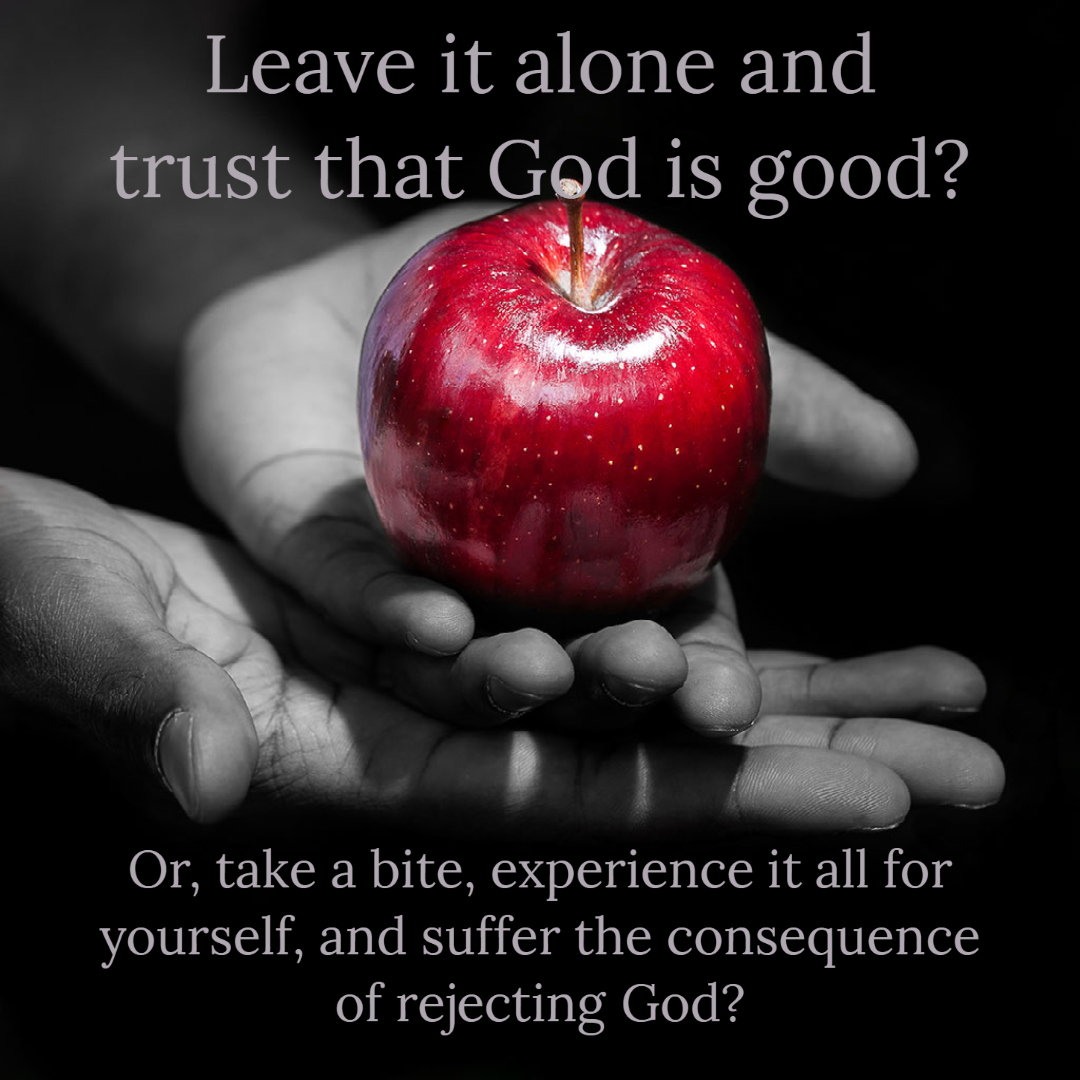
Why the fruit was a big deal, and why the tree was even in the garden

As creation and Christianity are debated between believers and skeptics, two questions often arise. The first is why God put the tree of knowledge of good and evil in the garden, and the second is why eating of that tree carried the death penalty.

In the below-posted video, Pastor Leland Acker makes the point that to fully give Adam and Eve life, they had to have the choice, the free-will to decide whether to follow God or reject Him.

When God formed man from the dust of the ground, and man became a living soul, man was gifted with the highest form of life. Far beyond existing, man was given self-awareness, consciousness, the ability to reason, to create, to problem-solve, to dream, and to cultivate. God, having created man in His image, bestowed upon man many of His own divine attributes.

Creating man to be a living soul, God wanted him to have the fulness of life. In order for man to be able to reason, create, solve and dream, man would also have to be given the choice of whether to trust and obey the Lord. God so wanted us to have the fulness of life, God gave us the choice.

So, to create the opportunity for that choice, God placed the tree of knowledge of good and evil in the midst of the garden of Eden. While one may wonder why knowledge would be a bad thing, keep in mind that this knowledge is an experiential knowledge. By eating the fruit, man would not be suddenly indwelt with endless information, rather he would come to learn good and evil by experiencing both. This knowledge would be gained apart from God, without His help and leadership.

Pursuing knowledge in this way would amount to a complete rejection of God.

So, man had a choice. Trust that God is good and live forever in His presence, or doubt God’s goodness, overthrow His presence in man’s life, and strike out on his own. The former carried with it the promise of eternal blessing. The latter carried a risk of death and eternal judgment.

The serpent (a.k.a. Satan) tempted Adam and Eve with just that. In his speech to Eve in Genesis 3, Satan said, “You will not die. For God knows that in the day that you eat thereof, you will be as gods, knowing good and evil.”

Genesis 3:6 records the logic Adam and Eve used when deciding to eat the fruit. It says, “And when the woman saw that the tree was good for food, and that it was pleasant to the eyes, and a tree to be desired to make one wise, she took of the fruit thereof, and did eat, and gave also unto her husband with her; and he did eat.”

The logic was, “It’s good to eat, it looks good, and it will make us wise (as gods.)” They ate so they could experience the pleasures of everything, take power over their own lives, and eject God from the life that He gave them.

This was not a simple mistake or a poor food choice. It was an all-out rebellion against God. They cut themselves off from God, Who gave them life.

And when you cut yourself off from the source of life, you die.

This would be a good time to pause and reflect. God said, “In the day that you eat of this fruit, you will surely die.”

Satan said, “In the day that you eat this fruit, you will be as gods.”

The question arises, “Where are Adam and Eve today?” Based on the answer to that question, who was telling the truth, God? Or Satan?

If you’ve ever attended a funeral, you know the answer to that question. There is good news, however. In the same chapter, God offered a way of redemption. By promising that the seed of the woman would crush the head of the serpent, while suffering a death-blow Himself, God promised a savior, a redeemer, who would come and save His people from the death that comes as a result of sin.

That Savior was Jesus Christ, who both defeated Satan and suffered death upon the cross, and obtained final victory through the resurrection. Belief in this brings salvation and eternal life, and wins God’s favor.

The result of that salvation is being welcomed into His eternal Kingdom, where God will have restored life to what He intended on it being in the Garden.

So, with all that in mind, trust that God is good. Trust in Him, and place your faith in the death Jesus died on the cross for your forgiveness of sin. Then leave that sinful lifestyle behind and follow Him.

False Promises of Freedom

Do you realize that, in the Garden of Eden, Adam and Eve lived under one restriction, and one restriction only?

“And the Lord God commanded the man, saying, Of every tree of the garden thou mayest freely eat: But of the tree of the knowledge of good and evil, thou shalt not eat of it: for in the day that thou eatest thereof thou shalt surely die.” – Genesis 2:16-17

Adam and Eve were told they could freely eat of every fruit of every tree in the garden, except the fruit of the tree of knowledge of good and evil. They were forbidden from eating of that tree, because doing so would cause death. Other than that, everything went.

In the history of man, I cannot think of another time when man was more free, let alone as free as Adam and Eve in the Garden.

Yet, in Genesis 3, Satan (in the form of the serpent) somehow convinced Adam and Eve that they were not free. He reasoned that they could never be free as long as they were under God’s authority, and God was intent on continuing His “oppression.”

That’s the message within Satan’s statement to Eve, “For God doth know that in the day ye eat thereof, then your eyes shall be opened, and ye shall be as gods, knowing good and evil.” – Genesis 3:5.

Adam and Eve were led to believe that by eating the forbidden fruit, they would be freed from God’s authority, free to do whatever they felt. They thought they were about to realize a level of freedom never before seen. They were wrong.

Their eating of the fruit brought sin into the world, and the knowledge of sin. So, instead of being freed from God, Adam and Eve were made slaves to sin, its consequences, and its relentless presence in every aspect of life. Consequently, the entire human race has been subjected to such.

In modern times, the Satanic Temple (which denies the existence of Satan, all the while advancing his message), proclaims that its doctrine would liberate people from the bonds of religion and unjust laws. In reality, they are making the same false promise as Satan made to Adam and Eve. Satan promised a freedom from God, a freedom to do with their bodies as they wished. The Satanic Temple lists that concept as one of its tenets. Yet we know that one cannot live in total freedom without impacting the freedom of others.

Recently, the Satanic Temple protested in favor of abortion, saying that pro-life legislation enslaves women to the oppression of motherhood. While motherhood is definitely a rigorous lifestyle (one of which many women have told me is completely worth it), the fact is that a pregnant woman cannot live free of motherhood without denying another person the most basic right to life. And while the Satanic Temple claims to support scientific reason, the fact is genetically, that “fetus” is a human being.

If a woman decides to defy God’s design for marriage, and live a sexually immoral life, then she can do so without the effect of pregnancy, and thus, motherhood, simply by employing birth control. Even if she is successful at this, she still faces the consequences of STD’s, the emotional damage brought on by promiscuity, and the degradation that often follows. (For what it’s worth, men who live sexually immoral lives face the same consequence).

What is promised as freedom from God’s law, the restraints of religion, or the morays of morality, actually presents a bondage all its own. My point? The promise of total freedom is a false promise that Satan has made since the creation of man. It never materializes, and never will.

Whether it was the prohibition of eating the fruit from the tree of knowledge of good and evil in Genesis, the 10 Commandments in Exodus, or the commandment to love each other in John 15, God’s commandments are given to protect us from destruction, and to help us enjoy the most of what life has to offer.

The prohibition against eating of the tree in the garden was to allow Adam and Eve maximum freedom without the fear or confusion over sin. The 10 Commandments guarded us against the self-destructive lifestyles of covetousness, deceit, theft, adultery, stupidity, and idolatry. The commandment to love each other moves God’s law from a list of do’s and don’ts to a check of your motivation. It all frees us. The question is, will you enjoy the freedom God makes freely available in Christ? Or will you choose the slavery that comes with sin?

Choose wisely, for your choice will last you for eternity.