Having begun His earthly ministry, and having performed several miracles along the way, Jesus called Levi to follow Him.
Levi was a publican, a Jewish man who had taken on the role of tax collector for the Roman government. For most Jews in Israel at the time, there was no lower life form. To the Pharisees, if a man became a publican, he had sold out his portion of Israel’s inheritance and his stake in the Kingdom of God. To the Pharisees, publicans could never be saved and would never go to Heaven.
Being cast out of Jewish society, many publicans took to self-indulgence and sinful lifestyles, which is why you often see sinners and publicans mentioned in the same sentences in the New Testament.
So, here you have Levi. Named after the son of Jacob who became the father of the Levitical tribe. Levi’s tribal namesake was responsible for the upkeep of the Tabernacle in the Old Testament, and for the upkeep of the Temple in Jesus’ day. The Levites were given six cities in which to live, cities that became “cities of refuge” for those trying to escape retribution from accusations over fatal accidents.
But, even with all this heritage, Levi sits at the receipt of custom, alienated from his countrymen, and a friend to sinners and other publicans.
And it was in that state that Jesus called Him to be a disciple, and Levi happily followed. He would later be renamed “Matthew,” which is a variation of the Greek word for “disciple.”
Having been called to be a disciple of Jesus, Levi holds a dinner for his sinner and publican friends. And in this passage, we see the mission of Christ on full display.
Levi’s plight reminds us of who we are, sinners who are irredeemable without the grace and mercy of God. We see what God did, in sending Jesus Christ to redeem us from sin. And, we see the proper response to the Gospel, which is repentance and faith.
You’ve probably heard the saying, “To err is human, to forgive is divine.”
That saying is not exactly scripture, but the truth is that man sins, and God forgives.
So, when it comes to the story of Jesus meeting the Samaritan woman at the well, you see the Lord’s divine nature as He confronts her sin, then discusses worship while calling her and her entire community to faith. In that series of events, we see the Lord’s commitment to salvation, His divine knowledge, and His declaration that He is the Christ.
The interesting thing about this account in scripture is Jesus “must needs go through Samaria (John 4:4).” The fact that the Lord not only went through Samaria, but that He had an intense purpose for going through Samaria bucked every convention of that day.
When traveling between Judea and Galilee, most Jews crossed the Jordan river and traveled on the East Side of the river to avoid the Samaritans. There was a deep divide between the Samaritans and Jews that was as much ethnical as it was cultural. This division dated back to the days of Ezra and Nehemiah, as the Israelites were returning to the Holy Land following the Babylonian captivity.
But, Jesus “must needs go through Samaria.” He needed to go. He was compelled to go.
When He meets the woman at the well, we find out why. He was there because there were lost souls in Samaria, completely written off by the Jewish society at the time, who were seeking salvation.
In His desire to go to Samaria, we see the Lord’s commitment to salvation.
Then, we see His divine knowledge. He knew the woman would be there. He knew everything about her. Further, He knew that this visit would lead to the salvation of many souls in Samaria.
Then, the Lord declared plainly to the woman that He was the Christ. When the woman said, “I know that when Messiah comes He will tell us all things,” Jesus replied, “I that speak to thee am He.”
While most sermons focus on the lost condition of the woman and her journey to faith, in this episode of Ancient Scrolling, we examine how this divinely appointed meeting demonstrates the deity of Christ.
The Pharisees were raised to believe that when the Christ came, He would go to the righteous, bless them, condemn the wicked, and defeat Israel’s enemies. At the time Christ came, the main enemy was the Roman Empire.
So, the Pharisees were looking for a messiah who would be a great military commander, a conquering hero, and one who observed the religion the same way they did.
However, Jesus defied those expectations. He didn’t come as a conquering hero, but yet a humble servant, a compassionate man committed to redeeming the lost people of Israel, and one who spoke God’s truth, which often ran contrary to the Pharisees’ traditions.
Jesus was the Only Begotten Son, the divine God in flesh, Who came to fulfill God’s promises of redemption. However, He didn’t fit the mold that the Pharisees wanted Him to fill, so they rejected Him.
But, there was still Nicodemus. Nicodemus saw the miracles and signs Jesus performed, but struggled to reconcile Jesus as being Christ with the preconceived notions of Who Christ would be. Unlike HIs fellow Pharisees, however, Nicodemus had the wisdom to inquire and learn.
So, he met with Jesus by night. And the Lord told him about the new birth, about salvation, and about the crucifixion and resurrection. In this episode of Ancient Scrolling, we look at that epic meeting between Jesus and Nicodemus, and we learn the Lord’s truth from it.
The Apostle John is setting out to demonstrate that Jesus of Nazareth was the only Begotten Son of God, and thus was the Christ, the Savior of mankind. In order to do that, he had to prove the divine nature of Christ, that He was God in flesh.
John wrote his account of the Gospel under the inspiration of the Holy Spirit in order to accomplish that goal. He opened his Gospel by demonstrating that Jesus was with God in the beginning, was God, and created all things. He referenced the ministry and testimony of John the Baptist to prove that point.
And then, in chapter 2, John records the miracle of Jesus turning water into wine. This was something that could only be accomplished by one who was in control of the elements, Who could only be the creator of the elements in the first place.
While the miracle of the water into wine was not a public miracle, it did demonstrate the divine power of Christ. And those who were privy to the miracle not only witnessed the power of God firsthand, but also became believers.
Jesus would go on to turn the tables over in the Temple in Jerusalem, and perform many mighty miracles there. Those miracles captured the attention of one Nicodemus, who would meet with Jesus at night, setting the stage for the most consequential theological discussion in human history. Check out this episode of “Ancient Scrolling” to learn more.
Thirty years after the death, burial and resurrection of Jesus Christ, many different theories and teachings on the nature and identity of Jesus surfaced. Most of these were wrong, and some were blasphemous.
For the Apostle John, these false doctrines being promoted about Jesus were personal. John knew the Lord personally, witnessed the miracles and earthly ministry of Jesus, and was at the foot of the cross while our Lord gave His life to pay the debt for our sin.
John was “the disciple whom Jesus loved.” So, it should come as no surprise that John took on the task of setting the record straight about Who Jesus of Nazareth was, that He was indeed the Christ, the only Begotten Son of God Who would take away the sin of the world.
In John 1, the Apostle John is laying out the case that Jesus of Nazareth was the divine Son of God Who created all things, was all powerful, Who was the Light of the world. In Him was life, and the life was the Light of men.
He tells us that He became flesh and dwelt among us, and we beheld His glory, the glory as of the only Begotten of the Father.
As he continues to make his case in John 1 that Jesus was the Christ, he incorporates the ministry of John the Baptist to prove the divinity and identity of Christ.
Not only did John the Baptist plainly declare that Jesus was the Christ, he proclaimed that Jesus had come to take away the sins of the world.
The Baptist’s statement, “Behold the Lamb of God which taketh away the sin of the world,” may not have a profound meaning to us without some theological training, for the people of John’s day, it was a bold statement.
“The Lamb of God” was a reference to the Old Testament practice of sacrificing lambs as a show of the forgiveness of sin that God offers. In pointing to Jesus as the Lamb of God, John proclaimed that the Lord would sacrifice Himself to take sin from the world once and for all. This, of course, was a prophecy about the coming crucifixion of Christ.
In this episode, we examine the ministry of John the Baptist, and how his ministry support’s the Apostle John’s position that Jesus of Nazareth was the divine Son of God, who would redeem His people by paying for the sins of the world with His very life.
The second season of “Ancient Scrolling” is kicking off with an in-depth exploration of the Gospel according to John.
In AD 65, some three decades after the death, burial, and resurrection of Jesus Christ, many in the Christian faith began to drift theologically. Several theories and doctrines about the identity of Christ surfaced, with many being wrong and others being outright blasphemous.
The Apostle John took this theological drift personally, as he not only knew Jesus personally, but was “The Disciple Whom Jesus Loved.”
So, John endeavored to set the record straight. His efforts, inspired by the Holy Spirit, and thus being scripture and the word of God, are what we now know as “The Gospel according to John,” and “1st, 2nd, and 3rd John.”
In Episode 1, John sets out to establish the identity of Christ, and to demonstrate that Jesus of Nazareth was the Christ.
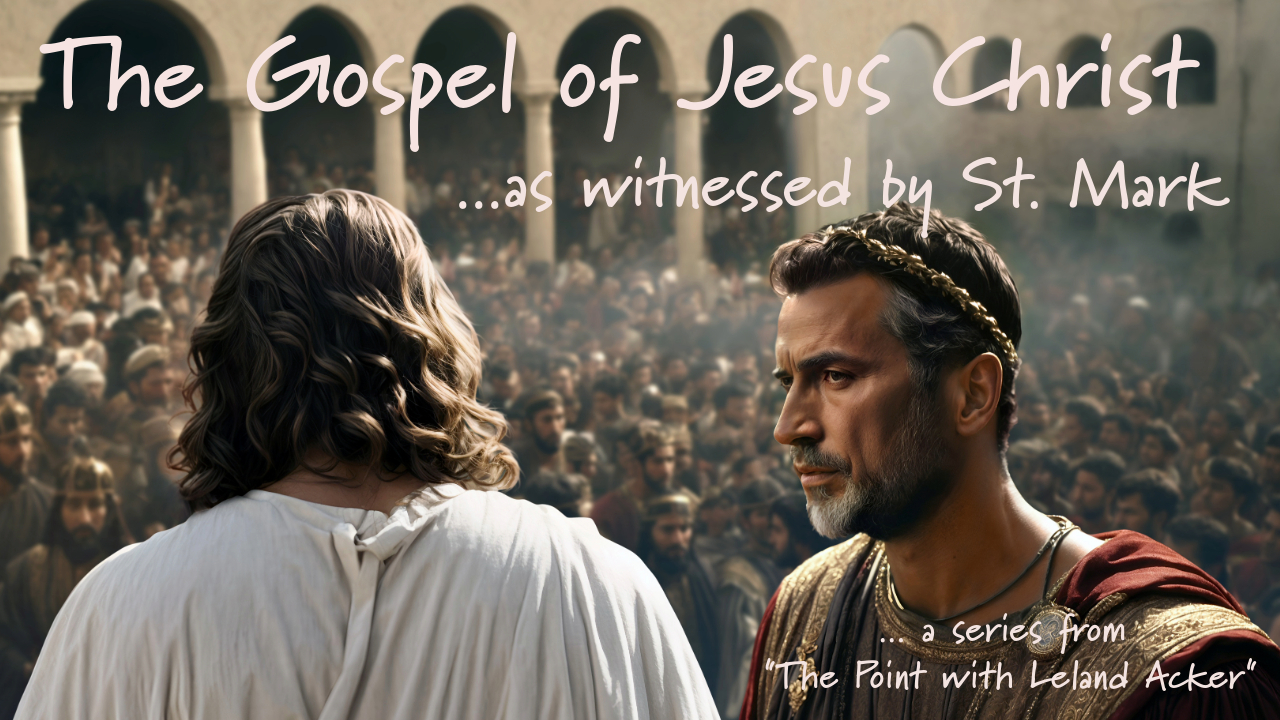
Mark wrote his account of the Gospel to demonstrate to us Who Christ is, not only by recording His actions, but also by giving us a written account of His death, burial and resurrection of Jesus Christ. The ultimate goal of Mark’s writings, and the writings of any New Testament author, is to build our faith.
By recording His actions, Mark paints a vivid picture of Who Jesus of Nazareth was, makes the case that He is the Christ, the Messiah, moreover the Savior of all mankind.
He opened His Gospel by showing how Jesus was the fulfillment of the Old Testament prophecies concerning the messenger that would go before the Lord. While this prophesied messenger was indeed John the Baptist, Mark pointed out how John the Baptist clearly identified Jesus as being the Christ.
As he continues his opening statement, Mark demonstrates the authority of Christ by showing His authority to call the disciples into apostleship, His authority to teach, and His authority over demons.
In Mark 1:16-20, Mark writes:
Now as he walked by the sea of Galilee, he saw Simon and Andrew his brother casting a net into the sea: for they were fishers. 17 And Jesus said unto them, Come ye after me, and I will make you to become fishers of men. 18 And straightway they forsook their nets, and followed him. 19 And when he had gone a little farther thence, he saw James the son of Zebedee, and John his brother, who also were in the ship mending their nets. 20 And straightway he called them: and they left their father Zebedee in the ship with the hired servants, and went after him.
Here, Mark records how Jesus called Simon (Peter) and Andrew, as well as James and John, to follow Him. When the Lord called them, He called them to follow Him, to learn from Him, and to help Him fulfill His mission. Likewise, when the Lord calls us, He calls us to salvation, to learn from Him, and to join His mission of spreading the Gospel.
Now, when He called them, He told them He would make them fishers of men. To them, fishing was a labor intense occupation where teams of men would drag nets throughout the sea to gather as many fish as they could. To be a fisher of men means to drag the net of the Gospel through the sea of humanity to bring as many to Christ as possible. This was a team effort.
Throughout the early years of Christianity, we see that it was always a team effort. The apostles always worked together in groups, whether they were sent out two-by-two by Christ into the villages of Galilee, or whether they were working together in the church of Jerusalem to preach the Gospel in the Temple court.
The Apostle Paul only traveled alone when he had to flee violence. However, during his missionary journeys, he always had people with him. Barnabas and Mark accompanied him on the first missionary journey. Other teammates to Paul included Luke, Silas, Timothy and Titus. Read any of Paul’s epistles, and you will see when he signs off that he lists the individuals who were with him who also sent their greetings to the church addressed in the letter.
Like the apostles, we are called to work as a team to spread, promote, propagate, publish and share the Gospel. We promote things all the time. We share funny posts on social media, we talk about our favorite TV shows and music, and we praise the restaurants that deliver amazing meals to our table. I’ll be sharing a link to this post as soon as I finish writing it.
Why don’t we share the Gospel more?
Social media is your story to the world. Through your posts and your comments, you tell the world Who you are and what you stand for. That story needs to center on the Gospel.
Like the Apostles were called to work together as a team in the ministry of Christ, we, too, are called to work as a team. There are no lone rangers in God’s work. We are to work as a team to spread the Gospel.
This is why much of the work in the Gospel is accomplished through the local church. We gather for worship, collect offerings to fund missionary endeavors, and we perform church outreach efforts. We fish together.
It is worth noting that when the Lord called us, He called us with the same authority with which He called His disciples on the shores of Galilee. This means that following the Lord’s call is not an optional feature to the Christian life. It is something the Lord calls us to, and something He expects from us.
Ephesians 2:8-9 say that it is by grace through faith that you are saved, and that not of yourselves, it is the gift of God. Not of works lest any man should boast. However, many Christians overlook verse 10, which says we are His workmanship, created in Christ Jesus unto good works, which God has before ordained that we should walk in them.
We were created to follow the Lord’s call, and to do His will, and to make an impact for the Kingdom.
Now, many Christians will object, citing work obligations, financial stress, and a busy family life. It is worth noting that the Apostles had things going on when the Lord called them as well. Simon and Andrew weren’t fishing as a hobby. Their abilities to feed their families depended on them having a successful catch.
James and John were not engaged in recreational crafting when they were mending their father’s nets. Those nets needed to be repaired in order to have another successful catch.
When Jesus called, they quickly left behind their livelihoods to follow. That requires faith.
The Lord has not necessarily called you to quit your job at 3M, the school, the state, or the phone company. However, using it as an excuse to fail to follow the Lord’s calling on your life will not work. By the authority in the Lord’s call, we have to prioritize the work of the Gospel.
Mark’s attention then turned to the Lord’s authority in how He taught.
Mark 1:21-22:
And they went into Capernaum; and straightway on the sabbath day he entered into the synagogue, and taught. 22 And they were astonished at his doctrine: for he taught them as one that had authority, and not as the scribes.
When Jesus taught in the synagogue, He did not spend time quoting other rabbis, discussing tradition, and sharing thoughts and ideas. He boldly proclaimed what the scriptures actually said. And what astonished those in attendance was the authority and certainty in which He delivered His teaching.
Well, of course He taught with authority. Not only were the scriptures about His redemption of His people, but it was through His Spirit that the scriptures were inspired and written in the first place.
There is a scene in the Chronicles of Narnia: The Lion, the Witch and the Wardrobe, where the white witch confronts Aslan the Lion about Edmunds betrayal, citing the deep magic’s requirement for such a one to be punished. Aslan responded by saying, “Do not cite the deep magic to me, I was there when it was written.”
In his Chronicles of Narnia series, C.S. Lewis attempted to explain the Christian faith in the form of a fantastical story involving talking animals and humans. In the Narnia universe, the deep magic was their scripture. Aslan the Lion was Lewis’ Christ-like figure, who submitted himself as a sacrifice for the betrayal of Edmund (and the sins of the creation). And in this scene, Aslan reminds everyone of His divinity and authority.
Likewise, when Christ taught in the synagogues, He was not merely another rabbi or scholar. He was the One Who inspired the scriptures, He was the subject of the scriptures, and His message, embedded in the scriptures, was redemption.
John 1 tells us that Christ was in the beginning with God, and that He was God, and that He created all things. Having created all things, then revealing Himself through scripture, we learn that Christ is the ultimate authority in the universe.
The scriptures were written by His authority and they say what He wanted said.
Therefore, when we study scripture, we are not merely reading a religious text or the works of a theological writer. We are reading the very words of God. We are in no place to reconsider, retranslate, reword, or question.
After demonstrating the Lord’s authority to call and His authority to teach, Mark showed us the Lord’s authority over demons.
Mark 1:23-26:
And there was in their synagogue a man with an unclean spirit; and he cried out, 24 Saying, Let us alone; what have we to do with thee, thou Jesus of Nazareth? art thou come to destroy us? I know thee who thou art, the Holy One of God. 25 And Jesus rebuked him, saying, Hold thy peace, and come out of him. 26 And when the unclean spirit had torn him, and cried with a loud voice, he came out of him.
Notice that, not only did the demon fear Jesus, but had to obey what Jesus told Him to do.
God and Satan are not two divine beings who are battling each other in a struggle of similar powers. God is God, has infinite power. Satan is a created being at the mercy of God’s power. Satan, therefore, has to obey and do what God orders. The same with demons.
So, when Jesus commanded the demon to come out of the man, he was forced to comply.
Demons have no power over the Lord. Further, Satan has no power with God either. He’s not a superboss at the end of a video game. He is a glorified demon. Nothing more.
Therefore, we can quit making Satan out to be a boogeyman, and we can quit fearing His antics. Go forward in faith, trust the Lord, and trust His call on your life.
Psalm 91:1 says, “He that dwelleth in the secret place of the most High shall abide under the shadow of the Almighty.”
We will find peace when we learn to live close to the Lord, under His authority, and depend on Him for our purpose, beliefs and protection.
Of all the men who walked and ministered alongside Jesus, Mark may have been the most overlooked. He was a disciple, yet he was not an apostle. He provided the upper room where Jesus instituted the Lord’s supper, was present at the arrest of Christ, and remained with the apostles after the crucifixion and resurrection of Christ.
Mark’s failures are recorded in scripture, and only twice do we see his successes in the faith. The book of Acts records how Mark accompanied Paul and Barnabas on the first missionary journey. However, Mark left the journey prematurely and returned home. His abandonment of the first missionary journey created a rift between he and Paul, and when Barnabas suggested that they take Mark on the second missionary journey, Paul vehemently objected. That conflict led to the breakup of Paul and Barnabas as a missionary team.
When Jesus was arrested, instead of trying to fight the temple guard as Peter did, Mark fled, not even taking the time to collect his garments.
Yet, despite all of this, Mark was a mighty man of God. He provided the upper room for the last supper. He remained with the apostles following the crucifixion and resurrection of Christ, taking part of a missionary journey with Paul, and ministering alongside Barnabas after that.
In his final days, the Apostle Paul wrote a letter to Timothy we now know as II Timothy. In it, he asked Timothy to come to Rome, and to bring Mark with him, because as Paul put it, he was profitable in ministry.
The Mark of II Timothy was a man who had grown from his failures in faith and his moments of weakness, and had become a mighty man of the Gospel.
We don’t know what prompted Mark to write his account of the Gospel, aside from the inspiration of the Holy Spirit. There doesn’t seem to be a specific occasion or audience. We do know that his work was an effort to record the crucial actions of Jesus leading up to the cross.
Matthew demonstrated how Christ fulfilled the Old Testament prophecies concerning Christ. Luke put together a comprehensive anthology of the actions and teachings of Christ. John recorded seven key miracles that demonstrated the divinity of Christ.
But Mark focused on an abridged collection of key actions and teachings from Jesus leading up to the Gospel.
Mark’s account of the Gospel is believed to have been the first written, and many scholars believe that Luke referenced his Gospel when writing his own. Mark’s Gospel demonstrates Who Jesus is so we can know Him, and knowing Him we can believe. The ultimate goal of Mark is to build our faith in the Lord.
Please understand, our efforts to provide historical and cultural context to books of the Bible should in no way lead the reader to think that these books are anything less than inspired scripture, thus being the actual word of God. It is through the historical and cultural context of these scriptures that we are able to hone in on what God was actually saying, and get the true message of the Bible.
So, as Mark opens his account of the Gospel, he provides us an introduction to Christ. He begins by showing the fulfillment of the scriptures, particularly pertaining to John the Baptist. John’s status of a prophet was almost universally accepted among the Jews and Judeo-Christian believing gentiles of the day. Mark showed through Old Testament prophecies that John’s ministry was to identify the Christ for us, and to prepare us to meet Him.
Mark then demonstrated that the ministry of John the Baptist was all about Jesus, preparing the people to meet Him and identifying Him as the Christ. He showed how John lived up to that prophetic purpose.
Mark then showed how God Himself witnessed to the identity of Christ at the Baptism of Jesus, saying “This is my Beloved Son, in Whom I am well pleased.”
Through these words, and through the rest of the writings in the Gospel of Mark, one must come to the conclusion that Jesus of Nazareth was indeed the Christ, the Savior, the divine Son of God Who gave His life for the sins of the world, so that man could be forgiven, saved from wrath, and redeemed into the Kingdom of God.
The Psalms are songs of praise to God, some written on certain occasions, and others written just to proclaim His glory. The context of Psalm 46 is debated. Some attribute it to King David after a battle was won. Some attribute it to the deliverance of Jerusalem from Assyria during the reign of King Hezekiah, in which the Assyrian army was miraculously wiped out by God. But, Psalm 46 is a Psalm of praise, praising God for His deliverance and the hope He gives.
In this world, we will face trouble. There’s the geo-political and economic troubles we see on the news. But then there’s our personal troubles. Jesus said in John 16:33, “These things I have spoken unto you, that in me ye might have peace. In the world ye shall have tribulation: but be of good cheer; I have overcome the world.”
In Psalm 46, we are remined that God is our refuge, that He is our hope, And we are invited to remember His marvelous works.
GOD IS OUR REFUGE AND STRENGTH.
Verse 1 – God is our refuge and strength, a very present help in trouble.
God is our refuge. He is where we can go to escape the trials and tribulations of life.We can look to Him for peace and comfort.We can lift up our concerns to Him in prayer, and know He hears and He does good for us (Romans 8:28).
God is our strength. He is the source of life.He is the force that gives us life and keeps us going.We press onward, not by our own strength, and not because we have to, but because He enables us, and powers us forward. Greater is He that is in us than he that is in the world.
He is our refuge and strength because He has redeemed us, given us new life through Christ, and an eternal hope in His Kingdom. Everything in this life is temporary, and soon we will be rescued from the trouble of this life.
Verses 2-3 Therefore will not we fear, though the earth be removed, and though the mountains be carried into the midst of the sea; 3 Though the waters thereof roar and be troubled, though the mountains shake with the swelling thereof. Selah.
Therefore, since God is our refuge and strength, we will not fear. We will not be overcome with anxiety. We will not entertain the thought that our ruin and demise has come.
Though the mountains be carried into the midst of the sea. Though the things that we felt were unmovable moved… Though the things we relied upon have failed. Though our security blankets have unraveled, we will not fear. We will not tremble before this world. And we will not lose hope.
Though the waters thereof roar and be troubled… Though things in this life rise up and intimidate us…Though our fears become reality…
Job said in Job 3:25, “For the thing which I greatly feared is come upon me, and that which I was afraid of is come unto me.”
Maybe your worst fear is coming upon you… Yet, you shouldn’t fear, because God is your refuge and strength.
In remembering God as our refuge and strength, we need to remember the hope He has given us.
THE HOPE GOD HAS GIVEN US.
Verse 4- There is a river, the streams whereof shall make glad the city of God, the holy place of the tabernacles of the most High.
The psalmist has stated that we will not fear, because God is our refuge and strength.He then lists some of the most cataclysmic things that could strike fear in our hearts (the mountains being carried into the sea…)
Then, He redirects us to the hope by painting a picture of the city of God… and He starts this picture with a river. There is just something peaceful about sitting next to a river. But for a city, a river is a source of life, provision of water, and possibly commerce. When the writer references the City of God, He isn’t talking about Jerusalem, because there is no river in Jerusalem. The writer is referencing the Heavenly City… New Jerusalem. And the river… the river of life. The writer is referencing our eternal home, God’s house with many rooms. The place Christ said He was going to prepare for us.
Heaven will be a place of eternal peace and rest. No anxiety, No trauma, no triggers, no painful memories haunting us. No problems, no turbulence, no tribulation.
Verse 5 – God is in the midst of her; she shall not be moved: God shall help her, and that right early.
The best part of Heaven will be the presence of God, and dwelling with our Lord Jesus Christ. Jesus said in John 14:3 – And if I go and prepare a place for you, I will come again, and receive you unto myself; that where I am, there ye may be also.
The most comforting words the disciples heard in Jesus’ comments in John 14… “That where I am, there ye may be also.”
If your faith and hope is in Christ, then the hope that you have in Heaven is seeing and living with Jesus. The Lord’s presence in Heaven will make it what we expect it to be.
Verses 6-7 The heathen raged, the kingdoms were moved: he uttered his voice, the earth melted. 7 The Lord of hosts is with us; the God of Jacob is our refuge. Selah.
The Lord will have ended sin and iniquity on earth. He will have set everything at peace. And He is with us, and will be our refuge.
BEHOLD THE WORKS OF THE LORD.
Verses 8-9 Come, behold the works of the Lord, what desolations he hath made in the earth. 9 He maketh wars to cease unto the end of the earth; he breaketh the bow, and cutteth the spear in sunder; he burneth the chariot in the fire.
Look at what God has done.
He’s ended wars and defeated the fiercest of enemies.He delivered Israel from Egypt, from the Amalekites, Philistines, Assyrians, Babylonians, Hittites and others. He has brought us through the worst life has thrown at us. He has raised up our nation, and given us His word.
God, who gave His Son to redeem us, will not withhold that which is good from us.
Romans 8:32 – He that spared not his own Son, but delivered him up for us all, how shall he not with him also freely give us all things?
Knowing what God did for us in the Gospel, what makes us think that He won’t carry us the rest of the way through?
Psalm 46:10-11 Be still, and know that I am God: I will be exalted among the heathen, I will be exalted in the earth. 11 The Lord of hosts is with us; the God of Jacob is our refuge. Selah.
Be still and know that He is God. Trust God. Trust His timing. Wait for His perfect timing. He will be exalted. He will be victorious. And, He is with us. (If God be for us, who can be against us?)
FINAL – There’s a lot of turbulence in the world today. Praise be to God that we can look to Him and find peace.
In Genesis 32, Jacob is following God’s direction to return to the Promised Land, however, there’s just one problem… Esau. The last time Jacob heard from Esau, Esau wanted to kill him. No doubt Esau still lived there, but the question was whether Esau was still angry. Despite God showing his favor upon Jacob in a very favorable way, Jacob still acts as if he is doomed once he sees Esau. That struggle in his faith sparked an epic wrestling match that continues to have implications today. Listen to our latest episode of The Gospel Expedition, on YouTube, or on Soundcloud.

 The Point...