Thirty years after the death, burial and resurrection of Jesus Christ, many different theories and teachings on the nature and identity of Jesus surfaced. Most of these were wrong, and some were blasphemous.
For the Apostle John, these false doctrines being promoted about Jesus were personal. John knew the Lord personally, witnessed the miracles and earthly ministry of Jesus, and was at the foot of the cross while our Lord gave His life to pay the debt for our sin.
John was “the disciple whom Jesus loved.” So, it should come as no surprise that John took on the task of setting the record straight about Who Jesus of Nazareth was, that He was indeed the Christ, the only Begotten Son of God Who would take away the sin of the world.
In John 1, the Apostle John is laying out the case that Jesus of Nazareth was the divine Son of God Who created all things, was all powerful, Who was the Light of the world. In Him was life, and the life was the Light of men.
He tells us that He became flesh and dwelt among us, and we beheld His glory, the glory as of the only Begotten of the Father.
As he continues to make his case in John 1 that Jesus was the Christ, he incorporates the ministry of John the Baptist to prove the divinity and identity of Christ.
Not only did John the Baptist plainly declare that Jesus was the Christ, he proclaimed that Jesus had come to take away the sins of the world.
The Baptist’s statement, “Behold the Lamb of God which taketh away the sin of the world,” may not have a profound meaning to us without some theological training, for the people of John’s day, it was a bold statement.
“The Lamb of God” was a reference to the Old Testament practice of sacrificing lambs as a show of the forgiveness of sin that God offers. In pointing to Jesus as the Lamb of God, John proclaimed that the Lord would sacrifice Himself to take sin from the world once and for all. This, of course, was a prophecy about the coming crucifixion of Christ.
In this episode, we examine the ministry of John the Baptist, and how his ministry support’s the Apostle John’s position that Jesus of Nazareth was the divine Son of God, who would redeem His people by paying for the sins of the world with His very life.
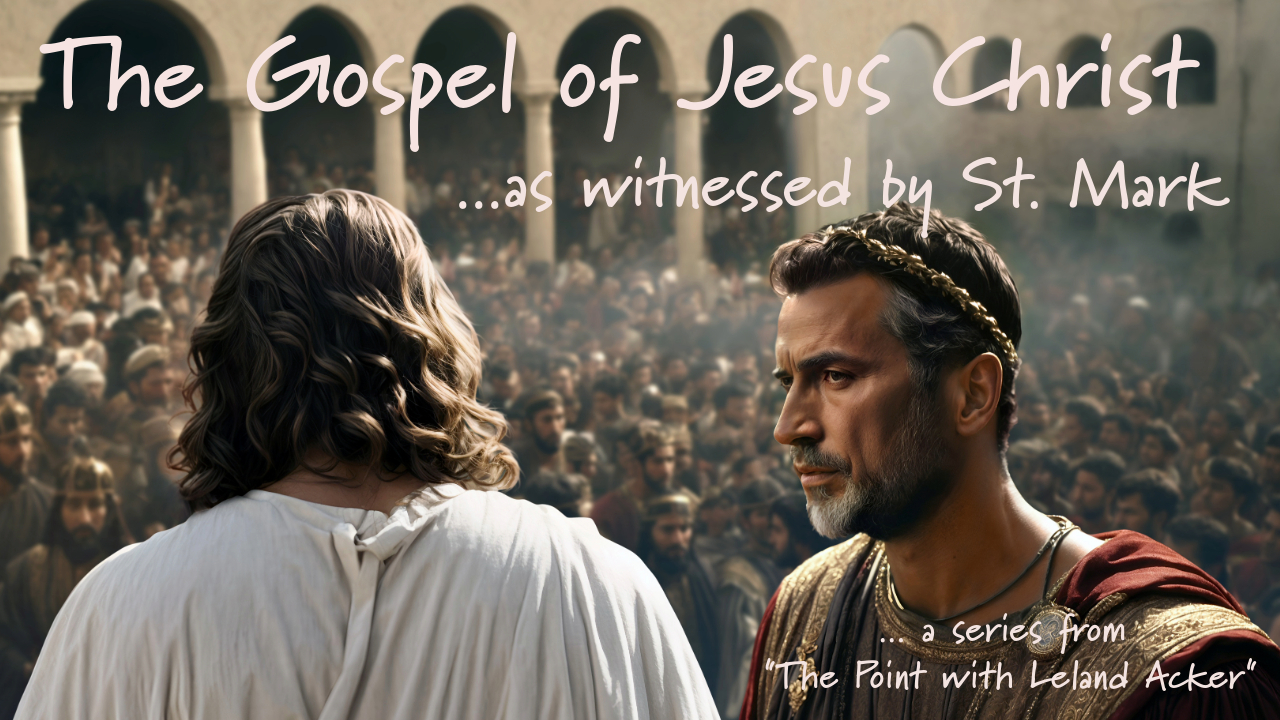
Of all the men who walked and ministered alongside Jesus, Mark may have been the most overlooked. He was a disciple, yet he was not an apostle. He provided the upper room where Jesus instituted the Lord’s supper, was present at the arrest of Christ, and remained with the apostles after the crucifixion and resurrection of Christ.
Mark’s failures are recorded in scripture, and only twice do we see his successes in the faith. The book of Acts records how Mark accompanied Paul and Barnabas on the first missionary journey. However, Mark left the journey prematurely and returned home. His abandonment of the first missionary journey created a rift between he and Paul, and when Barnabas suggested that they take Mark on the second missionary journey, Paul vehemently objected. That conflict led to the breakup of Paul and Barnabas as a missionary team.
When Jesus was arrested, instead of trying to fight the temple guard as Peter did, Mark fled, not even taking the time to collect his garments.
Yet, despite all of this, Mark was a mighty man of God. He provided the upper room for the last supper. He remained with the apostles following the crucifixion and resurrection of Christ, taking part of a missionary journey with Paul, and ministering alongside Barnabas after that.
In his final days, the Apostle Paul wrote a letter to Timothy we now know as II Timothy. In it, he asked Timothy to come to Rome, and to bring Mark with him, because as Paul put it, he was profitable in ministry.
The Mark of II Timothy was a man who had grown from his failures in faith and his moments of weakness, and had become a mighty man of the Gospel.
We don’t know what prompted Mark to write his account of the Gospel, aside from the inspiration of the Holy Spirit. There doesn’t seem to be a specific occasion or audience. We do know that his work was an effort to record the crucial actions of Jesus leading up to the cross.
Matthew demonstrated how Christ fulfilled the Old Testament prophecies concerning Christ. Luke put together a comprehensive anthology of the actions and teachings of Christ. John recorded seven key miracles that demonstrated the divinity of Christ.
But Mark focused on an abridged collection of key actions and teachings from Jesus leading up to the Gospel.
Mark’s account of the Gospel is believed to have been the first written, and many scholars believe that Luke referenced his Gospel when writing his own. Mark’s Gospel demonstrates Who Jesus is so we can know Him, and knowing Him we can believe. The ultimate goal of Mark is to build our faith in the Lord.
Please understand, our efforts to provide historical and cultural context to books of the Bible should in no way lead the reader to think that these books are anything less than inspired scripture, thus being the actual word of God. It is through the historical and cultural context of these scriptures that we are able to hone in on what God was actually saying, and get the true message of the Bible.
So, as Mark opens his account of the Gospel, he provides us an introduction to Christ. He begins by showing the fulfillment of the scriptures, particularly pertaining to John the Baptist. John’s status of a prophet was almost universally accepted among the Jews and Judeo-Christian believing gentiles of the day. Mark showed through Old Testament prophecies that John’s ministry was to identify the Christ for us, and to prepare us to meet Him.
Mark then demonstrated that the ministry of John the Baptist was all about Jesus, preparing the people to meet Him and identifying Him as the Christ. He showed how John lived up to that prophetic purpose.
Mark then showed how God Himself witnessed to the identity of Christ at the Baptism of Jesus, saying “This is my Beloved Son, in Whom I am well pleased.”
Through these words, and through the rest of the writings in the Gospel of Mark, one must come to the conclusion that Jesus of Nazareth was indeed the Christ, the Savior, the divine Son of God Who gave His life for the sins of the world, so that man could be forgiven, saved from wrath, and redeemed into the Kingdom of God.
Satan holds no power with God. He is not a divine opponent to our Heavenly Father, and he has no strength to truly battle with God. Satan was expelled from Heaven on God’s command, Satan is only allowed to operate within God’s permissive will, and Satan will ultimately be condemned to Hell for eternity by God’s divine order.
This is plainly seen in scripture as Satan had to obtain God’s permission before testing Job, as Satan had to obey the command of Christ to leave His presence in the wilderness, and as the demons cried out to Christ “Have you come to torment us before our time?”
Satan knows he has a limited time on this earth before his judgment is carried out and he is condemned to Hell for eternity. He knows he cannot win. So, his only recourse is to cause as much disruption as possible in an attempt to blunt God’s glory and to cause the Lord loss.
In God’s infinite power, Satan will find that to be an exercise in futility, because God takes all adversity and converts it to good, thus bringing Him glory.
In Matthew 13, Jesus gives the parables of the Wheat and Tares, the Leaven, and the Mustard Seed to foretell of Satan’s disruptive tactics among God’s people.
In the Parable of the Wheat and Tares, Jesus tells the story of a man who sowed good seed in his field. However, while men slept, his enemy came and sowed tares among the good seed. When it was discovered, the man recognized the tares as the work of his enemy.
Prioritizing the safety of the wheat (the good seed), the man instructs his servants to allow all of it to grow, and that the tares would be separated out at the harvest. In Matthew 13:36-43, Jesus gives the interpretation of this parable, which enhances the interpretation of the parable of the sower and provides a greater framework for interpreting the other Kingdom Parables (Leaven, Mustard Seed, Pearl of Great Price, and Treasure in a Field). Further framework in interpreting the parables can be found here.
In the Parable of the Wheat and Tares, we find that the man that sowed the good seed is the Son of Man. The good seed is the word, the Gospel. The field is the world.
As we learned in the Parable of the Sower, Christ sowed the Gospel to the entire world indiscriminately. He made the word available to everyone regardless of whether they would accept the word or not.
However, in the Parable of the Wheat and the Tares, we find that an enemy (identified in Matthew 13:39 as the devil, Satan), sowed a false gospel. He sowed a false word. As a result, true believers (wheat) and fake believers (tares) grow alongside one another in this world waiting for the day of the harvest, when the Lord will separate the believers from the non-believers, condemning the non-believers to Hell while gathering the believers into His Heaven.
The result is that the “righteous shall shine forth as the sun in the Kingdom of their Father.”
The reason Christ shared this parable was to prepare us for the inevitable conflict and disruptions that will come from having believers and non-believers living side-by-side. He prepared us for such disruptions so that we would not be discouraged or disillusioned by them.
The presence of Spiritual conflict is evidence that God is working. The presence of moral and Spiritual failures validates the predictions made by Christ in the parables, and thus lend even more credence to His words. Neither of these things, Spiritual conflict or Spiritual failures on the part of the people should discredit the Gospel. Quite the opposite.
In this parable, there are a few other lessons we should learn.
First, we ARE NOT to try to figure out who the non-believers and false believers are. This is a very clear point to this parable. The man in the story said that if the servants tried to dig up the tares, they may accidentally dig up the wheat also.
Our efforts to identify the “tares” among us will result in an atmosphere of constant scrutiny, and will create a culture of judgment. Often, we will misjudge a true believer to be a false believer, and destroy the faith or testimony of the true believer thinking they were false.
For the safety and sake of the true believers, Jesus taught us not to judge, not to scrutinize each other, and to allow Him to sort it all out on the day of judgment. This lesson from this parable holds true to the teachings of Christ in the Sermon on the Mount to “judge not lest ye be judged,” and the writings of Paul in Romans 14:4, “Who art thou that judgest another man’s servant? to his own master he standeth or falleth. Yea, he shall be holden up: for God is able to make him stand.”
Secondly, there is a dire warning to confirm whether you are a wheat or a tare. The wheat is gathered into barns. This is a picture of the saved being gathered and taken into God’s eternal Kingdom. The tares are gathered and burned in a picture of the eternal condemnation of Hell.
When I read the Lord’s interpretation of that part of the parable, it motivates me to check my faith and make sure my faith is in the true Gospel. It should be the same for you.
And thirdly, there is a message of hope. In that day, when the wheat and tares are separated, the “righteous shall shine forth as the sun in the Kingdom of their Father. (Matthew 13:43). The day is coming when the Lord will glorify us, and will give us the eternal blessing that He has promised.
We know for sure that we will inherit that promise, if we know Him as Savior.
The Greek language has a beautiful aspect to it… it puts the central thought of the message at the beginning of the sentence. So, when Jesus said in John 17:5, “And now, O Father, glorify thou me with thine own self with the glory which I had with thee before the world was,” the central thought was “And now…” meaning “This moment.”
Christ was asking God to glorify Him in that moment, not the same way an impatient child wants their birthday present “right now,” or the way I wish my download would complete “right now,” but rather, Jesus was saying, “In this moment, glorify Me.”
The moment Jesus was talking about was the Gospel, His death, burial and resurrection for our sins, according to the scriptures. It is in the Gospel that Christ is truly glorified, because in the Gospel, His mission is completed. In the Gospel, His claims of Messiahship are validated. In the Gospel, He has His complete victory.
The Gospel is the culmination of all the promises God made in the Old Testament. It is the fulfillment of the Law, and it was the subject of the prophets. It was the inspiration of the Psalms. When Jesus Christ died for our sins, redeeming us from condemnation and shame, completing that redemption with the resurrection, the disciples saw their faith become tangible. From that moment, they could keep silent no more.
Because of the Gospel, Jesus Christ is the central figure in human history. Secular history can neither deny the existence of Christ, nor can it deny His impact on the world. While secular history ingores the divinity of Christ and His redemptive work through the Gospel, secular history records how the teachings of Jesus have influenced the greatest philosophers ever since. The teachings of Jesus have also influenced Western literature, and if we are to be honest, the ministry of Jesus is the foundation for Western civilization.
Without Jesus, there would be no Western civilization, at least not as we know it. Northern and Western European peoples were barbarians before the conquest of the Roman Empire. Secular history records that fact. Furthermore, the Roman Empire was heavily influenced by Christianity. With the rapid spread of Christianity throughout the Roman Empire (much of it in that first generation after Jesus rose to be at the right hand of the Father,) Roman culture was heavily influenced by the faith. And when Constantine had his conversion a couple hundred years later, Christianity became the official religion of the Roman Empire.
The conquered barbarians were now civilized, living by Christian values, even if those values were forced upon them. The influence of Christianity then gave rise to literature, architecture, education, the Sistine Chapel, art, and culture.
It was Christianity which motivated the pilgrims to seek a new life in the new world, and serious historians cannot deny the influence of Christianity on the American colonies and the new nations emerging in the Americas. They may deny or disagree with the faith, but they cannot deny its influence.
With this influence apparent, it becomes evident that without Jesus, there would have been no Western Civilization. What more glory could the Lord ask for than to be the bedrock of our culture’s history? I tell you, it is to be the foundation of our faith, which He is. Hebrews 12 says He is the author and finisher of our faith.
Christ was truly glorified in the Gospel, in the moment that He asked God for the glory. Next, Christ will be glorified when He returns. When Christ returns, there will be no debate about Who He is or What He is. There will only be the decision to surrender to Him, or to fight against Him. And many, unfortunately, will choose the latter.
So, with that, the glory of Christ is truly that He is the turning point of human history, the beginning of Western Civilization, but more importantly, the foundation of our faith, a faith which looks to God for forgiveness and righteousness, and trusts Him for redemption when He returns to this world and establishes His Kingdom on Earth. That truly is epic.

 The Point...