sin

The Healing Power of Christ (Mark 1:29-2:13)

One of the most forgotten attributes of Christ is His healing power.

As Christians, we love to discuss salvation, family, work ethic, and morals. However, many times people enter the doors of our churches carrying the pain that life too often brings.

Whether that pain is grief over a lost loved one, the emotional damage brought on by divorce, the fear that ensues losing a job, or the literal pain of a chronic illness.

Many live resigned to the idea that the pain will never go away, and that the scars will remain indefinitely. This resignation, however, completely overlooks the fact that Christ is the Great Physician. He heals, calms and restores.

In Mark 1, we see the power of Christ to heal physical disease on full display as the Lord heals Peter’s mother-in-law from a fever. While we at Life Point completely support the use of modern medicine and accessing the healthcare system, we have not forgotten that the Lord can, and often does, heal us of physical disease. And when He chooses not to heal, we find peace in His plan, knowing that He brings all things into our lives for good.

For the most part, the Lord has blessed us to live in a time when medicine has advanced far beyond anything it has accomplished in human history. Those living today have unparalleled opportunity to be healed of viruses, infections, heart disease and organ failure, and even cancer in many situations. Diseases that were once terminal just a few decades ago can be managed with the patient living a meaningful life.

Still, the Lord has been known to heal supernaturally. In cases when He doesn’t heal, we are often reminded that the Lord often uses disease to transition us from this life into the next, where we will be in His presence and there will be no more pain or suffering.

What most people struggle with, however, is emotional and Spiritual pain. While modern medicine is making advancements against cancer and diabetes, it has very little to offer in terms of healing emotional and Spiritual pain.

There are medications that can numb the pain and manage mood swings, but no medication can heal grief or regret. No medication can resolve an ongoing conflict or secure victory in a Spiritual battle.

However, the Lord can.

We see His power to do this on full display as He cleansed the leper in Mark 1. Now, on the surface, it may appear that healing leprosy would fall under the heading of physical healing, and on the surface, you would be correct.

But leprosy presents a far deeper symbolism in scripture. Leprosy is very similar to sin, in that it infects, scars and disfigures, and can have an affect not only on the leper himself, but on those who come into contact with him.

This is why the Old Testament law went into such detail as to how lepers were to behave, how lepers were to be treated, and if cleansed, how their cleansing was to be made official via temple rituals.

When Jesus cleansed the lepers, He not only demonstrated His power over physical disease, but He demonstrated His power to cleanse and restore us from the devastation of sin, and from the pain of grief and regret.

Last, but certainly not least, the Lord demonstrated His power to forgive sin.

In Mark 2:1-13, we see Jesus in a house, surrounded by the “press,” when four friends broke a hole open in the roof and lowered their disabled friend to Jesus to be healed. Jesus first response was to tell the man that his sins were forgiven.

The Pharisees balked, saying to themselves that only God had the power to forgive sin. When Jesus perceived their thoughts, He healed the man’s disease to prove His divine power, and His power to forgive sin.

In the above posted edition of The Point, we go into greater detail about the Lord’s power to heal. He heals us on multiple levels. That fact should bring us relief, joy and peace.

Agents of Distraction: How We Wander from God

In this message, Pastor Leland Acker discusses how multiple, seemingly small decisions made to please ourselves lead us away from God. Scripture reference is Isaiah 53:6, which says, “All we like sheep have gone astray, we have turned every one to his own way, and the LORD hath laid on Him the iniquity of us all.”

Is The Butterfly Effect Really a Thing?

Some of the most intelligent people in the world subscribe to “The Butterfly Effect” theory. The theory goes as follows: One insignificant event can create a chain reaction that results in major events down the road.

To illustrate this, the statement is made that a butterfly flapping its wings in South America can create inclement weather in New England. Profound? Yes. True? Absolutely not.

First, the scientific aspects of the illustration do not work. The idea that a butterfly flapping its wings creates a series of disturbances in its airspace that send ripple effects through the atmosphere not only violates the laws of physics, nothing like that has ever been observed.

Furthermore, the idea that one small insignificant incident in your day created a chain reaction that set off a life changing catastrophe later also flies in the face of logic. Rather, the consequences that impact our lives are more routinely caused by a series of decisions that led to their inevitable conclusion.

So, what’s impacting your life is not so much the butterfly effect, but rather the domino effect, where one decision leads to another, which leads to another, which ultimately leads you to the place you are… whether good or bad.

It’s that concept that the prophet Isaiah spoke to when he said, “All we like sheep have gone astray, we have turned every one to his own way, and the LORD hath laid on Him the iniquity of us all.”

Going astray, turning each one to his own way, is the process of our making a series of sometimes inter-related decisions that lead us away from God and down the path to destruction. No one sets out to destroy their lives, but through these decisions, destruction results.

No one sets out to gain 300 pounds, but a series of inter-related bad diet choices leads us there.

No one sets out to declare bankruptcy, but a series of bad financial moves will land you there.

No one sets out to destroy their marriage, but a series of selfish choices will lead you to divorce.

No one aims to go to Hell, but a life of living for self and rejecting God will leave you there.

The good news that Isaiah 53:6 presents is that God redeemed us from the destruction our sin brings by laying the judgment of sin on Jesus Christ. In essence, God is stopping the next domino from falling through Jesus who stood in the gap when He went to the cross.

Wherever you are in life, God can redeem you from it, setting the stage to welcome you into His perfect Kingdom. The question is, will you set up a new line of dominoes, a series of good decisions borne out of faith in God and not your own rebellion?

Asking for a Sign

In Isaish 7, the Lord promised Ahaz, an unGodly king, that He would protect the him and his kingdom from a pending invasion. The Lord then invited Ahaz to ask Him for a sign. In essence, God extended His grace and provision to Ahaz, who rejected it out of his own pride.

In this message, Pastor Leland Acker shows how this fits into Isaiah’s theme of reasoning with God, and how we can align ourselves with God in our lives so we can experience the peace He offers.

What is God Inviting us to?

God constantly invites us to return to His presence and allow Him to fix what’s wrong in our lives.

In Isaiah 1:18, He invites us to “Come let us reason together.” Reasoning with God means allowing Him to highlight, confront, correct, and cleanse us from the sin in our lives, thus, the verse goes on to say, “though your sins be as scarlet, they shall be white as snow.”

Being confronted with your sins and having them corrected doesn’t sound like a pleasant experience. To be honest, it’s something that our flesh (our human nature) dreads. This is why we find it so hard to go to church on Sunday. This is why we avoid preachers, evangelists, and many times, why we decline to go to counseling or therapy.

We don’t want to confront our sin, our flaws, our bad decisions. We want to simply ignore them and hope things get better. However, the best way to exacerbate a problem is to pretend it doesn’t exist. The best way to solve a problem is to confront it head on. Admittedly, that’s a scary and unpleasant task, but healing requires it.

And, God invites us to reason with Him so He can do that work for us.

This process is demonstrated in action in Isaiah 6, and we see God extend this same invitation to King Ahaz in Isaiah 7 when He invites Ahaz to “ask a sign of the Lord.”

At Life Point Baptist Church, we are not here to cause you to feel shame, or to berate you or intensify the pain your sin has brought you. We do want to introduce you to our Lord so He can heal you. Services start at 11 am on Sunday mornings. We’d love to meet you.

Reasoning with God

In Isaiah 1:18, God says, “Come, let us reason together, saith the Lord. Though your sins be as scarlet, they shall be white as snow. Though they be red like crimson, they shall be as wool.”

As we discussed last week, to reason with God means to come to the Lord, allow Him to convict you of your sin and correct your sin, and then God will cleanse you and forgive you of your sin.

In Isaiah 6, we see what this looks like, as Isaiah has his reasoning moment with God.

Cards on the Table, This is Truth!

The conversation continues between Jesus and the Pharisees in the aftermath of His forgiving the woman who was taken in the act of adultery in John 8. The Pharisees are challenging Jesus’ authority and trying to discredit Him, while Jesus preaches the truth and calls them out on their Spiritual ignorance.

In this message, Pastor Leland Acker warns about the dangers of studying scripture without learning Who God is, and how many high-level Bible scholars spend lifetimes reading and studying scripture without knowing God. Such was the case for the Pharisees.

So, in this passage, Jesus reminded the Pharisees that, like all non-believers, they stand condemned before God. The only escape from this condemnation is through faith in Christ.

Jesus then confirmed His identity and promised blessings to the believers. Listen in as Pastor Leland Acker brings us an encouraging word from this powerful passage.

What Repentance Really Means

Facing death is an indescribable experience. We all know we are going to die, but we don’t know when, where, or how. There’s a moment of intensity you experience when all of those questions are answered.

Such was the case for the woman taken in the act of adultery in John 8. Here, she’s been thrown to the ground in front of Jesus, with a small mob of Pharisees accusing her of adultery and quoting Old Testament scripture in calling for her to be stoned to death.

The whole thing was a set-up to discredit Jesus and cause Him to lose followers. They intended on derailing His ministry altogether, but when you fight against the Lord, you lose every time.

John 8 records that Jesus wrote in the dirt, then told them that the one among them who had no sin could cast the first stone. Realizing their own hypocrisy, or maybe in an exercise in hypocrisy at its finest, they left.

Jesus then turned to the woman and said, “Where are your accusers, does no man condemn you?”

“None, my Lord,” she replied.

“Neither do I condemn you. Go, and sin no more.”

As teachers of grace, we often harp on the first part of our Lord’s pardon of the woman, “Neither do I condemn you.” However, the latter part is just as important, “Go, and sin no more.”

However, is it possible to go through life without sinning? Romans 7 teaches us that it is not.

So, did Jesus tell the woman to do the impossible? He did not.

Going back to the original language, Jesus was telling her to leave the lifestyle of sin. And in that, He painted us a perfect picture of repentance.

Repentance does not mean you live the rest of your life perfectly. It does not mean that you go back and make everything right with everyone you’ve ever sinned against. Repentance is more than simple sorrow or regret over sin. The act of repentance carries with it the notion that we are leaving our sinful ways behind.

Jesus instructed the woman to leave her adulterous lifestyle behind. Likewise, scripture commands the drug addict to leave the dealer and the user-buddies behind. The porn-addict is to step away from his computer, and the prideful man is to step away from the spotlight.

In the late 1980s, there was a church in the Dallas area that ministered primarily to Hippies and Rock and Rollers. This church routinely went into the nightclub district to find those who were being swallowed up by the darkness of sin. When they found someone ready to turn their life around and trust the Lord for salvation, they not only congratulated them on their profession of faith with a church invite, they took concrete steps to help that sinner leave the lifestyle they were caught up in.

Drug addicts were found homes away from their influencers. Prostitutes were rescued from their pimps. Homeless people were given food and shelter. They were all given the tools and opportunities they needed to leave the sinful lifestyle. That church didn’t merely preach repentance, they led you to it.

So, with all this in mind, let’s do a little self-assessment. Have we left our sinful lifestyle, habits, choices, and the tools that fuel them behind? Or do we keep them in a side-pocket in case we need them? Have you truly repented?

Why the fruit was a big deal, and why the tree was even in the garden

As creation and Christianity are debated between believers and skeptics, two questions often arise. The first is why God put the tree of knowledge of good and evil in the garden, and the second is why eating of that tree carried the death penalty.

In the below-posted video, Pastor Leland Acker makes the point that to fully give Adam and Eve life, they had to have the choice, the free-will to decide whether to follow God or reject Him.

When God formed man from the dust of the ground, and man became a living soul, man was gifted with the highest form of life. Far beyond existing, man was given self-awareness, consciousness, the ability to reason, to create, to problem-solve, to dream, and to cultivate. God, having created man in His image, bestowed upon man many of His own divine attributes.

Creating man to be a living soul, God wanted him to have the fulness of life. In order for man to be able to reason, create, solve and dream, man would also have to be given the choice of whether to trust and obey the Lord. God so wanted us to have the fulness of life, God gave us the choice.

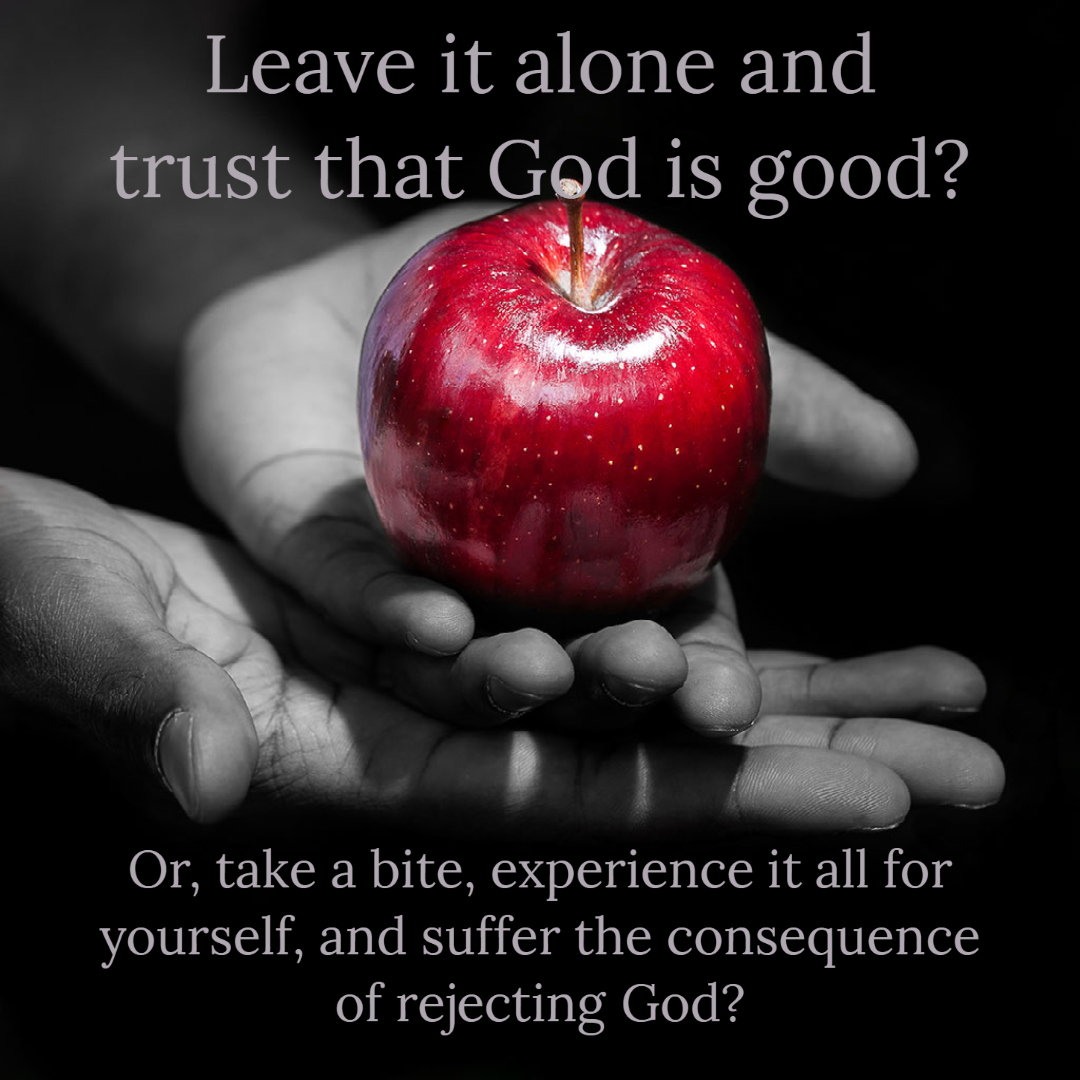
So, to create the opportunity for that choice, God placed the tree of knowledge of good and evil in the midst of the garden of Eden. While one may wonder why knowledge would be a bad thing, keep in mind that this knowledge is an experiential knowledge. By eating the fruit, man would not be suddenly indwelt with endless information, rather he would come to learn good and evil by experiencing both. This knowledge would be gained apart from God, without His help and leadership.

Pursuing knowledge in this way would amount to a complete rejection of God.

So, man had a choice. Trust that God is good and live forever in His presence, or doubt God’s goodness, overthrow His presence in man’s life, and strike out on his own. The former carried with it the promise of eternal blessing. The latter carried a risk of death and eternal judgment.

The serpent (a.k.a. Satan) tempted Adam and Eve with just that. In his speech to Eve in Genesis 3, Satan said, “You will not die. For God knows that in the day that you eat thereof, you will be as gods, knowing good and evil.”

Genesis 3:6 records the logic Adam and Eve used when deciding to eat the fruit. It says, “And when the woman saw that the tree was good for food, and that it was pleasant to the eyes, and a tree to be desired to make one wise, she took of the fruit thereof, and did eat, and gave also unto her husband with her; and he did eat.”

The logic was, “It’s good to eat, it looks good, and it will make us wise (as gods.)” They ate so they could experience the pleasures of everything, take power over their own lives, and eject God from the life that He gave them.

This was not a simple mistake or a poor food choice. It was an all-out rebellion against God. They cut themselves off from God, Who gave them life.

And when you cut yourself off from the source of life, you die.

This would be a good time to pause and reflect. God said, “In the day that you eat of this fruit, you will surely die.”

Satan said, “In the day that you eat this fruit, you will be as gods.”

The question arises, “Where are Adam and Eve today?” Based on the answer to that question, who was telling the truth, God? Or Satan?

If you’ve ever attended a funeral, you know the answer to that question. There is good news, however. In the same chapter, God offered a way of redemption. By promising that the seed of the woman would crush the head of the serpent, while suffering a death-blow Himself, God promised a savior, a redeemer, who would come and save His people from the death that comes as a result of sin.

That Savior was Jesus Christ, who both defeated Satan and suffered death upon the cross, and obtained final victory through the resurrection. Belief in this brings salvation and eternal life, and wins God’s favor.

The result of that salvation is being welcomed into His eternal Kingdom, where God will have restored life to what He intended on it being in the Garden.

So, with all that in mind, trust that God is good. Trust in Him, and place your faith in the death Jesus died on the cross for your forgiveness of sin. Then leave that sinful lifestyle behind and follow Him.