Philosophy

God Took A Day Off (Mark 2:23-3:6)

One of the most satisfying parts of a home improvement project is stepping back, and looking at the finished product. Isn’t it awesome when a home improvement project turns out right. The paint color perfectly matched the bedroom. The new deck greatly expands outdoor living space. That above-ground pool will provide refreshing entertainment all summer long. Sitting back, and enjoying the fruit of your labor is one of the great pleasures in life.

man and woman standing beside body of water during sunset

Photo by Luis Quintero on Pexels.com

Scripture tells us in Genesis 1 that God created the universe, and all life therein within 6 days, and on the 7th day, He rested. God rested on the 7th day, not because He was tired, but because He wanted to enjoy the beauty and goodness of His creation. He wanted to enjoy that pleasure of life. Enjoying a sabbath day’s rest, God saw that man would greatly benefit from such a day. So, He told man to remember the Sabbath, and to keep it holy. In Exodus 20:8-11, God told the Israelites that they were to set the Sabbath aside, rest, and worship. They were not to do work on that day, and they weren’t to force others to work for them. They were to enjoy the same day God enjoyed in the beginning.

As with all things, man found a way to turn the Sabbath, a day of rest and relaxation, into a burden. By the time Jesus came, Sabbath laws had become so complex that men were forbidden from picking corn to eat on the Sabbath, and they were prevented from healing on the Sabbath. It is those two issues Jesus confronts in Mark 2:23-3:6 when He said, “The Sabbath was made for man, and not man for the Sabbath.”

In essence, Jesus told the Pharisees, “The Sabbath was made to benefit and bless man, not the other way around. Man wasn’t created to worship the Sabbath.”

Taking that statement, we can learn three things. (1) The Sabbath is a gift from God. (2) Observing the Sabbath takes faith. (3) Observing the Sabbath glorifies God.

God gave the Sabbath day to us as a gift. God knew our nature. He knew without a Biblical command to stop and rest, we would continue our daily grind day in, and day out, without rest. He knew this would be harmful to us. Therefore, He commanded us to break the daily grind once per week. We are to take one day to set the struggles of life aside, rest, and enjoy the goodness of God, whether that be by enjoying His creation, or whether that be by enjoying the fruit of our labor. Either way, the Sabbath was God’s gift to us. We should be willing to accept that gift, but doing so requires faith.

Observing the Sabbath, like obeying all of God’s commands, requires faith. It requires faith in God to set aside the daily grind in favor of spending a day in God’s presence and blessings. It requires faith that God is not going to allow us to lose everything by taking a day off. It requires faith that God will provide for us on that day.

A good example of the exercise of that faith would be Chick-fil-A. When Truett Cathy founded the chain, he made the commitment to close the restaurants on Sundays to allow his employees to enjoy the Sabbath. Closing on Sundays is a huge sacrifice and step of faith in the restaurant business. Not only are Sundays the busiest days, but chicken restaurants are especially popular on those days. Yet, Cathy committed to closing on Sundays, which resulted in a number of blessings, including employee retention and increased business the rest of the week. Today, Chick-fil-A is winning the fast food wars, and they are winning on character and image. God has blessed because they honored the Sabbath. This glorifies God, which brings us to our final observation of the Sabbath.

Observing the Sabbath glorifies God. It shows faith in the Lord, and it shows His provision and protection of His people. Therefore, Christians ought to not only observe the Sabbath, but should also be willing to minister to others on that day.

The Sabbath is a beautiful gift God has given. Do we have the faith to accept that gift, and take that day to rest, enjoy His blessing, and worship Him?


The Power to Forgive (Mark 2:1-17)

In Mark 2, Jesus is in a house teaching the people about the coming Kingdom of God, their need to repent, and how salvation comes by faith. Many were bringing their sick and disabled loved ones to Jesus for healing, and a crowd had gathered to the point that no one could enter the house.

Then, four men show up carrying their friend who is “sick of the palsy.” Being unable to get him in the door, the men carry him up on the roof, break a hole in the roof, and lower him down in front of Jesus. It is at that moment that the Lord says something peculiar, “Son, thy sins be forgiven thee.”

Seeing this man disabled and in pain, the first thing Jesus said was, “Your sins are forgiven.” Why?

silhouette image of person praying

Photo by Rodolfo Clix on Pexels.com

Because whether or not we realize it, forgiveness of sin is our greatest need. We need forgiveness more than we need anything else. In this life, we face problems, and there are times we are not sure whether we will make it. Sometimes, our finances are in the tank. Sometimes, our relationships struggle. Sometimes, we suffer health problems. However, no cure to these problems will bring us the peace that comes through the forgiveness of sin.

If we suddenly obtain wealth, we still face the problem of future expenses. If our relationships are healed, there are still the scars of former hurt. Our health will progressively get worse as we get older. Yet, forgiveness of sin is not only an eternal blessing, it removes the fear of the next life from us. Forgiveness of sin will give us an eternal blessing that no earthly blessing can give.

Has God forgiven your sin? Has He forgiven your neighbor?

Take a listen to the above-posted sermon, and give God the glory for forgiven sin.

The futility of fishing alone

three men riding boats on body of water

Photo by Vietnamese Private Tours on Pexels.com

When Jesus told His disciples, “Come after me, and I will make you fishers of men,” we often misinterpret what He said. Having grown up in the United States, where the most common form of fishing is recreational, and is accomplished with a rod and reel, we often think of fishing as a recreational activity meant to be enjoyed in a relaxing manner. Such an activity can easily be enjoyed alone, and in some cases, it’s easier to enjoy the serenity of God’s creation when fishing alone.

However, as previously mentioned, fishing for the disciples of Christ was not a recreational activity accomplished with a rod and reel. It was a commercial enterprise undertaken for mere survival that was accomplished by casting a net. One thing we did not specifically address in the above-linked post is how the net was cast, and how it was drawn from the water.

In order to successfully fish with the types of nets the disciples used, you had to have a team (which is one reason you didn’t see the disciples by themselves when Jesus called them to be fishers of men. They were working as teams.) Often, these disciples utilized two boats to draw the net from the water. It took a lot of hands to fish with those nets, but the harvests could be great. With the help of Christ, they were on more than one occasion.

A fisherman who chose to fish alone would not only have a hard time properly casting the net, but properly drawing the net with a sufficient catch would prove nearly impossible.

The Spiritual application to this fact is that, as Christians, we will never be as strong in isolation as we will be when gathered with our brothers and sisters in Christ. The fundamental truth of fishing, whether commercially in Jesus’ day, or Spiritually in our day, is that it is a team effort. The Christian who chooses to isolate himself from his brothers and sisters in Christ has chosen a life that will prove frustrating and discouraging.

Therefore, let’s heed the Biblical command in Hebrews 10:25, which tells us not to forsake the assembling of ourselves together, and let us come together to encourage, pray and lift up each other. Then, let’s minister for the Lord together.

Let’s Go Fishing

boats fishing boat harbor harbour

Photo by Nick Santarone on Pexels.com

If I were to invite you to go fishing with me, what would you expect?

You would probably expect a relaxing afternoon on the local lake in a small boat, holding a fishing pole, and making casual conversation while waiting for the fish to bite. And why wouldn’t you? Living in America, all we’ve seen of fishing is canes, poles, lines, tackle and bait. Fishing in America is recreation. (Unless, of course, you work on a shrimp boat on the Gulf Coast.)

So, when we read that Jesus told His disciples that He would make them “fishers of men,” we tend to envision fishing poles, spoon lures and minnows.

In the Bible, Peter was a fisherman. Popular tradition holds that he was an expert fisherman, and had honed his craft well, building a great fishing business that he walked away from upon becoming a disciple of Jesus. However, if you were to travel back in time, and hand Peter a rod and reel, he would look at you like you were crazy. Peter had never seen such.

Fishing for Peter, and the other disciples so employed before following Jesus, involved the casting of nets in order to draw in as many fish as possible. This was not recreation to them, this was survival. It was how they gathered food, not only for their families, but also to sell for necessary provisions. Fishing was work. Fishing was business. Fishing was absolutely necessary for survival.

The casting of nets not only enabled Peter and his colleagues the ability to draw out as many fish as possible, but it also required a team effort. You never see the disciples fishing alone. In fact, in many cases, it took two boats to cast and draw a net. There are fish in that sea. We need the food. Therefore, we are going to draw out as many as we can.

With the modern American approach to fishing involving a rod and reel, many get the wrong idea when Jesus said, “Come, and I will make you fishers of men.” Some church leaders have taught that this means that the church should use bait to lure unsuspecting sinners in the door, then hit them with the surprise Gospel. Others have advocated that this means “finding the right fishing hole.” As a result, Christianity’s evangelistic efforts have suffered. As a whole, Christianity is not reaching as many as it has in the past, and new converts are not being properly discipled.

However, if we apply the imagery of casting a net, and drawing it back out of the water, we get a more beautiful picture of what Christ was referring to when He called His disciples to be “fishers of men.” Instead of targeting outreach to certain “fishing holes,” or trying to find the right “bait,” we should instead cast a wide “net,” reaching as many people as possible, regardless of location, demographic, or socioeconomic status.

In essence, our evangelistic efforts should be an all-out effort to reach every individual in our communities. This is accomplished when the membership of the church takes on the responsibility of personal evangelism, and when the church openly promotes, propagates and teaches the Gospel. When the church commits itself to its message, the Gospel, and relentlessly communicates that message, people will be reached and lives will be changed.

The mission of Life Point Baptist Church is to cast as wide of a net as possible, reaching as many as possible with the Gospel. This we will do, if we follow the example of the disciples, and follow Jesus as we continue to learn from Him.

The Greatest Love Story Never Told (Song of Solomon)

The Song of Solomon is often overlooked in Bible studies for a variety of reasons. First, it’s located in the middle of the Old Testament. Secondly, the imagery of passionate romance depicted in the book can seem awkward for groups with young children, or groups with both genders. Thirdly, and possibly the biggest reason, is that the book can be difficult to understand.

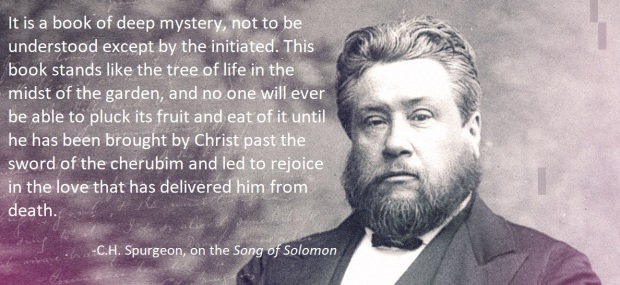
Even the great Bible expositor Charles Haddon Spurgeon expressed difficulty in interpreting the Song of Solomon when he said the book could only be understood by the “initiated,” and that the book stood in the middle of the Old Testament like the Tree of Life in the Garden of Eden, whose fruit you cannot eat unless you are brought by Christ past the cherubim with the fiery sword. Apparently, Spurgeon was incapable of simply saying, “This book is hard.”

Spurgeon song of solomonSong of Solomon is often preached as a book about marriage. However, Spurgeon believed, as do many other Bible teachers, that Song of Solomon is an allegory for the love Christ has for His people.


It’s with that context that we examine the book, Song of Solomon. The Song of Solomon can be divided into three parts… the romance, the wedding, and the marriage. Each mirrors a stage in our walk with Christ. The romance, where Christ loves us regardless of our station in life, and draws us to Him. The wedding, where we repent and commit ourselves to Him, and the marriage, where He takes us to our eternal home. In each of these parts, we can see the passionate love that Christ has toward us.

In the beginning of Song of Solomon, we see the romance develop between the Shulamite woman and King Solomon. In Verses 1:5-6, the Shulamite woman notes that she is black, that she keeps vineyards for others, and her mother’s children were angry with her. The fact that she is black indicates that she has spent her life in hard field labor. She has not known luxury, nor has she been able to preen or care for herself. While she says that she is comely (she looks good,) her body shows the effects of her life of hard labor.

She also says that she has not kept her own vineyard, which means she has no vineyard. She has no wealth, she has no assets.

She is hardly a bride suited for a king. In Old Testament times (as well as medieval times, and even modern times), royalty married those who could bring peace or prosperity to their kingdoms. Alliances, trade agreements, and even mergers were orchestrated through royal weddings. The Shulamite woman can offer none of these.

Yet, despite her destitute situation, King Solomon loves her. In Verse 2:4, the Shulamite woman says, “He brought me to the banqueting house. His banner over me was love.”

This is a Cinderella-type story if there ever was one. King Solomon not only loves the Shulamite woman, and cares for her, but he brings her to the banquet. There’s a banquet, a ball. The creme de la creme are there. And King Solomon has this Shulamite woman on his arm, is introducing her to every one, and his proud to be in love with her.

It means a lot that King Solomon makes this romance public. He loves the Shulamite woman. She is the object of his love, and he is driven by his love to care for her. She is not a scandal to him, and he is not ashamed of her.

This is a mirror to how Christ loves us. He loves us in spite of the fact there is nothing we can do for Him. He loves us in spite of the rejection we suffer at the hands of others. He lifts us out of our hopelessness and takes us into His kingdom, where we can know love, care, and be provided for.

In Chapter 3, we see the wedding. In Verse 3:11, the Shulamite woman tells the daughters of Zion to “Behold King Solomon,” who has been crowned with the crown of his espousals. Also in chapter 3, we see that King Solomon takes the Shulamite woman to His bedchamber, which is surrounded by 60 of the best fighters in the king’s army.

The espousals, the wedding, is the union of King Solomon to the Shulamite woman. The marriage union is an eternal union never to be broken. This is why marriage is so sacred to God. It provides a picture of the love between the Lord and His people.

Being married to King Solomon, the Shulamite woman would never again know fear. She would sleep in the safest place in the kingdom, and the king would never put her out.

Likewise, when you are a child of God, when you know Christ as your Savior, you are in the safest place in the universe, because nothing can get to you without going through God first. And God will never turn you away.

Jesus said in John 5:24, “Verily, verily, I say unto thee. He that heareth My words, and believeth on Him that sent me, hath everlasting life, and shall not come into condemnation, but is passed from death unto life.”

Basically, if you know Jesus as your Savior, you will never need to fear God’s wrath, and you will never come into condemnation. You are safe, and the Lord will receive you into His kingdom.

Finally, in Song of Solomon, we see the marriage.

No marriage is perfect. All marriages endure hard times, conflict, and sometimes estrangement. Thus, in Song of Solomon 5:2-8, we see such an occasion arise between the Shulamite woman and King Solomon. The king has come to her door, but she has just gotten ready for bed, her coat is put off, and she has washed her feet, and she doesn’t want to get messy. So, he leaves.

How often does the Lord knock on our door, but we are too busy with the day to day things of life to answer His call? How often are we preoccupied with the things of this world to answer God’s call on our life? How often do we put off doing something for the Lord because today is not a convenient day?

We miss our Bible devotional time, and our prayer time because we are too busy. We refrain from giving to the church because we have a lot of financial plans and obligations. We do not surrender to the ministry God has called us too because it would disrupt our current lifestyles. Then one day, we find ourselves apart from God, wondering why He is silent, and distant.

He knocked. We couldn’t be disturbed. Therefore, the fellowship was broken.

The good news is that there is reconciliation. In Verses 6:1-3 we see the reconciliation between the Shulamite woman and King Solomon. When we repent and turn to the Lord, He forgives, and we are reconciled to Him.

Closing out the Song of Solomon, we see a beautiful sight. In verse 8:12, the Shulamite woman has her own vineyard. The woman who had no vineyard in chapter 1 now has a vineyard of her own. She lives happily ever after, with Solomon.

Likewise, those of us who wonder this earth without a home, those of us who know Christ as our Savior, will one day have an eternal home.

In John 14:2-4, Jesus said, “In my Father’s house are many mansions: if it were not so, I would have told you. I go to prepare a place for you. And if I go and prepare a place for you, I will come again, and receive you unto myself; that where I am, there ye may be also. And whither I go ye know, and the way ye know.”

If you know Christ as your Savior, He has prepared an eternal home for you in Heaven. The day is coming when He will return and take you to that eternal home, and you will be with Him forever.

Even so, come Lord Jesus.

As Solomon loved the Shulamite woman, so Christ loved us. Will we receive His love by turning from sin and trusting in Him? Or will we spurn His love in favor of the sins of this world. Each will choose for himself or herself. How will you choose?

Whatever Happened to Simple Pleasures?

13139229_10209006359102001_6160792898451924492_n

Life in the United States has become more hectic. The cost of living has increased. Jobs demand more time and effort, and the kids are involved in more activities. Today, it is not uncommon for a high school student to put in a 12-hour day at work (classes and extra-curriculars) before coming home to do two hours worth of homework.

Meanwhile, Dad, who already clocked a 10-hour workday, sits on the couch checking and responding to work emails. Today, it seems that we are always working on something. We always have somewhere to be, or something to accomplish. The American life today is busy.

Life today is far from the future envisioned by a 1960s-era CBS News documentary about the future life in America. In it, Walter Cronkite previewed future technology, such as the internet, big screen TVs, automated home systems, the home office and distance learning. Much of that technology had not even begun development, but Cronkite foresaw it, and optimistically declared that, with life being made easier by these new devices, Americans would have more recreational time than ever before.

Cronkite’s vision of future technology came to pass. His vision of more recreation and leisure, and an easier lifestyle did not. Why?

We could list the societal changes and issues that drive our current pace of life, but the root cause is that we, by nature, are discontent. To be human is to be discontent. To be human is to want more. To be human is to want it better. Our desire for more, our discontentment drives us to take on more projects, duties, activities, and so forth to accomplish more and to profit more. In some cases, that is thrust upon us by discontent employers. The root cause is the same. Discontentment.

Lost in all of this hustle and bustle of discontentment are the simple pleasures of life… iced tea on the back porch, fishing on a Saturday afternoon, watching your kid step up to bat in a little league game. We are so busy trying to survey and claim the entire forest that we miss the beauty of the trees. And so, we miss the simple pleasures in life. Thus, our discontentment grows.

Scripture speaks into this in 1 Timothy 6:6, which says, “Godliness with contentment is great gain.” Basically, if you can learn to trust God and be content with what you have, you are the richest person you know.

Think about it. Who’s happier right now? The multimillionaire who stares at his portfolio all day stressing about the right time to make the next trade? Or the Social Security retiree who is sitting on the banks of the Mississippi river with his line in the water? At this very moment, which person would you rather be?

If you believe that peace and happiness will come at a time when you achieve a certain financial goal, you will never feel secure, and you will never be content. However, if you find contentment in the Lord, and the simple pleasures He brings into your life, you have already achieved wealth, and will find yourself at peace.

Now, if you’ll excuse me, I think I’ll go find my cane pole.

Written by Pastor Leland Acker

The Concept of Prayer Service

48423434_608600369559694_43192085209153536_o (1)Scripture says that “The effectual fervent prayers of a righteous man availeth much.” At Life Point Baptist Church, we not only believe that prayer changes lives, heals the sick, and transforms us as believers, we have seen it happen. Over the past five years, we have seen two cancer patients turn up cancer free after intense prayer was lifted up on their behalf. These are healings that can only be explained by God’s miraculous response. This is not that televangelist “lay hands on the sick” and heal, “only if they have healing faith” approach. There is no show here. There are no theatrics. Just simple, sincere prayer, and quietly trusting God to answer.
Over the past few years, we have seen a man who was in his final days recover and return home. We have seen patients with failing kidneys see their kidney function restored. In each of these cases, the patients sought medical care as we prayed. We trust doctors, too. In each case, healing occurred for which the doctor had little explanation.

Healing does not occur in all cases. Sometimes God, in His divine will, simply tells us, “My grace is sufficient for you.”

We have seen God provide for financial needs. And most importantly, we have seen God move in the lives of our loved ones. We have seen lives changed, souls saved, faith made complete.

For these reasons, and because scripture commands us, we pray.

Wednesday nights, Life Point meets at 6 p.m. for Prayer Service. We begin with a hymn, a congregational prayer, a message from the Bible, then we lift up our prayer requests, and then we all pray, simultaneously, individually, before reuniting in prayer to close out the service. The entire service lasts less than an hour.

So if you have a need in your life, one for which you want God to intervene on your behalf, pray. And, if you be so inclined, some join us, that we may pray with you. Then, we will all trust God together for the answer.

May God bless you. See you Wednesday.

The 7 Churches (Revelation 2)

The church is dead.

The church is judgmental.

The church is full of hypocrites.

Those common complaints against modern American churches are nothing new. For years, people have complained that the church experience can be cold, uncaring, and full of betrayal at the hands of those who pretend to be Christian, but are not.

Often, those complaints against the church are used as justification for rejecting church membership altogether, electing rather to worship God alone. After all, if Christ knew just how awful the church really is, wouldn’t He support a mass exodus from the church?

It might surprise you to know that the issues with the modern American church are nothing new. In fact, these issues permeated the first century churches. Thus, in Revelation 2, Christ begins the process of addressing each church individually, assessing the condition of each church and instructing them to repent of their sins and shortcomings.

Revelation was written to the seven churches of Asia (now known as Asia minor, or Turkey) to prepare them to meet the Lord. Speaking through the Apostle John, Jesus foretold the events that would precede His return, the events that would mark His judgment, and the promises to every believer.

The book of Revelation was written specifically to those seven churches to prepare them to meet the Lord, but the truth that is taught in this book will prepare us, also, to meet the Lord. Those churches of Asia met the Lord when they passed away. We will meet the Lord when we pass away, or when He returns, whichever comes first. Therefore, we should take the lessons of the book of Revelation and prepare for that day.

One of the most common errors in studying Revelation 2 is that many theologians believe that the letters to the seven churches are actually metaphors for seven different time periods during the church age. This approach to Revelation 2-3 is problematic for many reasons.

First, if Christ had dictated the letters to the seven churches as an allegory for the seven periods of the church age, then the message would have made absolutely no sense to those churches to whom the letters were written.

Secondly, as you read the letters to the seven churches, you will notice that Christ addresses specific issues, and specific individuals within the churches. While many try to parallel those specific individuals and issues with historic events during the church age, the fact of the matter is that there were specific issues and individuals addressed by Christ in those churches.

In other words, when these letters were read to the seven churches of Asia, no one had to ask, “I wonder what the Lord meant by that?” They knew exactly what Christ was talking about, whom He was talking about, and what He was commanding. There was no mystery to those first-century churches.

So, if these letters were addressed to the first century churches, and addressed specific issues within seven specific churches in Asia, then what’s the point of studying them today? Simple.

In the often forgotten Pauly Shore comedy, In The Army Now, Pauly Shore told the drill instructor that “welcomed” him to boot camp that she didn’t have to yell. The drill instructor replied, “IN THE U.S. ARMY, WE DO NOT YELL. WE MERELY SPEAK LOUDLY SO THAT ALL CAN LEARN FROM OUR MISTAKES!”

While it may seem sacrilege to reference a Pauly Shore movie during a Bible study, the fact is that we can learn from the mistakes of the seven churches of Asia, and we can take the lessons the Lord teaches them and apply them to our own lives.

In the letters to the churches in Revelation 2, we learn that Christ sees everything. He sees our love and works, or the lack thereof. He sees the motivation for our works. He sees our struggles and problems. He sees our errors. Then, He calls us to repent.

The above posted episode of The Point expounds those truths. If you listen, I predict you will be blessed by it.

The Art of Redemption

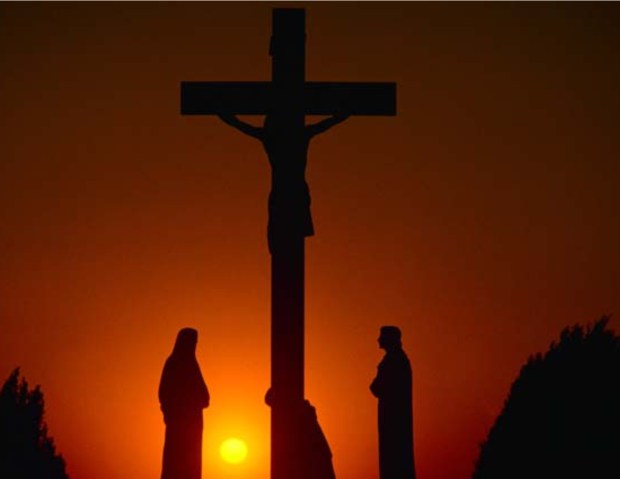
Crucifixion Sunset

Giving thanks unto the Father, which hath made us meet to be partakers of the inheritance of the saints in light: Who hath delivered us from the power of darkness, and hath translated us into the kingdom of his dear Son: In whom we have redemption through his blood, even the forgiveness of sins:

-Colossians 1:12-14

Redemption.

For some, it means validation. For others, it means to be set free. For others, it is the chance to go back and correct a wrong, or to try again after a failure and achieve success.

Redemption.

While these elements can accompany the Biblical meaning of redemption, true redemption goes much further. When the Bible tells us that God redeemed us through Jesus Christ, it tells us that he did more than validate us, set us free, or give us a second chance.

Biblical redemption carries with it the meaning of restoration.

In Old Testament times, slavery was a practice used to settle debt. If a man was in debt without any hope of being able to repay it, he could be sold into slavery. In order to make this dark practice more humane, and in order to teach us about salvation, God wrote into His law several provisions that would free slaves, one of which was redemption.

If a man were sold into slavery for, say, $50,000, and his brother learned that he had been sold into slavery, his brother could go to his master and buy his brother back. The slave master was obligated to sell the slave back to his family at the price he paid, without collecting a profit.

That process was known as “redemption.” The man would return home, a free man, no longer a slave. He would be reunited with his family and be able to farm his land and work his vocation. He was redeemed. He was restored.

Notice that the redeemed man did not become a slave to his brother who had purchased his freedom. Notice also that the man no longer owed the debt. He was completely free, and his life was restored. What an amazing feeling that must have been.

Scripture teaches us that, just like Old Testament slaves were redeemed by their families, God has redeemed us.

Just as that man in the Old Testament was sold into slavery, owing a debt he could not repay, we begin life as slaves to sin, owing a debt we cannot repay. Just as the brother of that man in the Old Testament purchased his brother out of slavery, Christ purchased us from sin, paying our sin-debt by giving His life on the cross.

And just as that man in the Old Testament was reunited with his family and set free, Christ has restored our lives and set us free. Restoration. Without it, there is no true redemption. Freedom. Without that, there is no redemption, for if you have not been freed, you have not been redeemed. You’ve merely been sold.

Therefore, when Christ redeems us, He has made us free indeed! Then, He begins the process of restoring our lives by transforming us into the persons He intended on being.

This concept is illustrated in countless ways in scripture. The redemption Christ offers us teaches us a few things.

First, we should accept the redemption. A man in the Old Testament who was set free could choose to remain a slave. Or, he could take his freedom and return to his family. Have you accepted the redemption offered by Jesus Christ? Have you turned from your sins and trusted Him for salvation? Or do you cling to your sins and trust your servitude?

Secondly, the Biblical concept of redemption rules out the notion that any works are necessary to achieve salvation. The Old Testament slave who was redeemed by his brother owed his brother nothing for his redemption. Nothing. Obviously, he should have been grateful and expressed his gratitude, but as a matter of obligation, owed his brother nothing.

When Christ redeems us, we owe Him nothing for our redemption. Obviously, we should be grateful and express that gratitude in obedience and service, but we have no contractual obligation to Christ in exchange for our redemption. This means that any religion that teaches that one has to live holy, be baptized, speak in tongues, be a faithful church member or give tithes in order to enter Heaven has no understanding of true redemption.

Any religion that teaches that salvation can be lost does not understand redemption.

When Christ redeems you, He sets you free, and you have eternal peace and security from Him that cannot be revoked. Learn to rest in that assurance, and serve the Lord with gladness and not fear.

And finally, this redemption teaches us about how much God loves us, and how priceless we are to Him. A man in the Old Testament would have to love his brother very much to make the financial sacrifice to redeem him from slavery. God loves us so much that He gave His only begotten Son to redeem us from the slavery of sin.

The world may have rejected you. Others criticize and judge you. You may feel like society has marginalized you and cast you out of the gates of the city. However, God loves you, sees the things which make you unique, gave His Son to redeem you, and has a place for you at His table. Will you turn to Him?

God paid the price for your redemption. That redemption becomes effective when you trust Jesus Christ as your Savior.

May God bless you today.

Offerings

Nehemiah1

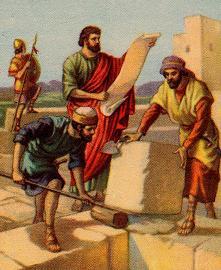
And some of the chief of the fathers, when they came to the house of the Lord which is at Jerusalem, offered freely for the house of God to set it up in his place: They gave after their ability unto the treasure of the work threescore and one thousand drams of gold, and five thousand pound of silver, and one hundred priests’ garments.

-Ezra 2:68-69

Thirty-nine cents might not seem like a big deal, however, back in 1996, one could supersize their fries and drink at McDonalds for that additional 39 cents.

In the mid-1990s, America was a fast-food nation, but we hadn’t yet become preoccupied with large food portions. Therefore, it often took the suggestive sale of the cashier to get the customer to agree to the 39-cent enhancement of their meal. As a result, it became a standing directive for fast-food order takers to ask customers, “Would you like to supersize that?”

Why would McDonalds build so much strategy into earning an additional 39-cents per customer? Simple.

Quora.com reports that the average McDonalds restaurant serves up to 5,000 customers per day. If each customer were to up-size their meal by 39 cents, then that individual McDonalds would earn an additional $1,950 per day, or $711,750 per year.

Across the entire corporation, McDonalds serves 68 million customers daily. That 39-cent upgrade would earn McDonalds an additional $26.5 million, or $9.6 billion in a year. Back in the 1990s, McDonalds understood that small amounts added up to big things.

It’s a strategy also employed by Texas Dairy Queens, which promote the fact that if all of their drive-thru customers would donate 25-cents per visit, then DQ could donate $5,000 per restaurant to Children’s Miracle Network.

Or, as my sales manager back at KYYK would tell me, “all those nickels and dimes add up.”

In Ezra 2, the Israelites were returning to Jerusalem to rebuild the Temple. As they arrived, those that had the ability gave offerings to the Temple. Some were able to give big offerings, others could only give a little. Therefore, “They gave after their ability unto the treasure of the work threescore and one thousand drams of gold, and five thousand pound of silver, and one hundred priests’ garments.”

God took the offerings of the people, and blessed it in a big way, using it to fund the reconstruction of the Temple.

The concept of “giving according to your ability” is a totally scriptural concept. It’s why God set the tithe at 10-percent, and why the Old Testament law ordered giving to be set by the ability of the worshiper to give.

When it comes to giving, there are those who have the ability to give a lot. There are those who can only give a little. However, if you give God something to bless, He has shown the ability to bless it into something big.

In Ezra, they wanted worship restored at the Temple, which needed to be rebuilt. In our time, we want to see revival in our land, and the Gospel spread throughout the world. If we want God to bless that effort, we have to give Him something to bless.

Imagine what God can do.

If McDonalds can turn 39 cents into $9.6 billion, and Dairy Queen turn 25 cents into $5,000, and these being secular organizations, imagine what God can do with the offerings we bring Him. May God bless you, as you bless Him.

So, when you worship God at your church this weekend, don’t forget to bring Him something to bless. One day, you will find out just how big of a difference you made.